
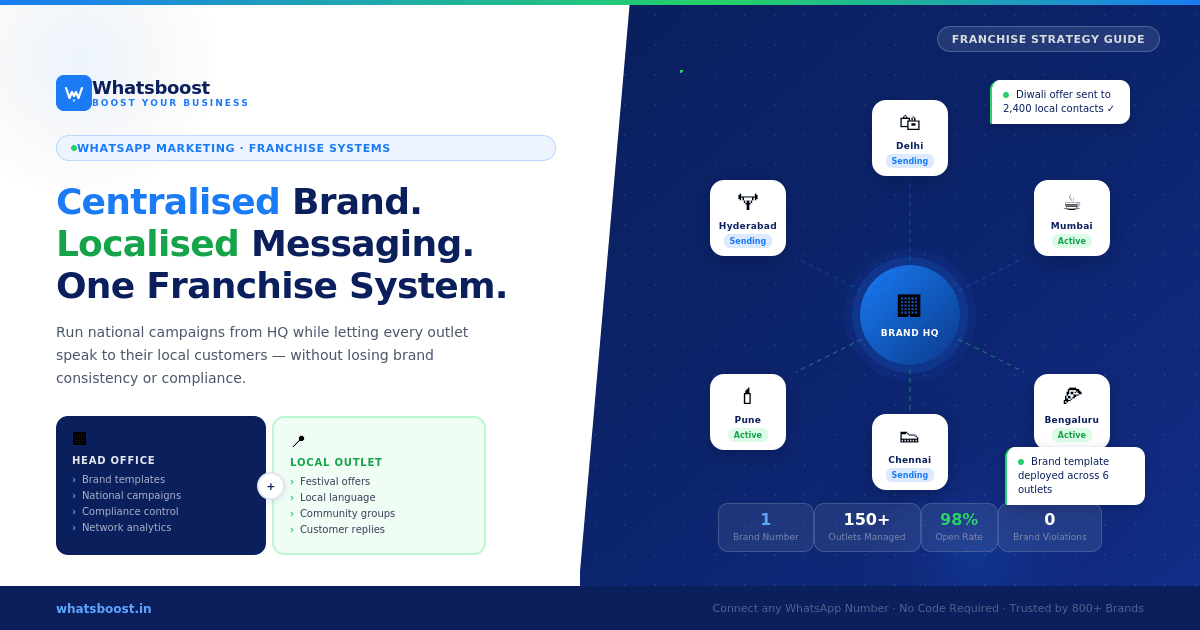
WhatsApp Marketing for Franchise Systems: Centralised + Localised Messaging
Most franchise systems either control everything from the centre and lose local relevance, or hand it to individual outlets and lose brand consistency. This guide breaks down exactly how to build a two-layer WhatsApp marketing system — where head office owns the brand, local franchisees own the relationship, and the entire network communicates with both consistency and context.
Running a franchise is an exercise in controlled tension.
On one side, you have a brand that spent years — and significant capital — building a specific identity. A tone. A visual language. A promise that customers can expect the same experience whether they walk into your outlet in Connaught Place or a franchise in Coimbatore.
On the other side, you have franchise owners who are running local businesses. They know their customers. They know the festivals their area celebrates, the offers that move their specific crowd, the language that builds trust in their neighbourhood. They have local context that no central marketing team sitting in a head office will ever fully have.
Most franchise systems try to manage this tension by choosing a side. Either head office controls everything — sending the same message to every customer, everywhere, regardless of local context — or they leave it to franchisees, leading to inconsistent, off-brand communication that quietly erodes what the brand spent years building.
WhatsApp, when structured correctly, offers something neither of those options provides: a system where centralised control and localised relevance coexist — at scale, without chaos.
Why Franchise Communication Breaks Down on WhatsApp Without Structure
Most franchise businesses that try to use WhatsApp for marketing start the same way. A few outlets are running their own numbers. The head office occasionally sends a broadcast. Some franchise owners are active, some aren't. Templates are inconsistent. The brand name is sometimes spelled differently across outlets. The tone swings between formal and casual depending on who's sending.
It doesn't look like a brand. It looks like forty separate small businesses that happen to share a logo.
The problem isn't WhatsApp. WhatsApp has 98% open rates, deep penetration in every tier of Indian city, and the kind of direct access to customers that no other marketing channel currently matches. The problem is that franchise systems try to use WhatsApp the way individual small businesses do — manually, reactively, without a structural layer that manages the relationship between central and local.
When that structural layer is missing, two things happen simultaneously. First, the brand suffers — customers in different locations receive wildly different communication and form inconsistent impressions of what the brand stands for. Second, individual franchisees suffer — they don't have the marketing expertise, the templates, or the automation infrastructure to run effective campaigns on their own, so many of them simply don't, leaving their customer bases under-communicated and underserved.
The Two-Layer Model: How to Think About Franchise WhatsApp Marketing
Before getting into tactics, the strategic framework matters. Franchise WhatsApp marketing should be thought of as a two-layer system — a centralised layer that owns brand identity and content, and a localised layer that owns customer relationships and contextual relevance.
These layers don't conflict. They complement each other when the system is designed with that complementarity in mind.
The centralised layer is responsible for:
- Brand voice and tone guidelines that apply to all communication across all outlets
- Approved message templates that franchisees can use without risk of off-brand communication
- Campaign calendars — national promotions, seasonal offers, product launches, brand announcements
- Compliance — ensuring that all WhatsApp communication across the franchise system stays within Meta's policies and doesn't expose any outlet to account restrictions
- Analytics — visibility into what's being sent, when, and how customers across the network are responding
The localised layer is responsible for:
- Customer lists specific to the outlet — opt-ins collected at point of sale, through local promotions, or via walk-in conversations
- Contextual messaging — local festivals, neighbourhood events, outlet-specific offers, regional language preferences
- Customer relationships — responding to individual queries, following up on local leads, managing community groups for regular customers
- Timing decisions — knowing that the Thursday evening slot works better for their customer base than Tuesday morning
The system works when the central layer creates the rails — the approved templates, the campaign assets, the structural infrastructure — and the local layer runs on those rails with the freedom to personalise within defined boundaries.
Centralised Messaging: What Head Office Controls and Why
The most common mistake franchise head offices make with WhatsApp is treating centralised messaging as "send the same broadcast to everyone." That's not centralised marketing. That's just large-scale irrelevance.
Effective centralised messaging means creating a structured content programme that individual outlets can deploy with local personalisation — not identical messages to identical audiences.
National campaigns with localised variables
A new product launch is a national moment. Every outlet needs to communicate it. But the message doesn't have to be identical. A template can carry national assets — the product image, the brand messaging, the core offer — while leaving variables that franchisees fill in: the local outlet name, the city, a locally relevant hook, a region-specific CTA.
The customer in Jaipur receives a message that feels like it came from the Jaipur outlet, not from a national marketing team. The brand message is intact. The local relevance is added.
Template libraries that franchisees actually use
One of the most underutilised opportunities in franchise WhatsApp marketing is the pre-approved template library. Head office creates 30-40 message templates covering the full range of communication scenarios — welcome messages for new customers, re-engagement for lapsed ones, promotional broadcasts for key sales periods, event announcements, service reminders, feedback requests.
Franchisees don't need to write a single message from scratch. They select the template that fits their current need, personalise the variable fields, and send. The brand voice is consistent. The content is relevant. The franchisee saved two hours of thinking about what to say.
This is exactly the kind of message design discipline that WhatsApp marketing campaigns achieving 50%+ open rates consistently use — structured templates with personalisation variables that feel individually crafted even when sent at scale across hundreds of contacts.
Broadcast segmentation from the centre
For campaigns that head office wants to control directly — a brand anniversary offer, a crisis communication, a system-wide policy update — centralised broadcast capability allows the head office to send to the entire network or to specific geographic segments in one coordinated action.
This is where bulk WhatsApp broadcast infrastructure becomes critical for franchise systems. A broadcast that goes out to 200,000 customers across 150 outlets, segmented by region and personalised by outlet name, cannot be managed manually. It requires a platform layer that handles the segmentation logic, the personalisation variables, the delivery management, and the compliance checks automatically.
Localised Messaging: What Franchise Owners Should Own
Local franchise owners have knowledge that no central marketing team has — and the most effective franchise WhatsApp systems give them the tools to act on that knowledge within a defined structure.
Regional language and tone
India's linguistic diversity is one of the most important variables that central WhatsApp marketing consistently underestimates. A message sent in English to a customer in a Tier 2 Tamil Nadu city lands differently than the same message in Tamil. A franchise owner in Ludhiana knows whether their customers respond better to Hindi or Punjabi. A franchise in coastal Karnataka knows the language that builds warmth with their customer base.
Localised WhatsApp messaging means giving franchise owners the ability to translate or adapt approved templates into the language of their customers — maintaining the core message while adjusting the linguistic vehicle to the context it's entering.
Local event and festival marketing
India celebrates over 40 major festivals — and different ones dominate in different regions. Diwali is national, but Pongal is deeply specific to Tamil-speaking communities, Bihu matters in Assam, Ganesh Chaturthi drives purchase behaviour in Maharashtra, Eid is the peak period for certain customer segments in many cities.
A franchise owner in Pune sending a Ganesh Chaturthi offer to their local customer list — using a brand-approved template but with a locally relevant personalisation — will outperform any national campaign that tries to speak to every festival at once. The central team can provide the template and the brand assets. The local owner provides the timing, the contextual hook, and the customer list that's actually relevant.
Local community groups
WhatsApp groups remain one of the most underused tools in franchise marketing — and one of the most powerful for building the kind of community that drives repeat purchase and word-of-mouth.
A franchise outlet that maintains a WhatsApp group for its top 150 customers creates an ongoing conversation space. Early access to new arrivals. Exclusive offers for group members. A direct line for feedback. Local announcements about events or changes. This isn't broadcasting — it's community-building that happens at a scale that feels intimate.
Managing these groups without automation, however, becomes a burden rather than an asset at any meaningful scale. WhatsApp group automation allows franchise owners to schedule group messages, automate welcome sequences for new members, maintain consistent posting cadences without daily manual effort, and manage multiple groups for different customer segments — loyal customers, new customers, VIP tier — without the operational overhead that kills most manual group management attempts.
The Infrastructure Question: One Number or Many?
This is the question every franchise system eventually has to answer, and getting it wrong creates problems that compound as the network grows.
Option 1: Each outlet has its own WhatsApp number
This is the most common starting point and the one that creates the most long-term complexity. Each outlet has its own number, its own customer lists, its own message history. There's no central visibility. Head office cannot see what any outlet is sending or how customers are responding. Brand consistency depends entirely on individual franchisee discipline.
As the network grows, this becomes completely unmanageable. If a franchisee leaves the system, their WhatsApp number — and all the customer relationships built on it — may leave with them.
Option 2: A single brand number managed centrally with outlet-level access
This is the more sophisticated and more scalable model. A single verified WhatsApp Business number represents the brand. Multiple agents — one per outlet — can access and manage conversations relevant to their location. The customer talks to "the brand," but the person responding knows their local context.
This is where multi-agent WhatsApp infrastructure becomes the operational backbone of the franchise system. A properly configured multi-agent setup allows each franchise location to have its own agent or agents who manage local conversations, respond to local customers, and run local campaigns — all under a single brand number with centralised oversight and conversation history that head office can monitor.
This model protects the brand. It protects the customer relationship. And it gives head office the visibility to identify which outlets are communicating effectively and which ones need support.
Option 3: Hybrid — brand number for broadcast, local numbers for relationship management
For larger franchise networks, a hybrid approach often works well. A centralised brand number handles all outbound broadcast campaigns — national promotions, system-wide announcements, brand content. Individual outlet numbers handle inbound conversations, local community groups, and customer relationship management. The brand number has the authority and scale. The local numbers have the warmth and context.
Building the Franchise WhatsApp Funnel End-to-End
The most effective franchise WhatsApp marketing operations don't treat each campaign as a one-off broadcast. They build a funnel — a structured customer journey that moves people from first contact to loyalty, with different layers of the franchise system playing different roles at different stages.
Stage 1: Lead capture and first contact (centralised)
National advertising — Meta ads, Google, OOH — drives people to WhatsApp via Click-to-WhatsApp CTAs. The first message they receive is automated, brand-approved, and personalised with the outlet nearest to them based on their location data. Head office designs this flow. The franchisee benefits from it without having to set it up themselves.
Stage 2: Qualification and local handoff (automated)
The automated welcome flow asks a few questions — what they're looking for, which location is most convenient, what their timeline is. Based on the responses, the conversation is routed to the relevant franchise agent who takes it from there with full context already gathered.
Stage 3: Local relationship building (localised)
The franchise agent manages the relationship from here — answering specific questions, sharing locally relevant information, building the kind of personal rapport that drives first purchase and beyond. This is where the local knowledge advantage is most valuable, and where the structured infrastructure gives the franchisee the tools to act on it consistently.
Stage 4: Broadcast nurturing (both layers)
Post-purchase, customers enter both the centralised broadcast list (for national campaigns) and the local outlet's communication flow (for local offers, community group invitations, feedback requests). The combination ensures that customers hear from the brand with national relevance and from their local outlet with personal relevance.
Stage 5: Loyalty and retention (localised)
Long-term customers are managed at the local level — VIP groups, loyalty program updates, personalised anniversary or milestone messages, re-engagement when purchase frequency drops. This is where building a complete WhatsApp marketing funnel that integrates broadcasts, groups, and automation pays off most — not as a series of disconnected messages, but as a systematic journey that each customer travels through over months and years of engagement with the brand.
Compliance and Brand Safety Across the Network
Every franchise system's nightmare is an outlet saying something on WhatsApp that creates a legal, reputational, or relationship problem for the whole brand.
This isn't hypothetical. It happens. A franchise owner sends an unapproved discount offer that contradicts national pricing policy. Another sends a WhatsApp broadcast to a list of customers who never opted in, leading to account restrictions. A third shares a message with incorrect product information.
Franchise WhatsApp infrastructure needs to build compliance in from the start:
Template approval workflows — no message goes out from any outlet unless it's based on a head-office-approved template. Custom messages for specific customer conversations are fine, but broadcast campaigns use only approved content.
Opt-in management — every customer on every outlet's list needs to have explicitly opted in to WhatsApp communication. This isn't optional. WhatsApp's policies enforce it through quality ratings, and India's DPDP Act makes it a legal requirement. The central system should provide a standardised opt-in collection process that every outlet uses.
Sending limits and monitoring — the central platform should have visibility into what's being sent from every outlet, at what frequency, and with what response rates. Outlets that are over-sending or seeing high block rates need immediate intervention before the account health affects the whole network.
How Whatsboost Supports Franchise WhatsApp Systems
The infrastructure described in this article — multi-agent access, centralised broadcast management, localised group automation, template libraries, opt-in compliance, and performance monitoring — requires a platform that can hold all of it together without requiring a dedicated technical team to run it.
Whatsboost is built for exactly this kind of structured, multi-location operation. Franchise networks can configure a system where head office controls the brand layer — templates, approved campaigns, visibility into network-wide performance — while individual franchise agents manage their local conversations and community groups within that structure.
The setup doesn't require API integration expertise or a development team. The platform is designed to be operational within hours for new outlets, scalable as the network grows, and structured enough that the brand controls the things that matter without micromanaging every local conversation.
For franchise teams that want to see how this translates to their specific network configuration before committing to a full rollout, booking a walkthrough with the Whatsboost team is the fastest way to map the two-layer model to your existing structure.
The Competitive Advantage Most Franchise Systems Are Missing
Franchise systems that figure out centralised + localised WhatsApp marketing don't just communicate better. They build a structural competitive advantage that's genuinely difficult to replicate.
National brand recognition, combined with the feeling of a local relationship, is what every franchise brand aspires to. Most achieve the first and sacrifice the second as they scale. WhatsApp, when structured into a proper two-layer system, is one of the few marketing channels where both can coexist without constant tension.
Your customers don't experience your franchise system as a corporate structure. They experience it as the outlet in their neighbourhood, the person who knows their order, the brand that sends them something relevant to their local celebration. Building the infrastructure that creates that experience — consistently, at scale, across every location in your network — is what separates franchise brands that grow customer lifetime value from those that are constantly replacing churned customers with new acquisition spend.
The channel is already there. The customers are already on it. The question is whether your franchise system has the structure to use it properly.
Want to automate WhatsApp for your business?
Set up campaigns, replies, and follow-ups in minutes.