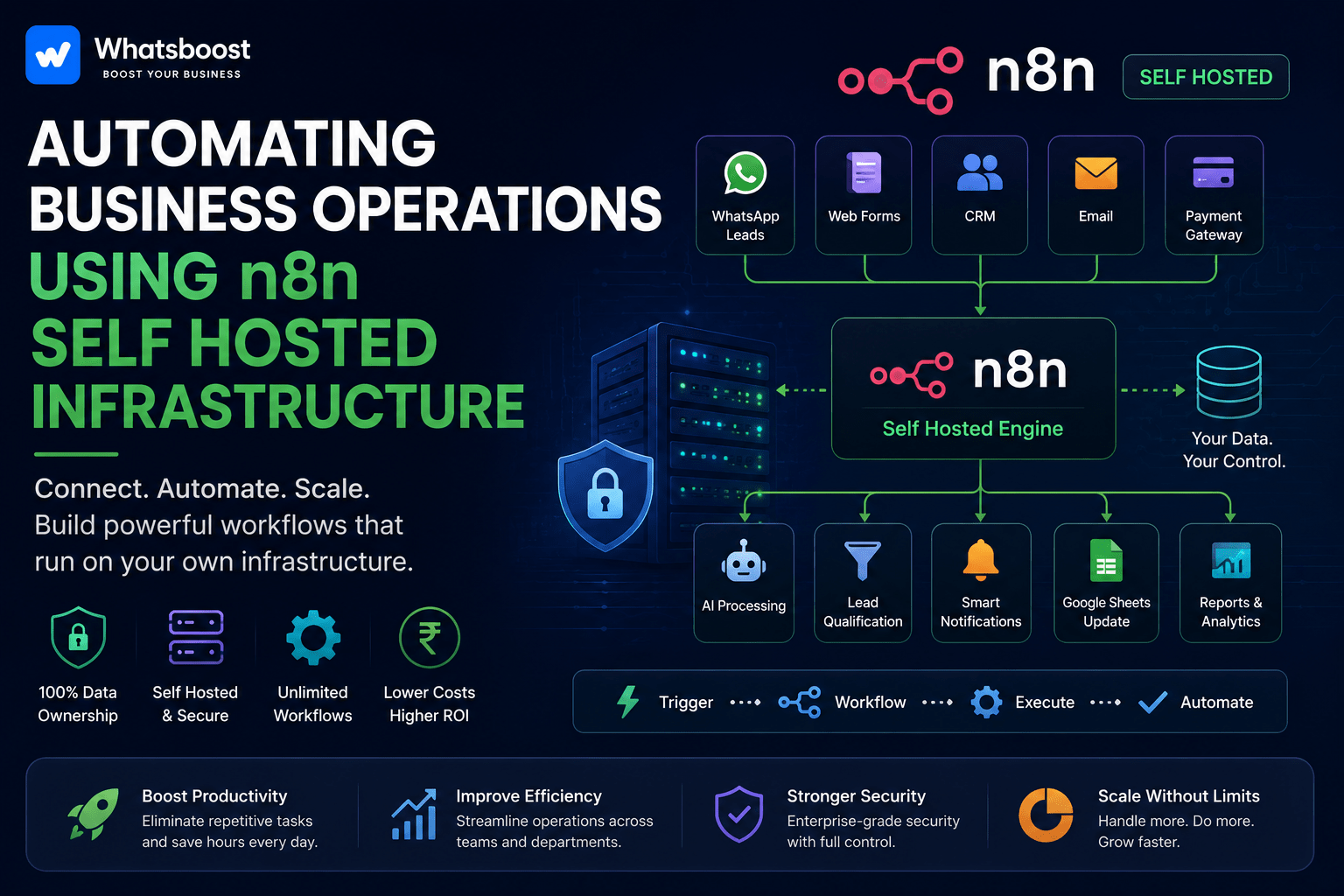
Automating Business Operations Using N8N Self Hosted Infrastructure
A comprehensive guide on how businesses use self-hosted N8N infrastructure to automate operations, customer workflows, AI systems, WhatsApp communication, and internal business processes.
Most businesses do not struggle because of lack of effort.
They struggle because too much of their operations still depend on manual coordination.
A sales inquiry arrives.
Someone manually assigns the lead.
A payment is received.
Someone updates a spreadsheet.
A customer books a meeting.
Someone sends reminders manually.
Support tickets pile up.
Teams forward messages across WhatsApp groups.
Follow-ups get missed.
Internal approvals stay delayed.
Individually, these tasks seem small.
Collectively, they create operational friction that slows growth, increases human dependency, and quietly reduces revenue efficiency.
This is exactly why operational automation is becoming one of the biggest competitive advantages for modern businesses.
And increasingly, businesses are realizing that basic automation tools are no longer enough.
They need connected operational systems.
That shift is one of the biggest reasons businesses are moving toward self-hosted automation infrastructure using n8n Official Website.
Because automation is no longer just about saving time.
It is becoming the infrastructure layer that powers business operations.
Why Businesses Are Re-Evaluating Their Automation Stack
Most businesses begin automation with isolated tools.
One platform for email automation.
Another for CRM workflows.
Another for WhatsApp.
Another for support tickets.
Another for internal approvals.
Initially, this works.
But as operational complexity grows, businesses start facing problems like:
disconnected workflows
rising SaaS costs
scattered customer data
duplicated tasks
workflow instability
integration limitations
poor operational visibility
Eventually, teams realize they are managing tools instead of managing operations.
This is where infrastructure-level automation becomes important.
And this is exactly where N8N fits differently compared to traditional no-code tools.
What Makes N8N Different From Typical Automation Platforms
Most no-code automation tools focus on convenience.
N8N focuses on flexibility and control.
That distinction matters enormously for businesses automating real operational systems.
N8N allows businesses to:
orchestrate APIs
automate backend workflows
build AI-integrated systems
connect internal databases
automate communication pipelines
manage event-driven workflows
create advanced operational logic
And when businesses self-host N8N, they gain even greater control over:
infrastructure
workflow execution
security
scalability
integrations
data governance
This is why many businesses now view N8N less as a “tool”
and more as:
an operational automation framework.
Why Self Hosted Infrastructure Matters for Business Automation
Many businesses underestimate how important infrastructure ownership becomes once automation expands across departments.
At small scale, hosted automation tools feel sufficient.
But as workflows become mission-critical, businesses start asking:
Where is our operational data processed?
Can we customize workflow execution?
What happens if automation volume scales rapidly?
Can we integrate private systems securely?
Are we dependent on third-party platform restrictions?
How predictable are long-term costs?
Self-hosted N8N gives businesses significantly more operational control.
That becomes especially important for:
healthcare organizations
SaaS companies
agencies
educational institutions
financial operations
customer support environments
high-volume communication systems
where workflow reliability directly affects business continuity.
The Real Goal of Business Automation
Many businesses misunderstand automation completely.
The goal is not:
“replace humans.”
The real goal is:
remove repetitive operational coordination.
Good automation should allow teams to spend less time on:
manual updates
repetitive follow-ups
status coordination
duplicate data entry
internal chasing
workflow switching
and more time on:
decision-making
customer relationships
sales
strategy
growth
This is where properly designed operational workflows create massive efficiency gains.
Common Business Operations Businesses Automate Using N8N
The strongest N8N implementations are not isolated automations.
They are connected operational ecosystems.
1. Lead Management and Sales Operations
This is one of the most common use cases.
Businesses automate:
lead capture
qualification
CRM updates
lead assignment
follow-up reminders
proposal workflows
sales notifications
instead of manually coordinating inquiries across multiple systems.
Businesses already building conversational workflows often connect N8N with structured WhatsApp sales funnel systems to improve lead handling consistency and conversion tracking.
2. WhatsApp-Based Operational Workflows
India’s business ecosystem is heavily conversational.
Businesses increasingly rely on WhatsApp for:
customer support
lead management
appointment coordination
payment reminders
internal communication
onboarding workflows
N8N allows businesses to orchestrate these workflows across:
CRMs
payment gateways
AI systems
Google Sheets
ticketing platforms
internal dashboards
inside one centralized operational system.
Companies improving customer coordination often combine self-hosted automation with structured WhatsApp automation and follow-up workflows to reduce manual effort while maintaining faster response systems.
3. Customer Support Operations
Support teams often waste enormous time handling repetitive coordination.
N8N helps automate:
ticket routing
escalation workflows
support notifications
AI-assisted replies
status updates
customer tagging
internal alerts
This improves response consistency while reducing operational overload.
Especially for growing businesses handling large customer communication volumes.
4. Internal Team Workflows
Many businesses still depend heavily on:
spreadsheets
manual approvals
scattered WhatsApp communication
disconnected reporting systems
N8N can automate:
HR onboarding
approval chains
operational reporting
employee notifications
internal escalation systems
task coordination
which significantly improves operational clarity.
5. Payment and Billing Automation
One of the biggest operational inefficiencies in growing businesses is fragmented payment coordination.
Businesses often manually:
verify payments
send reminders
update CRMs
trigger onboarding
notify teams
N8N helps automate these workflows across payment systems, communication tools, and operational databases.
This becomes especially useful for:
agencies
subscription businesses
SaaS companies
educational businesses
coaching businesses
Why AI Automation Is Increasingly Connected to N8N
This is one of the biggest shifts happening right now.
N8N is rapidly becoming an orchestration layer for AI-powered operations.
Businesses are using it to connect:
OpenAI
Claude
WhatsApp APIs
CRMs
vector databases
internal knowledge systems
support workflows
document processing systems
inside automated operational pipelines.
This enables businesses to build:
AI support agents
automated lead qualification
intelligent routing systems
AI-powered customer workflows
conversational automation environments
without depending entirely on closed enterprise AI ecosystems.
The Biggest Operational Problem Businesses Face With Automation
Most automation failures are not technical.
They are architectural.
Businesses often:
automate broken processes
create disconnected workflows
ignore operational dependencies
overcomplicate systems
skip monitoring infrastructure
lack workflow governance
As automation grows, unmanaged workflows can create:
duplicate communication
broken customer journeys
inconsistent data
operational blind spots
silent workflow failures
This is why infrastructure planning matters far more than simply building automations.
Why Businesses Need Professional N8N Implementation
Many businesses assume:
“No-code means easy.”
That assumption creates major operational risks.
Production-grade automation systems require:
infrastructure architecture
API planning
workflow governance
server configuration
monitoring systems
scalability planning
backup management
security controls
Without proper implementation, businesses often face:
unstable workflows
operational downtime
security vulnerabilities
integration failures
scaling limitations
Good automation should increase reliability.
Not create hidden operational chaos.
What Proper Self Hosted N8N Implementation Includes
Professional implementation usually includes much more than installing N8N on a server.
| Implementation Area | What It Covers |
|---|---|
| Infrastructure Setup | VPS, Docker, cloud deployment, SSL |
| Workflow Architecture | Scalable automation design |
| API Integration | CRM, WhatsApp, AI, payment systems |
| Monitoring Systems | Workflow health tracking and alerts |
| Security Hardening | Access control, authentication, encryption |
| Scalability Planning | Handling increasing workflow volume |
| Backup Systems | Workflow and database protection |
| Operational Governance | Workflow documentation and control |
Businesses that ignore these layers often face long-term operational instability.
Why Self Hosted Infrastructure Becomes More Valuable Over Time
Initially, businesses choose self-hosted systems for cost savings or flexibility.
But over time, the real value becomes:
operational ownership.
Businesses gain:
infrastructure visibility
workflow transparency
execution control
integration flexibility
AI workflow freedom
predictable scaling
This becomes increasingly important as automation expands deeper into core business operations.
Why Indian Businesses Are Especially Positioned for Workflow Automation
Indian businesses often operate with:
lean operational teams
high communication volumes
WhatsApp-driven coordination
manual dependency
fragmented systems
This creates enormous automation potential.
Businesses that successfully automate operational coordination usually improve:
response speed
customer experience
follow-up consistency
team productivity
operational scalability
without proportionally increasing manpower dependency.
That efficiency advantage compounds significantly over time.
How WhatsBoost Helps Businesses Build Self Hosted N8N Automation Systems
WhatsBoost helps businesses design and implement scalable self-hosted N8N environments for operational automation, customer communication workflows, AI systems, and business process orchestration.
Businesses can automate:
lead management systems
WhatsApp workflows
AI-integrated operations
CRM synchronization
support coordination
appointment automation
internal operational workflows
customer onboarding journeys
inside secure, scalable automation infrastructure.
Instead of fragmented tools and manual coordination, businesses gain connected operational ecosystems built for long-term growth.
Final Thoughts
Business automation is no longer just about convenience.
It is becoming operational infrastructure.
The businesses gaining the biggest advantage today are not necessarily the ones using the most tools.
They are the ones building:
connected workflows
scalable systems
operational visibility
structured automation environments
that reduce friction across the business.
Self-hosted N8N gives businesses something increasingly valuable in modern operations:
control.
Control over workflows.
Control over infrastructure.
Control over integrations.
Control over operational scalability.
And as automation becomes deeply connected to customer experience, AI systems, and business efficiency, that level of control becomes strategically important.
Want to automate WhatsApp for your business?
Set up campaigns, replies, and follow-ups in minutes.