Evolution of Bots in 2026: Future Trends That Will Redefine Conversational AI
Explore the evolution of bots in 2026 and discover the future trends shaping conversational AI, voice assistants, NLP, and chatbot automation. Learn how enterprises can leverage AI bots with WhatsBoost to transform customer engagement.
Evolution of Bots in 2026: Future Trends That Will Redefine Conversational AI
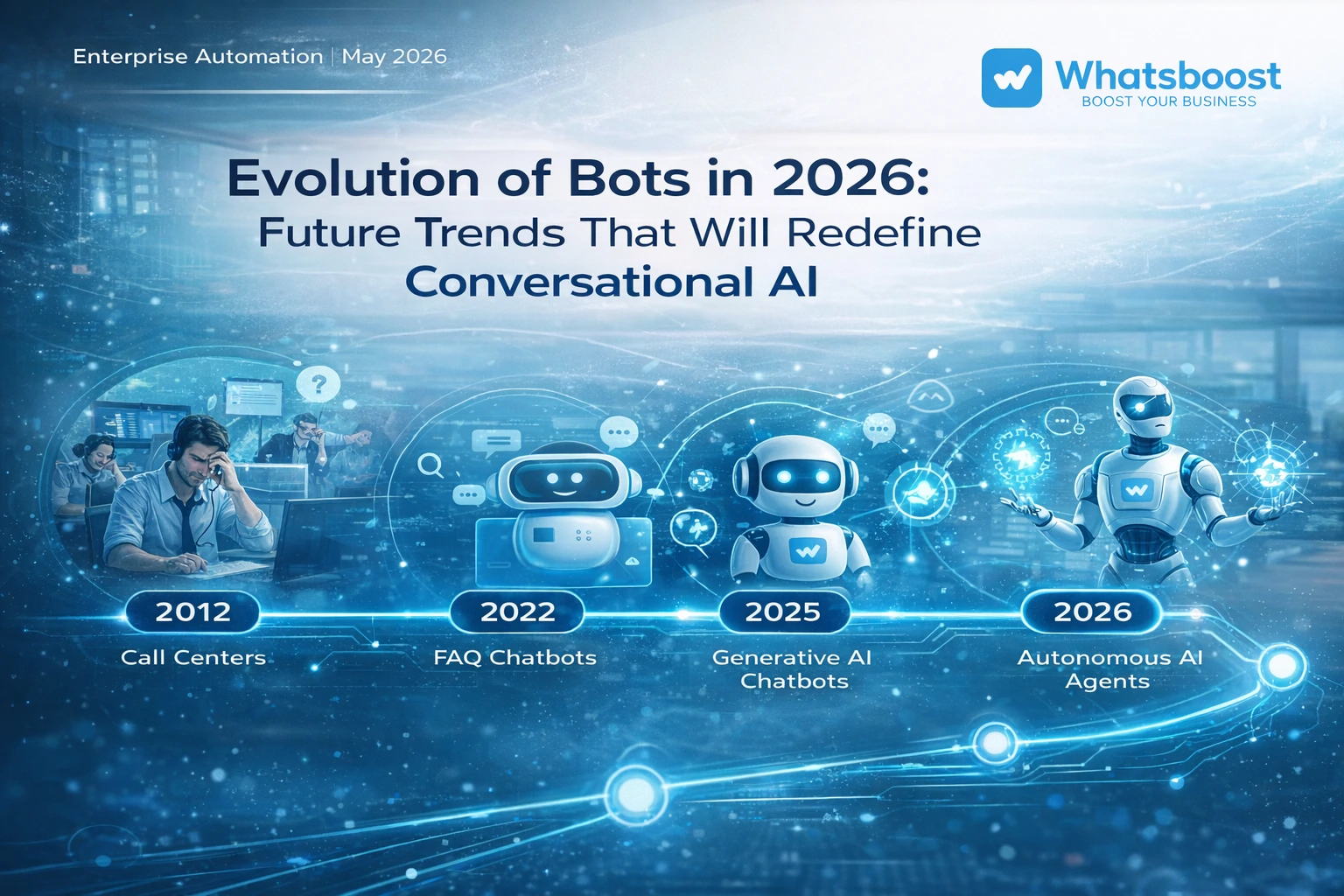
The Year Was 2012…
Customer queries are pouring into the call center of one of Italy’s largest car insurance providers.
Phones are ringing nonstop. Agents are overwhelmed. Operations costs are climbing. The only solution? Hire more people. Buy more computers. Expand infrastructure.
The operations manager dreams of a future where humanoid assistants—like something out of a sci-fi movie—handle repetitive queries.
Now fast forward to 2026.
The office is quieter. Fewer chairs. Fewer stressed faces. Customer queries have increased — but frustration has decreased.
What changed?
One word: Bots.
The company implemented a simple FAQ chatbot. Over time, that bot evolved into a powerful conversational AI assistant. Today, it handles thousands of customer queries daily — accurately, instantly, and at scale.
This isn’t fiction.
This is the evolution of bots — and in 2026, we’re only just getting started.
How Bots Evolved: From Scripts to Intelligence
The evolution of bots didn’t happen overnight. It has been driven by massive advances in:
Natural Language Processing (NLP)
Machine Learning
Transformer architectures
Voice technology
Conversational AI systems
Let’s break this down.
1. Advancements in Natural Language Processing (NLP)
In early chatbot days, bots operated on rigid scripts. If a customer typed anything outside predefined keywords — the bot failed.
Today in 2026, bots:
Understand context
Detect sentiment
Interpret ambiguity
Handle multi-turn conversations
Respond conversationally
Low-Code & No-Code Revolution
One of the biggest shifts in the evolution of bots was democratization.
Previously, only AI engineers could build intelligent bots.
Now?
Platforms like WhatsBoost enable businesses to:
Build AI-powered chatbots without coding
Train bots using website URLs
Upload documents for instant training
Automate workflows with drag-and-drop builders

2. Rise of Transformers & Generative AI
The turning point in chatbot evolution was the rise of transformer-based models like GPT architectures.
These models changed everything because they:
Understand conversation history
Generate human-like responses
Adapt to tone and context
Reduce repetitive clarification loops
In 2026, generative AI bots don’t just answer — they assist, predict, recommend, and execute tasks.

3. Supervised & Unsupervised Machine Learning at Scale
Bots in 2026 combine:
Supervised Learning
Labeled customer conversations
Pre-trained intents
Guided customer flows
Unsupervised Learning
Pattern recognition
Customer clustering
Behavior prediction
Market basket analysis
For example:
E-commerce bots now identify buying patterns and proactively recommend products.
Insurance bots detect risk signals and suggest personalized coverage.
This is not automation — this is predictive intelligence.
4. The Rise of Voice Bots & Virtual Assistants
Voice assistants saw explosive growth earlier, but 2026 marks the year of conversational maturity.
Modern voice bots can:
Understand accents
Handle emotional tone
Process contextual follow-ups
Execute payments
Control IoT devices
Smart Homes + Smart Commerce
Consumers now use voice to:
Make payments
Book appointments
Track deliveries
Reorder products
Voice commerce is projected to dominate micro-transactions globally.
For enterprises, this means one thing:
If your brand doesn’t speak — it risks becoming invisible.

5. Conversational AI Gets Emotional
A major future trend in bots in 2026 is emotional intelligence.
Bots now:
Detect frustration
Identify urgency
Adapt tone
Escalate intelligently
For example:
If a customer says:
“I’m really upset about this refund delay.”
The bot doesn’t reply with a robotic response.
It says:
“I’m really sorry for the inconvenience. Let me prioritize this for you.”
That emotional adaptation drives customer satisfaction and loyalty.
Future Trends in Bots Beyond 2026
Now let’s look ahead.
1. Autonomous AI Agents
Bots will move beyond response-based systems.
They will:
Make decisions
Complete tasks independently
Negotiate pricing
Optimize schedules
Manage workflows
This is where conversational AI merges with enterprise automation.
2. Deeper E-Commerce Penetration
AI bots will:
Guide customers through buying journeys
Personalize recommendations
Reduce cart abandonment
Handle returns instantly
With WhatsBoost automation, businesses can already:
Send automated WhatsApp reminders
Trigger abandoned cart sequences
Qualify leads
Route hot prospects to sales teams
3. AI-Powered Payments via Bots
Chatbots are integrating payment gateways seamlessly.
Users can now:
Complete purchases inside chat
Receive invoices
Subscribe to services
Schedule EMI payments
Payment integrations with gateways are becoming native.
The evolution of bots now includes financial intelligence.
4. Bots + Workforce Collaboration
Instead of replacing humans, bots are becoming co-workers.
In 2026:
Bots handle repetitive queries
Humans handle strategic conversations
AI summarizes customer history before handoff
Agents get real-time suggestions
The result?
Higher efficiency.
Lower burnout.
Better customer experience.
Why Enterprises Must Act Now
Hyper competition leads to hyper innovation.
Enterprises that adopt bots now gain:
24/7 availability
Reduced operational costs
Higher customer satisfaction
Scalable support systems
Improved lead qualification
Faster response times
The evolution of bots is not slowing down.
It’s accelerating.
How WhatsBoost Helps Businesses Stay Ahead
WhatsBoost enables businesses to:
Build AI-powered WhatsApp bots
Automate sales funnels
Set up conversational flows
Capture and segment leads
Trigger drip campaigns
Integrate CRM systems
Instead of just answering queries, WhatsBoost bots:
Convert leads
Nurture customers
Automate follow-ups
Drive revenue
This is the future of conversational automation.
The Bigger Picture: AI Is More Profound Than Fire
Sundar Pichai once said:
“Artificial intelligence is one of the most profound things we’re working on as humanity. It is more profound than fire or electricity.”
Looking at the evolution of bots in 2026, that statement feels less dramatic — and more factual.
Bots are:
Reshaping digital commerce
Reinventing customer service
Transforming workplace productivity
Redefining communication
The real question is no longer:
“Will bots replace humans?”
The question is:
“How fast will your business adapt?”
Book a Demo – Automate Your Customer Engagement
If you want to:
Reduce customer service workload
Increase sales conversions
Implement AI chatbot automation
Scale without hiring endlessly
👉 Schedule a WhatsBoost demo today.
Let AI do the repetitive work — so your team can focus on growth.
Frequently Asked Questions (FAQs)
What is the evolution of bots?
The evolution of bots refers to the transformation from rule-based scripted chat systems to intelligent AI-powered conversational agents capable of understanding context, sentiment, and executing complex tasks.
What are the future trends in bots in 2026?
Major trends include:
Emotional AI
Autonomous agents
Voice commerce
AI-powered payments
Multi-turn conversational AI
Enterprise automation integration
How are bots used in customer service?
Bots handle FAQs, order tracking, refunds, lead qualification, appointment booking, and escalate complex cases to human agents.
Will bots replace customer support agents?
No. Bots augment human agents by handling repetitive tasks and allowing humans to focus on strategic, complex conversations.
WhatsBoost Automation FAQs
What is WhatsBoost?
WhatsBoost is an AI-powered WhatsApp automation platform that helps businesses automate conversations, lead generation, sales follow-ups, and customer support.
Can WhatsBoost integrate with CRM systems?
Yes. WhatsBoost integrates with CRM tools and enables seamless customer data synchronization.
Is WhatsBoost suitable for enterprises?
Absolutely. WhatsBoost is designed to scale with enterprise requirements, handling thousands of conversations simultaneously.
How long does it take to deploy a WhatsBoost bot?
Deployment can happen within days depending on complexity, thanks to its low-code setup.
Final Thoughts
The evolution of bots in 2026 shows us one undeniable truth:
We are entering the era of intelligent conversational ecosystems.
Businesses that adapt early will:
Scale faster
Reduce costs
Increase engagement
Outperform competitors
The future belongs to those who automate smartly.
And that future starts now.
Want to automate WhatsApp for your business?
Set up campaigns, replies, and follow-ups in minutes.