
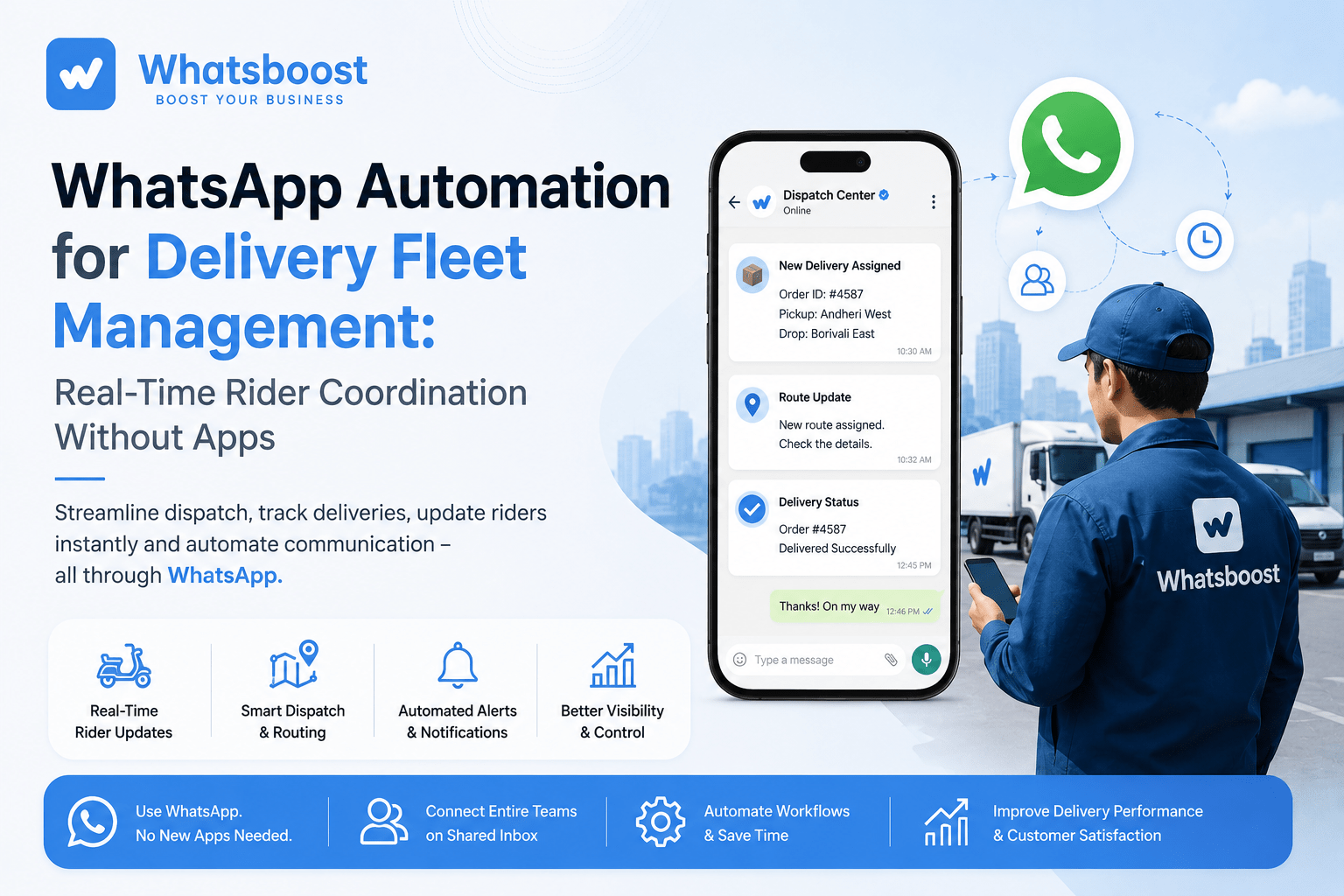
WhatsApp Automation for Delivery Fleet Management: Real-Time Rider Coordination Without Apps
Managing delivery riders through phone calls, spreadsheets, and multiple messaging groups creates delays and operational inefficiencies. Learn how businesses use WhatsApp automation to coordinate riders, manage dispatches, track delivery status, and improve delivery operations without requiring dedicated mobile apps.
Whether it is e-commerce, food delivery, pharmacy distribution, retail logistics, field services, or B2B distribution, delivery performance depends on coordination.
Orders must be assigned.
Riders must be informed.
Customers need updates.
Dispatch teams require visibility.
Managers need operational control.
The challenge is that many businesses still manage these activities through phone calls, WhatsApp groups, spreadsheets, and manual follow-ups.
As delivery volumes increase, communication becomes harder to manage.
The result is often:
Delayed deliveries
Rider confusion
Missed updates
Dispatch bottlenecks
Customer complaints
Operational inefficiencies
This is why many businesses are adopting WhatsApp automation as a communication layer for fleet operations.
The goal is not simply sending messages.
The goal is building a structured delivery communication system.
Why Traditional Rider Coordination Breaks Down
Many growing delivery businesses operate with:
Manual dispatch calls
Multiple WhatsApp groups
Individual rider communication
Excel-based tracking
Informal escalation processes
These methods work at small scale.
However, operational complexity increases rapidly as rider count grows.
Common Challenges
| Operational Issue | Business Impact |
|---|---|
| Riders miss updates | Delayed deliveries |
| Dispatch teams make repeated calls | Reduced productivity |
| No visibility into rider status | Poor operational control |
| Customers ask for delivery updates | Increased support workload |
| Shift changes and reassignments | Coordination delays |
The underlying problem is often not transportation.
It is communication.
Many delivery delays are coordination failures before they become logistics failures.
Why Businesses Are Using WhatsApp Instead of Dedicated Delivery Apps
Dedicated delivery applications can be effective, but they also introduce challenges.
Many businesses struggle with:
User adoption
Training requirements
App installation barriers
Device compatibility issues
Additional software costs
WhatsApp already exists on virtually every rider's phone.
Instead of forcing behavioral change, businesses can automate communication through a platform employees already use daily.
This reduces operational friction while improving communication consistency.
How WhatsApp Automation Supports Delivery Fleet Operations
WhatsApp automation creates structured workflows around delivery communication.
Instead of relying on manual coordination, information can move automatically between dispatch teams, riders, and customers.
Delivery Assignment Notifications
When an order is assigned, riders can receive:
Customer details
Delivery address
Order information
Priority instructions
Estimated timelines
This eliminates manual dispatch communication for routine assignments.
Route and Schedule Updates
Operational changes happen constantly.
Traffic conditions.
Delivery prioritization.
Customer requests.
Urgent deliveries.
Automated WhatsApp notifications ensure riders receive updates immediately.
Pickup Confirmation Workflows
Riders can confirm:
Pickup completed
Order collected
Dispatch accepted
Delivery started
These updates improve operational visibility.
Real-Time Rider Coordination Without Building a Mobile App
One of the biggest misconceptions in logistics technology is that every operational challenge requires a dedicated application.
In reality, many coordination problems can be solved through workflow automation.
Example Workflow
| Step | Automated Action |
|---|---|
| Order assigned | Rider receives WhatsApp notification |
| Rider accepts assignment | Dispatch receives confirmation |
| Delivery started | Status automatically updated |
| Customer informed | Automated delivery notification |
| Delivery completed | Final confirmation generated |
This creates a lightweight operational workflow without requiring a custom rider application.
Delivery Visibility Is Becoming a Competitive Advantage
As delivery operations grow, visibility becomes increasingly important.
Managers often struggle to answer:
Which riders are active?
Which deliveries are delayed?
Who accepted assignments?
Which routes face issues?
Where are operational bottlenecks occurring?
Without visibility, businesses rely on assumptions.
With structured communication workflows, operational status becomes easier to track.
Visibility is not about tracking every rider movement. It is about understanding operational progress in real time.
WhatsApp as an Operational Layer for Logistics
Historically, businesses viewed WhatsApp as a messaging tool.
Today, many organizations use it as an operational layer.
The platform increasingly supports:
Workforce coordination
Dispatch communication
Delivery notifications
Internal collaboration
Customer updates
This shift is similar to how support teams now use shared communication systems rather than personal devices.
For example, businesses managing high conversation volumes often implement a WhatsApp Shared Inbox to improve visibility, assignment, and accountability across teams.
Related Reading:
WhatsApp Shared Inbox: The Playbook for Routing, Roles, and SLAs (2026 Guide)
WhatsApp Business Multiple Users vs Shared Inbox: Which Is Better for Teams?
Automatic Assignment of WhatsApp Conversations to Multiple Agents
Shared WhatsApp Workflows for Multi-Department Support Teams in India
These approaches demonstrate how communication workflows become operational systems rather than simple messaging channels.
Beyond Delivery Updates: Additional Fleet Communication Use Cases
Once WhatsApp workflows are established, businesses can automate additional operational processes.
Rider Attendance and Shift Communication
Dispatch teams can automate:
Shift reminders
Attendance confirmations
Route allocations
Shift change notifications
Incident Reporting
Riders can report:
Delivery issues
Vehicle problems
Customer concerns
Route disruptions
through structured communication workflows.
Escalation Management
Critical issues can be automatically routed to supervisors for faster resolution.
This reduces dependency on informal communication channels.
Communication Operations Matter in Logistics
Many businesses focus on:
Vehicles
Routes
Fuel costs
Delivery speed
While these are important, communication often receives less attention.
However, communication directly influences:
Delivery efficiency
Rider productivity
Customer experience
Dispatch performance
Operational responsiveness
A delivery operation can only move as efficiently as the information flowing through it.
This is why communication automation is increasingly becoming part of logistics operations.
How WhatsBoost Supports Delivery Communication Workflows
WhatsBoost helps businesses automate WhatsApp communication across teams, workflows, and operational processes.
Instead of relying on manual coordination, businesses can create structured communication workflows for:
Rider notifications
Delivery updates
Assignment workflows
Internal coordination
Operational alerts
Customer communication
The objective is not merely automation.
The objective is operational consistency at scale.
Key Takeaways
Delivery fleet management is often viewed as a logistics challenge.
In reality, it is also a communication challenge.
As delivery volumes increase, manual coordination becomes difficult to sustain.
WhatsApp automation helps businesses:
Coordinate riders efficiently
Reduce dispatch workload
Improve operational visibility
Standardize communication
Deliver faster updates
Scale delivery operations without additional complexity
The future of delivery management is not necessarily more apps.
For many businesses, it is better workflows.
Frequently Asked Questions
Can WhatsApp automation improve delivery visibility?
Yes. Automated workflows help dispatch teams monitor delivery progress, rider responses, assignment status, and operational updates more efficiently.
Is WhatsApp automation suitable for logistics companies?
Yes. Logistics providers, courier companies, food delivery businesses, pharmacies, distributors, and field service organizations can all benefit from structured communication workflows.
Want to automate WhatsApp for your business?
Set up campaigns, replies, and follow-ups in minutes.