
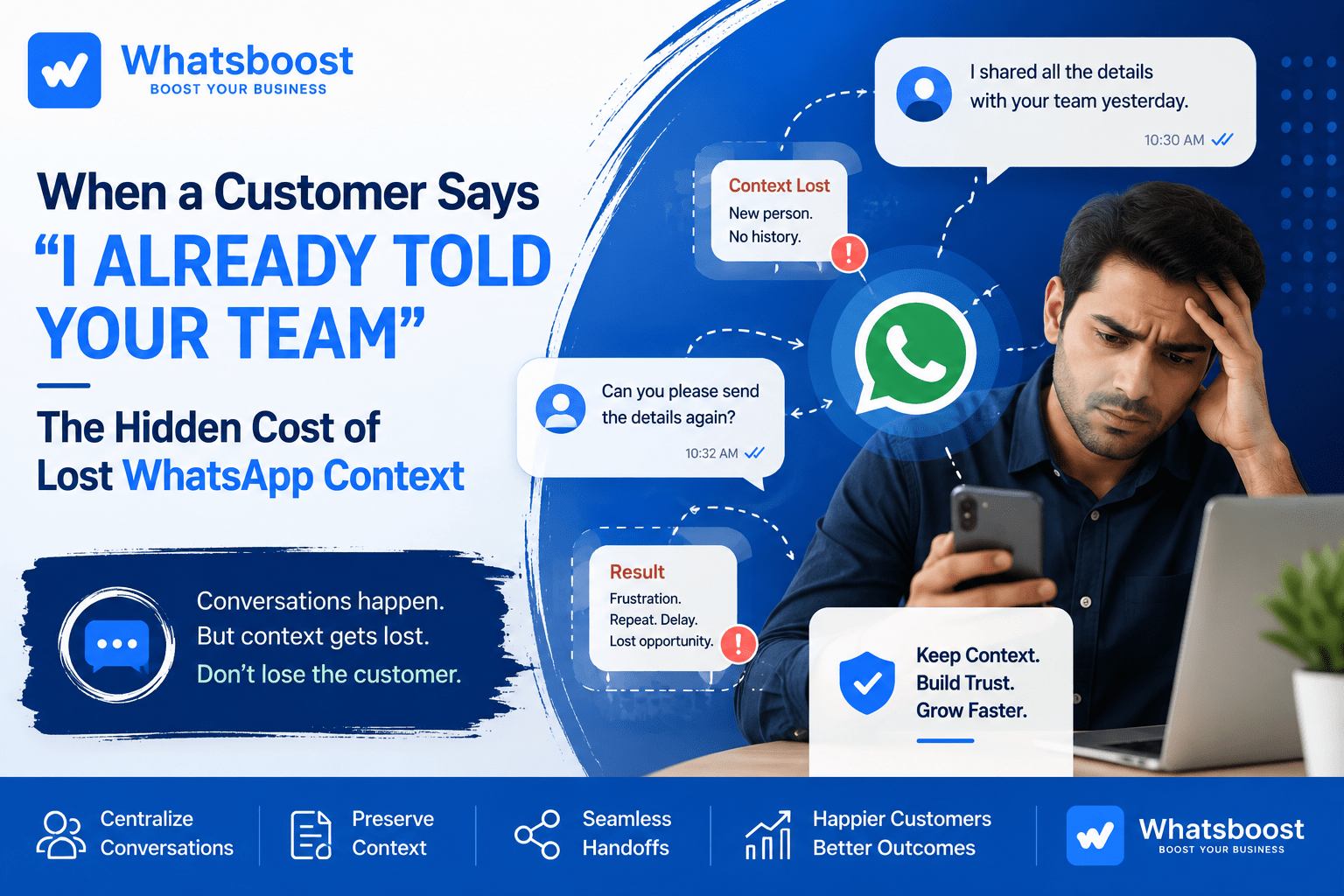
When a Customer Says "I Already Told Your Team": The Hidden Cost of Lost WhatsApp Context
When a customer says "I already told your team," it's usually a sign that conversation context — not just chat history — never made it to the next person. This article breaks down why WhatsApp context gets lost across handoffs, role changes, and department transfers, and what businesses actually need to capture to stop customers from repeating themselves.
"I already explained this to someone on WhatsApp."
For a customer, that sentence is usually an expression of frustration.
For a business, it is a warning sign.
It means information entered the organization but didn't necessarily travel through it.
A customer may have already explained their requirement to a salesperson. They may have sent photographs, documents, product specifications, budget details, delivery instructions, or even a detailed description of a problem.
Then the salesperson goes on leave.
Another team member takes over.
And the customer hears:
"Could you please explain your requirement again?"
Nothing technically went wrong with WhatsApp.
The message was delivered. The conversation exists. The problem is that the context did not move with the customer.
This is becoming an increasingly important issue for businesses that rely heavily on WhatsApp for sales, customer support, account management, and client communication. The challenge isn't simply managing more messages. It is making sure that the information contained inside those messages remains useful when the person, department, or stage of the customer journey changes.
A WhatsApp Conversation Can Contain More Business Context Than a CRM Record
A CRM usually stores structured information: name, phone number, company, lead source, deal stage, assigned salesperson, last activity. Those fields are useful, but they don't necessarily explain the entire relationship.
Consider a customer who says:
"We need 40 units initially, but if the quality is good, we'll probably order 200 more next quarter. The delivery location is different from our registered office, and our procurement team will need 30-day payment terms."
A CRM might contain: Quantity: 40. Potential future order: 200. Payment terms: 30 days.
But the actual conversation contains much more. The customer has revealed intent. They've explained their internal buying process. They've flagged a future opportunity. They've identified a condition that could affect the deal.
When that information remains trapped inside a conversation that only one employee understands, the business has effectively created a context dependency.
The Problem Isn't That Businesses Have Too Many Conversations
Businesses often describe WhatsApp management as a volume problem — too many messages, too many groups, too many customers, too many enquiries.
But volume isn't the fundamental problem. The deeper problem is continuity.
A customer doesn't experience the business as separate departments. They experience one relationship. If they explain their requirement to marketing, then speak to sales, then contact support, they expect the business to know what has already happened. The organization may have different teams — the customer doesn't care.
From their perspective: "I told your company."
That's why context loss is so damaging. The customer doesn't think, "I told salesperson A on WhatsApp, but salesperson B doesn't have access to that information." They simply think: "Why do I have to explain everything again?"
Context Loss Happens More Often Than Businesses Realize
A salesperson changes roles. A salesperson who managed a portfolio moves to another department. The conversations remain associated with the old workflow, while the new employee has to reconstruct the customer history from scratch.
Someone goes on leave. A customer needs an urgent update. Another employee takes over. They can see some information, but not necessarily understand what was discussed previously or what was promised.
A lead moves from marketing to sales. Marketing generated the enquiry. Sales receives the contact. But the original conversation, campaign context, customer questions, and objections may not move with it.
Sales hands the customer to support. The customer has already explained the problem during the sales process. Support starts the conversation from scratch.
A client communicates with multiple employees. One employee receives a design change. Another receives an approval. A third receives a payment-related message. The client believes they're talking to one company. Internally, the information is fragmented across people.
None of these situations is unusual. Together, they create a serious operational problem.
The Most Expensive Information Is Sometimes the Information Nobody Recorded
Businesses tend to record information that fits neatly into fields — lead name, email, phone number, order value, invoice number, deal stage.
But customers don't communicate in fields. They communicate in sentences. They explain why they're hesitant. They mention what they expect. They reveal what matters to them. They casually mention a future requirement. They complain about something that may become a retention issue later. They tell a salesperson why they chose a competitor.
That information may never become a CRM field — yet it can be more commercially useful than the basic contact information already stored there.
This is why conversation context deserves to be treated as business information rather than simply chat history. The objective isn't to store every message forever just because it exists. The objective is to preserve the information that helps the next person understand what is happening.
Why Copy-Pasting Conversations Isn't a Real Solution
A common reaction is: "Just forward the chat to the next employee."
That can work occasionally. It doesn't scale. A forwarded conversation still forces the next person to read through a long thread and figure out: What does the customer actually need? What has already been agreed? What is still pending? Who promised what? What is the customer's priority? What should happen next?
The business has transferred the conversation, but not necessarily the understanding. That's an important distinction. Good systems don't merely move messages around — they make the important context accessible at the point where it's needed.
The Difference Between Conversation History and Conversation Context
These terms sound similar, but they aren't.
Conversation history answers: "What was said?"
Conversation context answers: "What does all of this mean for the next person?"
Imagine a 70-message conversation. The history is all 70 messages. The useful context might be only this:
Customer wants a 3-bedroom property. Budget is approximately ₹1 crore. Moving within six months. Has already rejected two projects because of location. Wants a site visit this weekend. Salesperson promised to share two suitable options.
That summary can be far more useful than forcing another employee to read the entire conversation. This is where structured workflows and automation can make a meaningful difference.
What Should Actually Move With a Customer?
Not every WhatsApp message needs to become structured business data — that would create another problem: information overload. Instead, businesses should identify the context that changes what happens next.
For a sales conversation: customer requirement, budget, purchase timeline, product or service interest, key objections, decision-maker information, next action, assigned employee.
For support: issue, severity, previous troubleshooting, customer expectation, current status, escalation requirement.
For an existing client: project, current deliverable, latest approval, pending change, deadline.
The exact information differs by business. The principle doesn't:
Capture the information that another person would need to continue the relationship without making the customer start again.
This Is Where WhatsApp and CRM Need to Work Together
A CRM is useful because it creates an organizational record. WhatsApp is useful because that's where many customer conversations actually happen. When the two operate separately, the business has two versions of the customer relationship — one inside the CRM, one inside WhatsApp — and neither is necessarily complete.
A better model allows relevant conversation information to flow into the systems where teams actually work. A customer sends an enquiry on WhatsApp. The lead enters the CRM. Qualification information is captured. The conversation is associated with the customer record. The salesperson continues the discussion. Important outcomes are recorded. When the customer moves to another stage, the relevant information remains available.
This is more than simply connecting two applications — it is about creating continuity between conversation and business process. WhatsBoost's existing CRM workflow integration with WhatsApp covers how WhatsApp can connect to CRM events beyond simple lead capture, including deal-stage changes, follow-ups, status updates, and conversation outcomes.
That distinction matters: CRM integration shouldn't be treated merely as a way to store phone numbers. Its larger purpose is to preserve the relationship as the customer moves through the organization.
What Happens When the Human Who Knows Everything Leaves?
This is the test most businesses never perform. Imagine your best salesperson resigns tomorrow. Ask: Could another employee continue their active WhatsApp conversations without the customers noticing a major difference?
If the answer is no, you have a knowledge dependency.
The salesperson may have spent two years building relationships. They know which customers prefer calls. They know who needs approval from a procurement team. They know which client is sensitive about delivery delays. They know which prospect is genuinely interested despite not responding frequently.
None of that may exist in the CRM. It exists in their memory and their WhatsApp conversations. When they leave, the organization doesn't just lose an employee — it loses relationship context.
The Customer Shouldn't Become the Integration Layer
This is perhaps the most frustrating version of the problem. A customer communicates with marketing, then sales, then operations, then support — but every department asks the customer to repeat information because the systems don't communicate with each other.
The customer becomes the messenger between departments. They explain the same requirement four times. They resend the same document. They repeat the same complaint. They explain the same timeline. They remind the business about its own previous commitment.
At this point, the problem is no longer a WhatsApp problem. It is an organizational information-flow problem. WhatsApp simply makes the problem visible because so much customer communication now happens there.
Automation Should Preserve Context, Not Just Send Messages
When businesses hear "WhatsApp automation," they often think about automated replies. But that's only one part of the picture.
A new enquiry arrives → customer information is captured → qualification questions are answered → relevant details are stored → the lead is assigned → the salesperson receives the context → the conversation continues → important outcomes update the customer record.
The automation isn't valuable because it sent five messages. It's valuable because the right information reached the right person at the right time. That's a much more useful definition of business automation.
The Goal Isn't to Store Everything
There's an understandable temptation to capture every WhatsApp conversation, every message, every timestamp, every attachment. More data doesn't automatically create more value — it can create noise.
A sales manager doesn't need to read 500 messages. They need to know: Which leads need attention? Which customers are waiting? Which conversations contain complaints? Which deals are at risk? Which customers have requested something that hasn't been actioned?
This is where structured data and automation become more useful than raw conversation archives. For teams that want to take this further, WhatsBoost already supports workflows around collecting WhatsApp conversation data and routing it into tools such as CRM systems, Google Sheets, helpdesks, and collaboration platforms.
The important question, however, isn't simply where the data goes. It's what the business does with it after it gets there.
From "What Did the Customer Say?" to "What Do We Need to Do?"
This is the transition that makes conversation data operationally valuable.
Imagine a customer writes: "The delivery was supposed to happen Friday. We haven't received anything yet and our installation team is already scheduled."
The raw message contains information. The business needs an action: Category — delivery issue. Priority — high. Customer — existing account. Required action — operations escalation. Expected resolution — delivery update.
The same principle works in sales. A customer says: "We like the proposal but need a revised quotation for 100 units." The useful business interpretation becomes: Deal stage — negotiation. Requirement — revised quotation. Quantity — 100. Next action — sales to send revised proposal.
The customer shouldn't have to explain this again to someone else. The business already knows what needs to happen.
This Is Where AI Can Become Useful — If the Foundation Is Right
AI can summarize long conversations, identify customer intent, extract requirements, classify conversations, detect complaints, identify buying signals, and suggest next actions.
But AI shouldn't be used as a shortcut around poor process design. If a business doesn't know what information matters, adding AI won't automatically solve the problem.
The better sequence is: Conversation → Relevant information → Structured context → Business action → Measurement.
AI can potentially make the middle stages faster and more scalable. But the business still needs to decide what constitutes useful context.
A Better Question for Businesses Using WhatsApp
Instead of "How many WhatsApp messages did we receive this month?" ask: "How much customer knowledge did we actually retain from those conversations?"
Instead of "How many chats did our sales team handle?" ask: "Could another salesperson continue those conversations without making the customer repeat everything?"
Instead of "Do we have WhatsApp automation?" ask: "Does our automation move customer information into the next business action?"
These questions lead to a different way of thinking about WhatsApp. It stops being just a communication channel. It becomes part of the organization's information flow.
The Future of WhatsApp Business Isn't Just Faster Replies
Faster replies matter. Automation matters. Lead generation matters. But as businesses become increasingly dependent on conversational channels, another capability becomes equally important: continuity.
The customer should be able to move from one employee to another without losing context — from marketing to sales, from sales to onboarding, from onboarding to support, from support back to account management. The channel may remain WhatsApp throughout the journey. What changes behind the scenes is the workflow managing the relationship.
That's where businesses move from simply communicating through WhatsApp to actually operating through WhatsApp-connected systems.
Where WhatsBoost Fits
WhatsBoost can become part of that infrastructure by connecting WhatsApp conversations with automation, customer data, CRM workflows, team processes, and other business systems.
The objective isn't simply to make WhatsApp send messages automatically. It's to help businesses create workflows where customer conversations lead to structured actions. A new enquiry can become a lead. A customer response can update a workflow. A conversation can be routed to the right team member. A customer requirement can trigger an internal action. A CRM event can trigger a WhatsApp communication. And the relevant context can remain available as the customer moves through the business.
That is ultimately what makes automation useful: the customer doesn't have to carry the organization's information between departments. The system should do that.
Final Takeaway
When a customer says "I already told your team," the problem isn't that the customer is impatient. They may actually be pointing to a structural weakness inside the business.
The information exists. The conversation happened. Someone knows what the customer needs. But the knowledge hasn't moved to the person who needs it next. That's the hidden cost of lost WhatsApp context.
Businesses don't necessarily need to capture every conversation or automate every interaction. They need to make sure that important customer context survives employee changes, department handoffs, sales-stage changes, support escalations, and customer lifecycle transitions.
Because the real value of a customer conversation isn't the message itself. It's what the business knows after the message has been sent — and whether that knowledge can still be used when the next person takes over.
Want to automate WhatsApp for your business?
Set up campaigns, replies, and follow-ups in minutes.