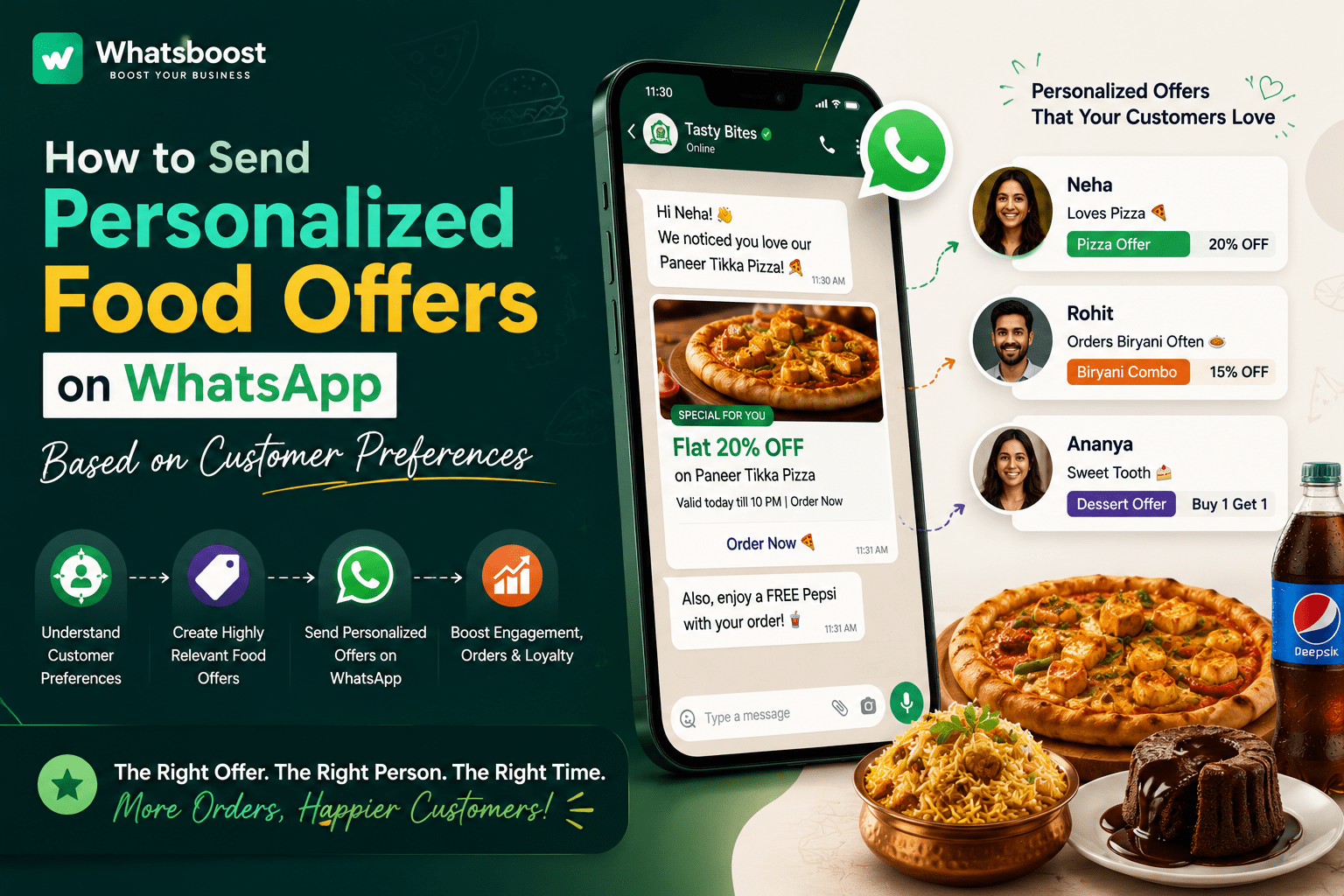
How to Send Personalised Food Offers on WhatsApp Based on Customer Preferences
A complete guide for restaurants and food businesses to create personalized WhatsApp marketing campaigns based on customer behavior, preferences, and ordering patterns.
Most restaurant owners already know that WhatsApp gets opened faster than email.
That is no longer the interesting insight.
The real question is:
Why do some food businesses get repeat orders from WhatsApp campaigns while others get ignored, muted, or blocked?
The answer is surprisingly simple.
Most restaurants still send promotions based on what they want to sell.
Customers respond better to offers based on what they actually prefer buying.
That distinction is becoming increasingly important because customer attention is shrinking while food choices are expanding.
A customer who repeatedly orders paneer tikka is unlikely to care about a seafood combo offer.
Someone who orders desserts every weekend may completely ignore a pizza discount.
A customer who only buys during office lunch hours behaves differently from someone ordering late-night snacks.
Yet many restaurants still send identical WhatsApp broadcasts to everyone.
The result?
Low engagement.
Poor repeat ordering.
Weak campaign performance.
Customer fatigue.
The restaurants generating stronger results today are moving toward behavior-based WhatsApp marketing, where offers are triggered by customer preferences, ordering habits, spending patterns, and purchase history.
And that shift is quietly changing how food businesses approach retention marketing.
Why Generic Food Promotions Are Becoming Less Effective
The food delivery ecosystem has become dramatically more competitive.
Customers are exposed daily to promotions from:
restaurants
cloud kitchens
Swiggy campaigns
Zomato notifications
loyalty programs
coupon platforms
Because of this saturation, generic discounts are losing effectiveness.
A restaurant sending:
"20% OFF on all menu items today"
may actually perform worse than a smaller, highly targeted offer such as:
"Your favorite peri peri burger is back. Order before 8 PM and get free fries."
The second message feels relevant.
And relevance is increasingly becoming the most important metric in conversational marketing.
What Customers Actually Mean When They Say "Personalized"
Many businesses misunderstand personalization.
Personalization is not simply inserting the customer's first name.
This:
Hi Rahul, get 15% OFF today.
is technically personalized.
But it is not meaningful.
Real personalization happens when communication reflects customer behavior.
For example:
| Customer Behavior | Personalized Offer |
|---|---|
| Frequently orders biryani | Weekend biryani combo offer |
| Orders every Friday night | Friday reminder campaign |
| Usually buys desserts | New dessert launch alert |
| Stops ordering for 45 days | Win-back discount campaign |
| High-value customer | VIP loyalty reward |
This kind of targeting feels significantly more relevant.
And relevance drives action.
Why WhatsApp Is Particularly Powerful for Food Businesses
Food purchases are often impulse-driven.
Customers rarely spend days researching what they want for dinner.
The decision window is short.
This makes communication timing extremely important.
According to Statista WhatsApp Usage Data, India remains WhatsApp's largest market globally.
For restaurants and food brands, this creates a major advantage.
Customers already use WhatsApp throughout the day.
Which means restaurants can reach people inside a platform where attention already exists.
The challenge is not reaching customers.
The challenge is sending messages that feel relevant enough to open.
The Three Types of Customer Preference Data Most Restaurants Ignore
Many food businesses think they lack customer data.
Usually, they already have it.
They simply are not organizing it properly.
1. Product Preference Data
What does the customer repeatedly order?
Examples:
South Indian food
Chinese dishes
healthy bowls
desserts
beverages
meal combos
Repeated orders reveal preference patterns surprisingly quickly.
2. Ordering Time Preferences
Some customers consistently order:
office lunch
evening snacks
weekend dinners
late-night meals
Timing itself becomes a personalization signal.
A breakfast campaign sent at 8 PM has almost no contextual relevance.
3. Spending Behavior
Customers also behave differently based on spending patterns.
| Customer Type | Marketing Approach |
|---|---|
| Budget-conscious | Combo offers |
| Premium spenders | Exclusive menu launches |
| Frequent buyers | Loyalty rewards |
| Dormant customers | Re-engagement campaigns |
Many restaurants focus only on discounts.
But spending behavior often predicts future ordering patterns more accurately.
Why Segmentation Performs Better Than Broadcasting
One pattern appears repeatedly across successful restaurant marketing campaigns:
The more targeted the audience, the better the engagement.
Instead of sending one campaign to 5,000 customers, restaurants increasingly create smaller segments such as:
vegetarian customers
dessert buyers
repeat customers
weekend diners
office lunch customers
premium spenders
inactive customers
This improves:
open rates
click-through rates
repeat purchases
customer retention
while reducing message fatigue.
A Realistic Example
Imagine a restaurant has 2,000 WhatsApp subscribers.
A traditional campaign might send:
Flat 20% OFF today.
to everyone.
A preference-based campaign could send:
| Customer Segment | Campaign |
|---|---|
| Pizza buyers | Buy 1 Get 1 Pizza |
| Dessert customers | New cheesecake launch |
| Frequent diners | Loyalty reward |
| Dormant customers | Come back and get ₹150 OFF |
The same database suddenly becomes much more valuable.
Not because more messages were sent.
Because smarter messages were sent.
Where Most Restaurants Lose Repeat Orders
One of the biggest retention mistakes happens after the first order.
The customer buys once.
Then nothing happens.
No follow-up.
No preference tracking.
No segmentation.
No retention workflow.
Eventually the customer forgets the restaurant exists.
Restaurants spend heavily acquiring new customers while neglecting existing ones.
This is operationally expensive because acquiring a new customer is usually far more difficult than reactivating someone who already purchased before.
This is why many food businesses are increasingly building structured customer journeys using systems like WhatsApp automation and follow-up workflows.
Because repeat ordering usually happens through continuity rather than one-time promotions.
The Role of AI in Personalized Food Marketing
AI is changing food marketing in an interesting way.
Not because AI writes promotional messages.
But because AI can identify patterns humans often miss.
For example:
AI can automatically detect:
favorite menu categories
order frequency
customer lifetime value
inactivity periods
preferred ordering times
repeat purchase behavior
This allows businesses to create highly targeted WhatsApp campaigns without manually analyzing thousands of orders.
The future of restaurant marketing is increasingly shifting toward:
behavioral personalization rather than mass promotions.
Why Timing Often Matters More Than Discounts
Many restaurant owners assume bigger discounts automatically create better results.
In reality, timing often matters more.
A 10% discount delivered exactly when a customer is likely to order can outperform a 30% discount sent randomly.
For example:
A lunch combo promotion sent at 12:15 PM to office workers may outperform a larger offer sent at 9 PM.
Because context influences behavior.
This is why advanced WhatsApp campaigns increasingly combine:
customer preferences
ordering habits
timing patterns
purchase history
instead of relying solely on discounts.
How Restaurants Can Build Personalized WhatsApp Campaigns
A practical workflow usually looks like this:
Step 1: Capture Customer Data
Collect:
order history
favorite categories
purchase frequency
contact information
Step 2: Create Segments
Group customers based on:
food preferences
order frequency
spending patterns
inactivity periods
Step 3: Build Automated Campaigns
Trigger campaigns based on behavior.
Examples:
Birthday offer
30-day inactivity campaign
Dessert launch campaign
Weekend combo promotion
Step 4: Measure Results
Track:
campaign engagement
repeat orders
conversion rates
revenue generated
Many restaurants already using structured WhatsApp sales funnels eventually expand into preference-based marketing because segmentation improves campaign efficiency significantly.
What Most Articles About Restaurant WhatsApp Marketing Miss
Many guides focus entirely on:
sending promotions
bulk messaging
WhatsApp broadcasts
But very few discuss:
customer preference infrastructure.
The real competitive advantage is not sending more offers.
It is building systems that understand:
what customers like
when they buy
how often they order
what makes them return
That operational layer is where long-term retention comes from.
How WhatsBoost Helps Food Businesses Personalize WhatsApp Offers
WhatsBoost helps restaurants, cafés, cloud kitchens, food brands, and hospitality businesses build structured WhatsApp marketing workflows based on customer behavior and ordering preferences.
Businesses can create:
customer segmentation systems
personalized food campaigns
automated follow-ups
repeat-order workflows
loyalty campaigns
customer reactivation sequences
preference-based targeting
WhatsApp retention funnels
without manually managing thousands of customer conversations.
Restaurants looking to improve retention often combine these workflows with structured WhatsApp customer re-engagement campaigns to bring inactive customers back into the ordering cycle.
Final Thoughts
The future of food marketing on WhatsApp is unlikely to be won by restaurants sending the highest number of messages.
It will be won by businesses sending the most relevant ones.
Customers increasingly expect businesses to understand:
what they like
when they order
how they behave
what interests them
The restaurants generating stronger repeat business today are treating WhatsApp less like a broadcasting platform and more like a customer intelligence channel.
Because personalized food offers are not really about promotions.
They are about relevance.
And in modern conversational commerce, relevance is becoming one of the strongest drivers of customer retention.
Want to automate WhatsApp for your business?
Set up campaigns, replies, and follow-ups in minutes.