
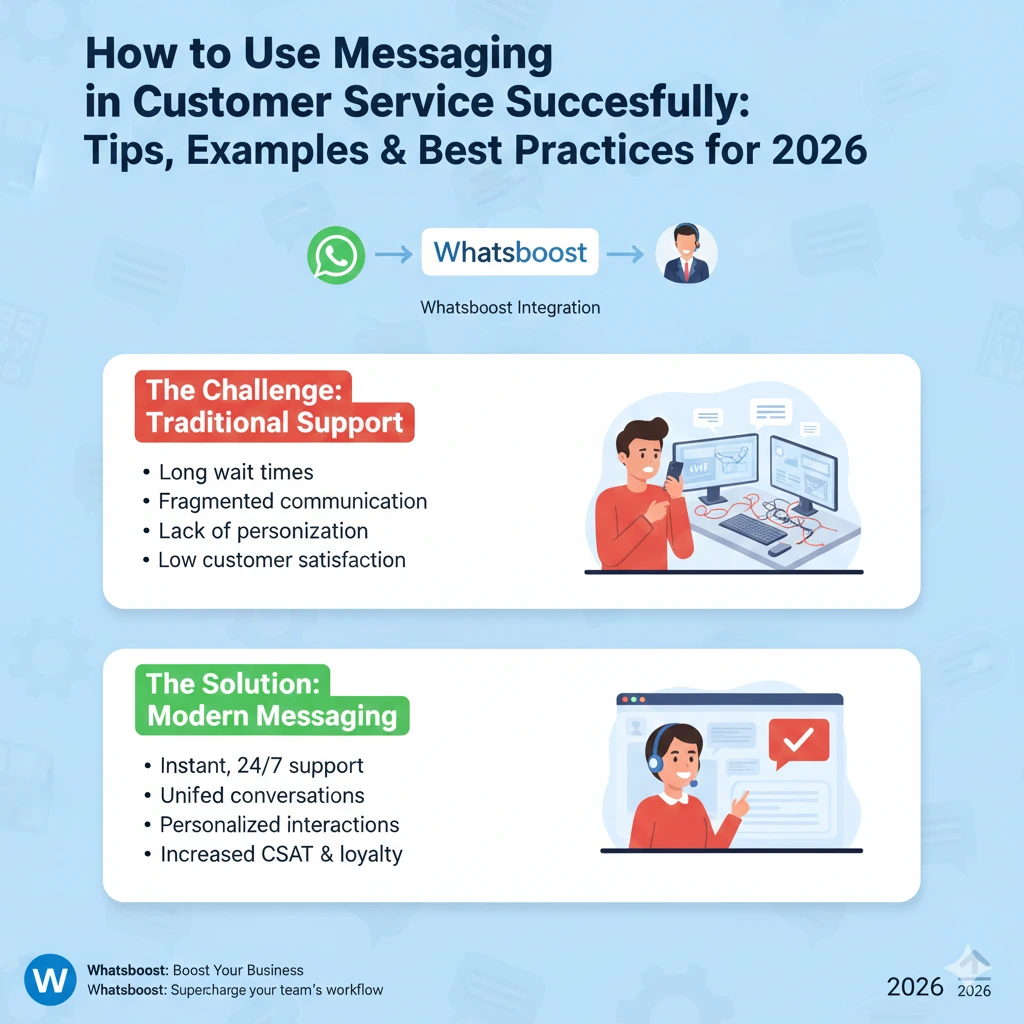
How to Use Messaging in Customer Service Successfully: Tips, Examples & Best Practices for 2026
Discover how to use messaging in customer service more effectively in 2026. Explore actionable tips, real-world examples, and best practices to deliver faster, smarter support.
Not too long ago, phone support was the undisputed king of customer service. In 2026, that is no longer the case. Customers today prefer to send a message over making a phone call — and the numbers back this up. Over 78% of customers now reach out to businesses via text or messaging apps, and more than 50% prefer messaging to phone calls as a support channel.
The shift is clear. Platforms like WhatsApp and Facebook Messenger have become primary touchpoints for customer support, with over one billion users contacting a business through Meta's messaging apps every single week. Messaging is faster, more convenient, and more efficient — for customers and businesses alike.
So how do you make the most of it? Here are four practical tips, real-world examples from leading brands, and best practices to help you deliver exceptional customer service through messaging in 2026.
Four Tips for Successful Customer Service via Messaging
1. Be Conversational
Messaging apps are built for conversation — so use them that way. When a customer reaches out on WhatsApp or Facebook Messenger, they are not expecting a formal, corporate reply. They are in the same environment they use to chat with friends and family, and your tone should reflect that.
More importantly, make sure you are actually available. Nothing damages the customer experience faster than sending a message and receiving silence in return. Whether you use a live agent, a chatbot, or a combination of both, ensure that every message gets a timely response. Being present and responsive on messaging channels is the baseline expectation in 2026.
2. Take Advantage of Multimedia
One of the biggest advantages messaging apps have over traditional support channels is multimedia. Customers can send photos, videos, voice notes, and documents — making it far easier to explain a problem without lengthy back-and-forth exchanges.
Encourage your customers to use this. For example, if a customer has a defective product, ask them to send a photo. This saves your support team time, reduces the need for follow-up questions, and leads to faster resolutions. Textile company hessnatur does exactly this — asking customers to photograph fabric issues directly on WhatsApp, which has significantly reduced return rates and agent handling time.
3. Integrate Chatbots
Chatbots are one of the most powerful tools available for messaging-based customer service. They are available 24 hours a day, respond instantly, and can handle up to 80% of frequently asked questions without any human involvement.
Even a basic chatbot can dramatically reduce the workload on your support team while improving response times for customers. For more complex queries, the chatbot can seamlessly hand the conversation over to a human agent — giving customers the best of both worlds. In 2026, a messaging support strategy without a chatbot is leaving significant efficiency gains on the table.
4. Actively Promote Your Messaging Support Channel
You could have the best messaging support setup in the world — but if your customers do not know it exists, it does not help anyone. Promote your messaging channel everywhere: your website, social media profiles, email signatures, product packaging, and even in-store signage.
If you use WhatsApp, take it a step further with click-to-chat links that take customers directly into a conversation with your business. The easier you make it for customers to reach you, the more they will use it — and the less pressure you will have on your phone and email channels.
Best Practices From Four Companies Leading the Way
BMW — Automating FAQs at Scale
Car dealerships and repair shops handle enormous volumes of customer queries daily. Most of these are repetitive — is my car ready? What time can I pick it up? Does it need additional repairs?
BMW's Munich headquarters tackled this challenge head-on by introducing WhatsApp as a customer service channel, paired with an automated chatbot to handle FAQs. The results were transformative. BMW was able to answer 80% of customer questions instantly through the bot, significantly reducing agent workload and cutting response times for customers. What previously required a costly call centre could now be handled automatically, at scale.
Orion Mall — Meeting Customers on Their Preferred Channel
Orion Mall, one of Bangalore's largest shopping centres, receives hundreds of daily queries — from movie screening times to store locations to daily promotions. Recognising that WhatsApp was their customers' preferred communication channel, Orion Mall launched a WhatsApp support channel powered by a chatbot they named "Genie."
The chatbot handles FAQs smoothly and efficiently, delivering fast answers without customers needing to call or visit the information desk. The response from shoppers was overwhelmingly positive — customers loved the speed and convenience of getting answers on a platform they already used every day.
Women's Best — Building Dialogue With Global Customers
Sports brand Women's Best reaches 1.3 billion people across 150 countries, in multiple languages. Managing incoming customer queries at that scale is a serious operational challenge. By launching a dedicated WhatsApp support channel, Women's Best was able to answer customer queries twice as fast and meaningfully reduce their inbound call volume — all while maintaining a personalised, engaging experience for customers worldwide.
Sephora — Centralising Multi-Channel Messaging Support
Beauty retailer Sephora built its customer base on Instagram and Facebook — so naturally, that is also where customers come with questions. To manage queries across both platforms efficiently, Sephora introduced a centralised messaging solution for Facebook Messenger and Instagram Direct.
The results spoke for themselves. 100% of customers reaching out via messaging were served on the same channel, and average response times dropped by 15% — resulting in more first-contact resolutions and happier customers overall.
Messaging Works Across Every Industry
The examples above span automotive, retail, fashion, and beauty — but messaging-based customer service delivers results across every sector. Car dealers reduce call volumes. eCommerce businesses improve the user experience. Banks automate services while maintaining data protection. Tourism companies outpace their competitors. The common thread is the same: customers want fast, convenient support on the channels they already use.
Elevate Your Messaging Customer Service With Whatsboost
Getting started with messaging in customer service does not have to be complicated. Whatsboost gives your business everything you need to deliver professional, scalable customer support through WhatsApp — without requiring any special IT infrastructure or coding knowledge.
With Whatsboost's chatbot builder, you can automate answers to frequently asked questions, qualify incoming queries, and route complex issues to the right human agent — all within a single platform. And with Whatsboost's broadcast feature, you can proactively reach out to customers with updates, promotions, and service notifications at scale.
In 2026, meeting your customers on messaging is not optional — it is expected. Whatsboost makes it simple to get there.
FAQs: Messaging in Customer Service
Why is messaging better than phone support for customer service? Messaging is faster, more convenient, and less intrusive than a phone call. Customers can send a message at any time and continue with their day while waiting for a reply — unlike a phone call, which demands their full attention in the moment.
Which messaging apps should businesses use for customer service? WhatsApp is the most widely used messaging app globally and is the top choice for businesses in 2026. Facebook Messenger and Instagram Direct are also valuable, particularly for businesses with a strong social media presence.
How do chatbots improve customer service on messaging apps? Chatbots provide instant, 24/7 responses to common questions, reducing wait times and freeing up human agents to focus on complex issues. Even basic chatbots can resolve up to 80% of FAQs without any human involvement.
How do I get customers to use my messaging support channel? Promote it actively — on your website, social media, email footer, and any physical marketing materials. For WhatsApp, use click-to-chat links to make it effortless for customers to start a conversation with just one tap.
How does Whatsboost help with customer service? Whatsboost enables businesses to manage WhatsApp customer service at scale through automated chatbot flows, broadcast messaging, and a centralised platform for handling all customer conversations efficiently.
FAQs About Whatsboost Automation
What is Whatsboost? Whatsboost is a WhatsApp marketing and automation platform built on the WhatsApp Business API, helping businesses automate customer engagement, send bulk messages, and build chatbot-powered support flows. Explore more at Whatsboost.
Can Whatsboost handle customer service queries automatically? Yes. Whatsboost's chatbot builder lets you automate responses to common customer queries around the clock — and hand off to a human agent when needed.
Can I send service updates to customers in bulk using Whatsboost? Yes. With Whatsboost's broadcast feature, you can send personalised bulk WhatsApp messages to your entire customer base — ideal for order updates, announcements, and proactive support notifications.
Is Whatsboost suitable for businesses without a technical team? Absolutely. Whatsboost is designed to be intuitive and easy to set up, with no coding required. Any business can get started quickly and start delivering better customer service through WhatsApp right away.
Want to automate WhatsApp for your business?
Set up campaigns, replies, and follow-ups in minutes.