Property Inquiry Management for Builders: Handling High Volumes Without Missing Leads
Builders and developers running high-volume property sales don't fail because of poor marketing — they fail because their inquiry handling system breaks under load. This article lays out the operational framework successful developers use to manage inquiries from multiple sources, qualify leads at scale, route them to the right salespeople, and convert them into site visits before competitors do.
Every builder who has run a successful campaign knows this feeling: the ads go live, inquiries flood in from 99acres, MagicBricks, Instagram, and Google — and within 72 hours, the sales team is overwhelmed, follow-ups are inconsistent, and a significant portion of those leads quietly disappear.
The instinct is usually to pause the campaigns, review the targeting, or hire more salespeople. None of those actions address the actual problem.
The problem is not lead generation. The problem is the absence of a system that can receive, organize, qualify, route, track, and follow up on property inquiries at the speed and volume that modern real estate marketing generates them.
This distinction matters enormously. Builders in India spend between ₹500 and ₹5,000 per qualified lead depending on the source, project type, and city. When those leads are mishandled — not responded to quickly enough, not routed to the right salesperson, not followed up with the right information at the right time — the money is simply lost. Not partially recovered. Gone.
This article is not about generating more property inquiries. It is about building the operational infrastructure that ensures every inquiry you already receive is handled correctly, tracked completely, and converted as efficiently as possible.
Why Inquiry Volume Breaks Manual Systems
A builder managing a single project in a Tier 2 city might receive 200 to 400 inquiries per month during an active campaign. A developer running three simultaneous projects in multiple cities can receive 1,500 or more. The sources are fragmented: property portals, website contact forms, WhatsApp messages, Instagram DMs, walk-in registrations, broker referrals, and event registrations from property expos.
Manual systems — spreadsheets, WhatsApp groups, shared Excel files — were designed for low volumes. When inquiry volumes cross 50 to 100 per week, these systems begin showing predictable failure patterns:
Duplicate assignment. Two salespeople follow up on the same lead. The buyer gets confused. Both salespeople feel the lead was wasted.
Missed leads. Portal inquiry notifications pile up in a shared email inbox. Nobody marks them as handled. They expire without a call.
Slow first response. The average time to first response in a manual system is often measured in hours. In a competitive market where the same buyer has inquired about three projects, hours can cost bookings.
No visibility. Sales managers cannot see who has followed up with whom, which leads are hot, which are dormant, or what the pipeline actually looks like.
Information asymmetry. The salesperson who spoke to the lead last week is on leave today. Nobody knows what was discussed, what was promised, or what the buyer's specific requirements were.
Each of these is not a people problem. It is a systems problem. And systems problems require systems solutions.
What a Property Inquiry Management System Actually Does
A property inquiry management system is not simply a CRM with a real estate label on it. It is the combination of processes, integrations, workflows, and communication protocols that govern what happens to every inquiry from the moment it arrives to the moment it converts — or is correctly marked as lost.
Functioning inquiry management systems for builders operate across five core functions:
1. Centralized Inquiry Capture
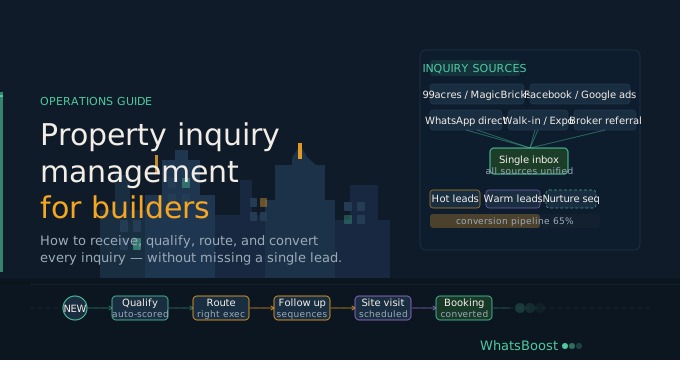
Every inquiry source — 99acres, MagicBricks, Housing.com, Google Ads lead forms, Facebook lead forms, website forms, WhatsApp Business numbers, and offline registration cards — must feed into a single system. If even one source is excluded, that source becomes an invisible lead leak.
The practical implementation involves API integrations with property portals, webhook-based capture from ad platforms, and a dedicated WhatsApp Business number that serves as a single point of entry for direct inquiries. The goal is a unified inbox where no inquiry requires manual entry to appear in the system.
2. Instant Acknowledgement and Pre-Qualification
The first message a prospect receives sets the tone for the entire relationship. Builders who automate instant acknowledgements — within 60 seconds of inquiry submission — perform significantly better on site visit conversion than those who rely on sales teams to initiate contact.
Acknowledgement alone is not enough. The first automated interaction should also begin light qualification: understanding the buyer's configuration preference (1BHK, 2BHK, 3BHK), budget range, timeline, and whether they are an end-user or investor. This information, captured before a salesperson speaks to the prospect, transforms the quality of every subsequent conversation.
3. Intelligent Lead Routing
Not all salespeople should handle all inquiries. High-intent leads — defined by criteria like budget above a threshold, specific configuration request, or second-time inquiry — should be routed to senior closers. Lower-intent or early-stage leads can be handled by junior executives focused on qualification and nurturing.
Routing can also be based on project assignment, geography, language preference, or the lead source itself. A referral from a channel partner is a different kind of inquiry than a Facebook lead ad click, and the initial response should reflect that.
4. Structured Follow-Up Sequences
Research on Indian real estate buyer behavior consistently shows that the decision to purchase a home involves multiple touchpoints over weeks or months. A buyer who inquires today and does not respond immediately is not a dead lead. They may be comparing options, waiting for a financial clearance, or consulting family members.
A structured follow-up sequence keeps the builder present in that decision-making process without requiring salespeople to manually schedule and remember each interaction. Sequences should be defined by lead stage, with different messaging for a lead that has not responded to any contact, a lead that has engaged but not visited, and a lead that has visited but not booked.
5. Pipeline Visibility and Sales Accountability
A builder's sales manager needs to answer three questions at any point in time: How many live inquiries are in the system? Where is each lead in the pipeline? Which leads require immediate action?
Without a system that tracks these in real time, management operates on information that is 24 to 48 hours stale. Decisions about campaign budgets, team staffing, and project positioning are being made on incomplete data.
The Inquiry Lifecycle: From First Message to Booking
The following framework describes the stages that every property inquiry should move through in a well-designed system. Each stage has a defined trigger, a defined action, and a defined handoff.
| Stage | Trigger | System Action | Human Action |
|---|---|---|---|
| New Inquiry | Form submission, WhatsApp message, portal lead | Automatic acknowledgement sent; lead created in CRM | None required immediately |
| Pre-Qualification | Acknowledgement delivered | Automated qualification questions sent via WhatsApp | None required yet |
| Lead Scoring | Qualification responses received | System scores lead based on budget, timeline, intent | Salesperson reviews hot leads within 1 hour |
| Assignment | Score above threshold | Lead auto-assigned to relevant salesperson | Salesperson receives notification with full context |
| First Human Contact | Assignment complete | Reminder sent to salesperson if no contact within 30 minutes | Salesperson calls or messages with context |
| Site Visit Scheduling | Interest confirmed | Automated calendar link or slot options sent | Salesperson confirms booking |
| Pre-Visit Nurturing | Site visit scheduled | Project brochure, location map, testimonials sent automatically | None required |
| Post-Visit Follow-Up | Site visit completed | Automated follow-up sequence initiated | Salesperson calls within 24 hours with specific offer |
| Negotiation | Post-visit interest confirmed | Pricing, payment plan, and documents shared | Senior closer takes over |
| Booking / Lost | Decision made | Booking confirmed or lead marked with loss reason | Reporting updated |
This lifecycle ensures that no lead falls through the cracks between stages. Every handoff is explicit. Every delay triggers a system reminder. Every outcome is recorded.
Where Indian Builders Lose Leads: The Four Failure Points
Builders who analyze their inquiry data carefully find that lead leakage concentrates at four specific points in the process. Understanding these failure points makes it possible to address them systematically rather than reactively.
Failure Point 1: The Response Gap (0 to 60 Minutes)
A buyer who submits an inquiry on a property portal or clicks a WhatsApp ad is, at that moment, at peak interest. They have a question. They want an answer. If they do not receive one within the next 30 to 60 minutes, the momentum dissipates. They browse other listings. They submit another inquiry to a competitor project. They get a call from a broker and agree to a visit.
The response gap is the single highest-impact failure point because it affects every inquiry indiscriminately. Builders who close it with automation — instant WhatsApp acknowledgements that confirm receipt and provide initial project information — convert meaningfully more inquiries into engaged leads than those who depend on salespeople to make the first move.
Failure Point 2: The Qualification Drop-off (Day 1 to Day 3)
Many salespeople are trained to chase hot leads and deprioritize everything that does not respond immediately. This is rational behavior given their workload, but it creates a systematic problem: a large percentage of legitimate buyers require two to four contacts before they engage meaningfully.
A buyer who did not answer a call on Monday afternoon may have been in a meeting. The same buyer, contacted via WhatsApp on Tuesday morning with a specific project update, may respond within minutes. Systems that run multi-channel, multi-day follow-up sequences for all leads — not just the ones that respond quickly — recover a significant number of what would otherwise be lost opportunities.
Failure Point 3: The Post-Visit Silence (Day 3 to Day 14)
A site visit is not a conversion. It is the beginning of the final stage of the decision process. Buyers who visit a project are actively comparing it against other options they have already visited or plan to visit. The builder who maintains the most organized, persistent, and relevant communication in the 7 to 14 days following a visit has a structural advantage.
The failure mode here is salesperson discretion. Without a defined post-visit sequence, the quality of follow-up depends entirely on individual initiative. Some salespeople follow up daily. Others wait to hear from the buyer. The outcome is unpredictable. Systematic post-visit workflows eliminate this variability.
Failure Point 4: The Long-Nurture Abandonment (Week 3 Onwards)
Real estate purchase decisions in India take time. According to ANAROCK's research, the lead-to-booking conversion time for homes priced between ₹1 crore and ₹2 crore averaged 30 days in 2025. For affordable housing, it was 19 days. These timelines mean that a lead that has not converted in two weeks is not a dead lead — it may simply be a slow-moving one.
Builders who abandon nurture sequences after two to three weeks lose a substantial portion of eventual conversions. Buyers in the consideration phase need periodic, value-adding touches: a progress update on the project, a financing option update, a new unit availability notification. These touches keep the project present in the buyer's consideration set without requiring daily manual effort.
The Role of WhatsApp in Property Inquiry Management
WhatsApp is not a separate channel for Indian real estate. It is the default communication medium. Buyers share brochures, floor plans, and payment schedules over WhatsApp. They ask questions, negotiate, and confirm site visits there. They forward property details to family members through the same platform.
This has significant operational implications for builders.
A builder who manages inquiries through a traditional CRM but handles buyer communication manually on WhatsApp has created a gap between their system of record and their actual customer relationships. Conversations happen outside the CRM. Context is lost when salespeople change. Follow-up decisions are made without complete information.
WhatsApp Business API integration solves this by making WhatsApp a managed, trackable channel rather than an informal one. Every message sent and received is logged. Automated sequences can be triggered by CRM events. Salesperson handoffs include the full conversation history. Templates ensure brand consistency across all communications.
The practical workflow looks like this: A lead submits an inquiry through any source. Within 60 seconds, they receive a structured WhatsApp message that acknowledges their interest, confirms the project they inquired about, and asks two to three qualification questions. Their responses flow back into the CRM. A score is assigned. The lead is routed. The assigned salesperson's first call is informed by answers the buyer has already provided.
This is not WhatsApp marketing. It is WhatsApp as an operational infrastructure for inquiry management.
Building the Inquiry Management Stack: What Builders Need
A complete property inquiry management system for a mid-to-large builder is not a single software product. It is a stack of integrated components, each responsible for a specific function.
| Component | Function | What Breaks Without It |
|---|---|---|
| Lead Aggregation | Pulls inquiries from all sources into one system | Portal leads arrive in separate inboxes; some never reach the sales team |
| WhatsApp Business API | Manages buyer communication at scale with tracking | WhatsApp becomes ungovernable; conversations exist on personal phones |
| CRM / Pipeline Tool | Tracks lead stage, history, assignment, and activity | Salespeople manage leads in their own way; no visibility |
| Automated Sequences | Sends pre-defined follow-up messages based on triggers | Follow-up depends on salesperson initiative; inconsistent outcomes |
| Lead Scoring | Prioritizes leads by intent signals | All leads treated equally; hot leads mixed with cold ones |
| Routing Rules | Assigns leads based on defined criteria | Manual assignment creates delays and mismatches |
| Reporting Dashboard | Gives management real-time pipeline visibility | Decisions made on stale or incomplete data |
| Site Visit Scheduler | Allows buyers to self-schedule or confirms slots | Visit scheduling requires back-and-forth calls; drop-offs increase |
Builders who implement all eight components in an integrated fashion create a compound operational advantage. Each component reduces a specific type of lead leakage. Together, they create a system where inquiry volume can scale without proportionally scaling the sales team.
Lead Qualification: The Framework That Saves Sales Team Hours
Not every inquiry deserves the same intensity of follow-up. A buyer who has specified a ₹1.5 crore budget, asked for a 3BHK on a specific floor, and mentioned they want to move in within six months is a fundamentally different lead from someone who clicked a Facebook ad while scrolling and filled a form without reading the project details.
Treating them identically wastes the sales team's most valuable resource: time.
A practical qualification framework for property builders operates on four parameters:
Budget fit. Does the buyer's stated budget align with the project's price range? Significant mismatches do not necessarily disqualify a lead — buyers frequently underestimate budgets — but they do indicate a different kind of conversation.
Timeline. Is the buyer looking to move within three months, within a year, or is this an investment inquiry with no fixed timeline? Immediate buyers need intensive follow-up. Investor inquiries need periodic updates and yield information.
Decision authority. Is the person making the inquiry the decision-maker, or do they need to consult a spouse, parent, or financial advisor? Knowing this shapes the site visit invitation — bringing the full family to the site visit dramatically improves booking probability.
Engagement signals. Has the buyer responded to automated messages? Have they asked specific questions about unit availability, pricing, or possession timelines? These behavioral signals are often more reliable than stated intent.
These four parameters, captured systematically through the initial automated interaction and updated through subsequent exchanges, allow sales teams to allocate their time where it creates the most value.
The Multi-Source Problem: Managing Inquiries from Portals, Ads, and WhatsApp Together
One of the underappreciated operational challenges for Indian builders is the sheer fragmentation of inquiry sources. A developer running an active marketing program might receive inquiries simultaneously from:
- 99acres and MagicBricks (portal leads with varying quality and form data)
- Google Search and Display campaigns (lead form extensions and landing page submissions)
- Facebook and Instagram (Click-to-WhatsApp ads and lead forms)
- YouTube pre-roll ads (landing page submissions)
- Direct WhatsApp messages (organic, referral, and repeat inquiries)
- Broker channel (referrals from channel partners)
- Walk-in registrations at the site office
- Property exhibition registrations
Each source has different data quality, different buyer intent levels, different response expectations, and different follow-up requirements. A portal lead that submitted their contact information has very different expectations than a buyer who clicked a WhatsApp ad and is now in an active conversation.
Managing these intelligently requires source tagging at the point of entry. Every lead that enters the system should carry information about where it came from. This serves two purposes: it allows the sales team to calibrate their initial approach to match source context, and it provides the marketing team with attribution data that informs future campaign decisions.
Builders who track conversion rates by source discover, almost universally, that not all their lead sources are created equal. Some sources generate high volumes of low-quality leads. Others generate fewer leads but at significantly higher conversion rates. Without source-level data, these differences are invisible and marketing budgets are allocated based on volume rather than value.
Sales Team Structure for High-Volume Inquiry Management
The operational design of the sales team matters as much as the technology stack. Builders who treat all salespeople as interchangeable generalists create a system that performs inconsistently regardless of the tools in place.
A more effective model separates inquiry handling into distinct roles:
Inquiry Response Team (IRC). These are the first responders. Their job is speed and initial qualification. They are measured on response time, qualification completion rate, and lead-to-handoff conversion. They do not close deals. They create properly qualified, fully context-loaded opportunities for the closing team.
Site Visit Conversion Team. These salespeople handle qualified leads from the moment a lead agrees to consider a site visit through the visit itself. Their metric is visit-to-booking conversion. They are product experts, relationship builders, and objection handlers.
Post-Visit Nurture Team. For projects with longer decision cycles — premium projects, plots, commercial — a dedicated nurture function prevents post-visit leads from going cold. These team members run structured follow-up sequences, address specific objections, and facilitate the financial and documentation conversations that precede booking.
Not every builder needs three distinct teams. Smaller operations can combine IRC and nurture functions. But the principle — matching role specialization to the stage of the buyer journey — improves performance at every scale.
Metrics That Actually Matter for Inquiry Management
Builders frequently track inquiry volume and booking numbers. The operational gap between those two numbers — where lead leakage actually lives — goes largely unexamined.
The metrics that reveal the health of a property inquiry management system are:
| Metric | What It Reveals | Healthy Benchmark |
|---|---|---|
| First Response Time | How fast the system acknowledges new inquiries | Under 5 minutes (automated), under 30 min (human) |
| Qualification Rate | % of inquiries that complete the qualification process | 40–60% with structured automation |
| Inquiry-to-Site-Visit Rate | % of qualified leads that visit the project | 15–25% depending on project type and price |
| Site-Visit-to-Booking Rate | % of site visits that convert to bookings | 20–35% for well-managed projects |
| Follow-Up Completion Rate | % of leads that receive all defined follow-up touches | Should be 100% — gaps indicate system failure |
| Lead Leakage Rate by Stage | Where in the pipeline leads are dropping | Identifies the specific failure point to address |
| Source-Level Conversion Rate | Which lead sources convert best | Informs marketing budget allocation |
| Average Days to Booking | How long the typical conversion cycle takes | Varies by segment — track trends, not absolute values |
Reviewing these metrics weekly, rather than monthly, gives sales managers the visibility to intervene before leads become permanently cold. A sudden drop in first response time indicates a system failure. A drop in site visit conversion signals a product or pricing problem. Tracking them together creates a diagnostic view of the entire inquiry management operation.
Common Mistakes Builders Make With Inquiry Management
Running campaigns without a system in place. Marketing should not scale ahead of the system's ability to handle the resulting inquiries. Builders who launch high-budget campaigns with manual inquiry handling systematically burn their own marketing investment.
Treating WhatsApp as informal communication. When salespeople manage buyer conversations on personal WhatsApp numbers, the organization has no visibility, no record, and no continuity when team members leave. WhatsApp Business API is not optional for builders managing more than 50 active leads at a time.
Over-investing in CRM features, under-investing in process. A sophisticated CRM with no defined follow-up process still produces inconsistent outcomes. The process must be designed first. The tool implements and enforces it.
Declaring leads dead too early. Research consistently shows that meaningful segments of buyers require six or more touches before responding. Inquiry management systems that mark leads as lost after two failed contact attempts are systematically discarding genuine opportunities.
Ignoring post-visit follow-up. The sale does not end with the site visit. It begins there. Builders who allocate significant resources to getting buyers to the site but have no structured post-visit system lose a disproportionate share of eventual bookings to competitors who do.
Conclusion: The Inquiry Management Advantage
The builders who consistently outperform their peers in conversion do not necessarily have better projects, better locations, or higher marketing budgets. They have better systems for what happens after the inquiry arrives.
Property inquiry management is not a back-office function. It is a core competitive capability. In a market where multiple developers are competing for the same buyer's attention, the organization that responds fastest, qualifies most accurately, routes most intelligently, follows up most consistently, and uses post-visit engagement most effectively will win a disproportionate share of bookings.
The system described in this article is not aspirational. It exists and operates in developer offices across India today. The question for any builder is not whether to build it, but how quickly it can be implemented before the next campaign launches — and the next wave of inquiries arrives that a manual system cannot handle.
WhatsBoost helps real estate builders and developers implement WhatsApp-powered inquiry management systems — from centralized lead capture and automated qualification to structured follow-up sequences and sales pipeline visibility. If your team is managing property inquiries at scale and wants to reduce lead leakage, we can help you design and deploy the right workflow.
Want to automate WhatsApp for your business?
Set up campaigns, replies, and follow-ups in minutes.