WhatsApp as a Lead-Scoring Tool: How Teams Decide Which Leads Get Calls vs Email
Most Indian sales teams decide who gets a call based on gut feel — and lose high-intent leads to competitors who responded first. This guide breaks down how to read WhatsApp behaviour signals as a lead-scoring system, classify every lead into the right response tier automatically, and stop wasting rep time on leads that were never going to convert
Every sales team in India has the same invisible problem.
Leads come in. The pipeline fills up. And then someone has to decide — who gets a call today, who gets an email, and who gets ignored until they follow up again.
Most teams make that decision based on gut feel. Or whoever shouted loudest in the last meeting. Or simply whoever the rep remembered to call.
That's not a sales process. That's organised chaos.
What WhatsApp does — when used correctly — is turn lead scoring from a gut-feel exercise into a behaviour-driven system. One where the lead tells you exactly how serious they are, through actions rather than words, and your team acts on data rather than instinct.
Here's how that actually works.
The Core Problem: Why Indian Sales Teams Score Leads Wrong
Lead scoring isn't a new concept. B2B software companies have been doing it for years with tools like HubSpot and Salesforce. But for most Indian SMBs — coaches, real estate teams, EdTech businesses, service agencies, D2C brands — traditional lead scoring fails for three reasons:
1. The data doesn't exist in one place. Leads come from Instagram DMs, website forms, JustDial, IndiaMART, WhatsApp messages, and referrals — all at once. There's no unified behaviour trail to score from.
2. Email-based scoring is irrelevant here. Traditional scoring models give points for "opened email" or "clicked email link." In India, where WhatsApp open rates hit 98% versus email's 20–24%, email engagement is a weak signal. It tells you almost nothing about actual intent.
3. Scoring happens too late. By the time a CRM tags a lead as "hot," the rep has already wasted two calls on the wrong people — and the actual hot lead has already spoken to a competitor who responded faster.
WhatsApp fixes all three — but only if you build the right signals into the conversation.
What Makes WhatsApp a Natural Lead-Scoring Engine
WhatsApp isn't just a communication channel. Every interaction inside it is a data point.
| WhatsApp Signal | What It Indicates | Score Weight |
|---|---|---|
| Replied within 5 minutes | High intent, actively deciding | Very High |
| Clicked a product link in chat | Specific interest, not just browsing | High |
| Asked about price or timeline | Active evaluation stage | Very High |
| Answered all qualification questions | Engaged, not a tyre-kicker | High |
| Used quick reply buttons | Low friction engagement, comfortable | Medium |
| Opened message but didn't reply | Aware but not ready | Low |
| Stopped responding after Q2 | Likely cold or wrong fit | Negative |
| Replied with voice note | High comfort level, likely serious | High |
| Asked "how soon can we start?" | Purchase-intent language | Very High |
These aren't assumptions. They're behavioural signals that the conversation generates automatically — without your rep having to assess anything manually.
The key insight: a lead's WhatsApp behaviour is more honest than anything they put in a form.
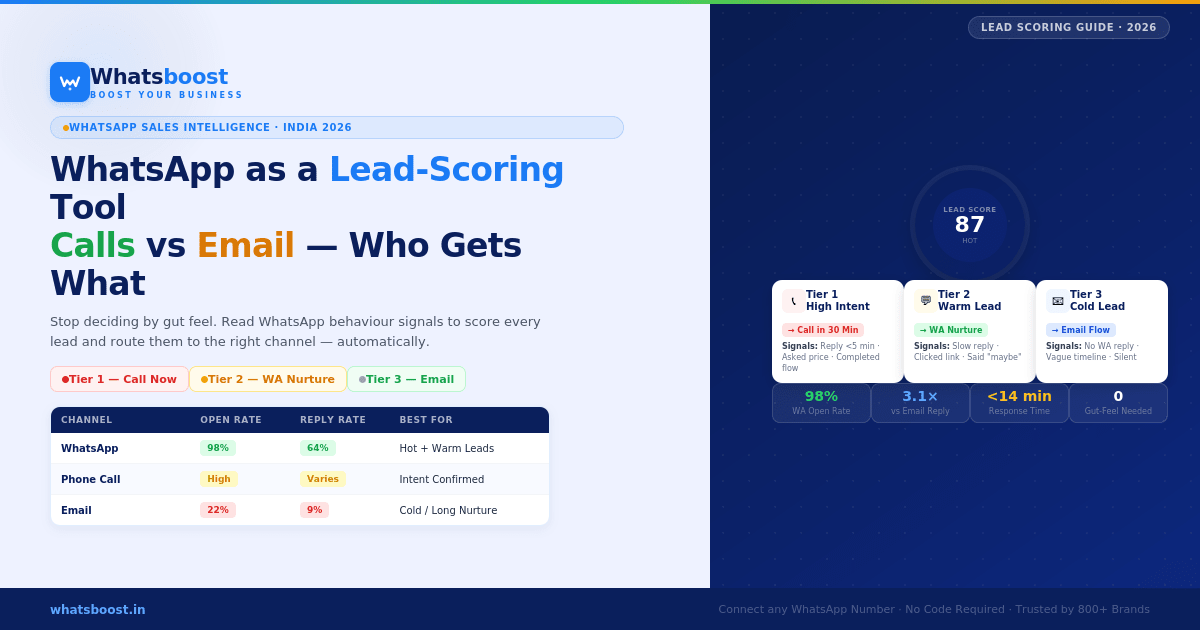
The 3-Tier Lead Classification System
Once you're reading WhatsApp signals correctly, every lead falls into one of three tiers — each requiring a completely different response from your sales team.
🔴 Tier 1 — Call Immediately
Signals:
- Replied within minutes of first contact
- Asked about pricing, onboarding, or timelines
- Completed the full qualification flow
- Used purchase-intent language ("when can we start", "what's included", "do you have slots this week")
- Responded to a follow-up message unprompted
Action: A human rep picks this up within 30 minutes. The conversation context from WhatsApp is shared so the rep doesn't start from zero. This is a closing conversation, not a discovery one.
🟡 Tier 2 — WhatsApp Nurture First, Call Later
Signals:
- Engaged with initial messages but went quiet after Q2 or Q3 of the qualification flow
- Clicked links but didn't ask follow-up questions
- Said "I'll think about it" or "will get back to you"
- Timeline mentioned is 2–4 weeks out
- Replied slowly (24+ hours between messages)
Action: Enter a structured WhatsApp nurture sequence. Not a call — not yet. The lead isn't warm enough for a call to convert, but they're not cold enough to abandon. A well-timed sequence of value messages keeps them in the funnel without burning rep time.
⚪ Tier 3 — Email Sequence or Long-Term Nurture
Signals:
- Never replied to qualification messages
- Opened messages but never interacted
- Completed the form/ad but gave no WhatsApp engagement
- Timeline is "sometime in the future" or vague
- Multiple unanswered follow-ups
Action: Move to email. Not because email is better — it isn't — but because this lead has demonstrated they don't engage on WhatsApp actively right now. Email becomes the low-cost holding channel while WhatsApp is reserved for leads who actually use it.
The Signal Most Teams Miss: Response Time Is the Strongest Score
Indian sales teams obsess over what a lead says. The smarter signal is when they say it.
Response time within a WhatsApp conversation is one of the most reliable intent indicators available — and it costs nothing to track.
- Replied in under 10 minutes → They're on their phone, actively considering. Call window is open right now.
- Replied in 2–6 hours → They checked at a break. Still warm, follow up today.
- Replied next day → Passive interest. WhatsApp nurture is right, call is premature.
- No reply after 48 hours → Move them down a tier unless they re-engage.
This is data your team already has inside every WhatsApp conversation. The problem is that without a system reading it, it disappears into a chat thread that nobody audits.
This is where WhatsApp automation for lead qualification changes the game — not just by asking the right questions, but by tagging and routing leads based on how they respond, not just what they respond with.
WhatsApp vs Email vs Call: Which Channel for Which Lead Stage
This is the decision most sales managers in India never formalise — and it costs them constantly.
| Lead Stage | Best Channel | Why | Avoid |
|---|---|---|---|
| First contact (under 5 min) | 98% open rate, instant, conversational | Cold call — too aggressive | |
| Qualification | WhatsApp (automated) | Non-intrusive, leads self-qualify at their pace | Form or email — too slow |
| Warm follow-up | 64% reply rate, feels personal | Email — 9% reply rate | |
| Intent confirmed | Phone call | Closes faster, builds final trust | Email — too passive for this stage |
| Long-term nurture | Low cost, low friction, good for content | WhatsApp — feels spammy if lead isn't engaged | |
| Re-engagement (cold) | WhatsApp first, then email | Opens the loop without commitment | Cold call — high rejection rate |
| Post-call follow-up | Fast, confirmations and next steps | Email — often missed |
The data from real automations tells a sharp story. WhatsApp delivers a 3.1× higher reply rate than email for follow-ups. Response time drops from 6 hours to 14 minutes when WhatsApp is in the loop. These aren't theoretical gains — they're documented outcomes from businesses running integrated automation workflows that connect WhatsApp behaviour to CRM stage and rep action.
How the Scoring Signals Feed Into Your Pipeline
The scoring system is only as useful as what happens next. Here's how WhatsApp lead signals should map directly to pipeline action — and why most Indian sales teams break it at this exact step.
The typical (broken) flow: Lead messages on WhatsApp → Rep sees it when they check their phone → Rep manually decides what to do → Sometimes acts on it, sometimes forgets → Lead cools → No record of what happened
The scored (working) flow:
Lead messages → Automated qualification starts instantly
↓
Lead completes Q1, Q2, Q3 → Tagged: "Qualified - High Intent"
↓
Response time tracked → Under 5 min → Tagged: "Hot - Call Priority"
↓
Rep receives alert with full context → Calls within 30 minutes
↓
Call logged → CRM updated → Next action triggered automatically
The difference isn't the data — you had the data both times. The difference is whether the data triggers action or disappears.
The reason most Indian businesses lose leads even after the first WhatsApp message is engaged isn't follow-up intention — it's that the signal exists but no system acts on it. A lead who replied in 4 minutes and asked about pricing is sitting in a chat unattended while a rep is calling someone who submitted a form three days ago.
Industry-Specific Scoring Signals That Actually Matter in India
Different businesses need different triggers. Here's what the scoring signals look like across the categories where WhatsApp lead scoring is most impactful:
Real Estate
- High-score signals: Asked for site visit timing, inquired about loan options, mentioned a specific BHK configuration
- Medium-score signals: Clicked project brochure link, asked about location, replied twice in same session
- Low-score signals: Asked generic "what's the price" without follow-up, no response to site visit invitation
EdTech / Coaching
- High-score signals: Asked about batch start dates, mentioned a specific goal, asked "what's the fee structure"
- Medium-score signals: Watched demo video link, asked about faculty, mentioned a competitor they've tried
- Low-score signals: Downloaded free resource, didn't engage with follow-up, said "I'll think about it" more than once
B2B Services
- High-score signals: Asked about deliverables, timelines, team size, mentioned a specific problem they need solved
- Medium-score signals: Replied to case study message, asked for proposal
- Low-score signals: Said "send me details" but hasn't opened the document link
D2C / E-commerce
- High-score signals: Asked about COD, return policy, or delivery time to their pin code
- Medium-score signals: Clicked product image link, asked about variants
- Low-score signals: Replied once to a broadcast, no further engagement
The Re-Engagement Decision: When to Stop Calling and Switch Channels
One of the clearest uses of WhatsApp lead scoring is knowing when to stop calling a lead and shift strategy.
Indian sales reps typically call a lead 5–7 times before giving up. That's expensive and often counterproductive — repeated missed calls from an unknown number actively damage the brand's credibility with the lead.
A scoring system changes that decision:
- 2 unanswered calls + WhatsApp opened but not replied → Stop calling. Send a WhatsApp message instead: "Hey [Name], tried calling a couple of times — no worries at all. Whenever you're free, just reply here and I'll give you all the details."
- 2 unanswered calls + WhatsApp not opened → Lead isn't checking either channel actively. Move to email, reduce follow-up frequency.
- Lead re-opens your last WhatsApp message after 5 days of silence → This is a re-engagement signal. Trigger a fresh follow-up immediately — they're back in consideration mode.
These re-engagement messages on WhatsApp aren't guesswork — when the timing and phrasing are matched to the lead's behaviour stage, response rates increase significantly compared to generic follow-up blasts sent to the entire list.
Building This Into a System: What You Actually Need
This article describes a scoring logic. Executing it requires three things:
1. A WhatsApp automation layer that runs the qualification flow, tracks responses, reads engagement signals, and tags leads automatically — without a rep manually doing any of it.
2. A routing system that takes those tags and either alerts a rep (Tier 1), continues a nurture sequence (Tier 2), or moves the lead to an email workflow (Tier 3) — based on the score, not based on who's checking the chat.
3. CRM integration that ensures the WhatsApp conversation history, the tags, and the score all land in the same place the rep works from — so the first call starts with context rather than a cold introduction.
Whatsboost handles all three without requiring API setup or a dedicated developer. The qualification flows, the automatic tagging based on response behaviour, the rep alerts, and the CRM sync all sit within the same platform — meaning the scoring system described above can be operational within days, not months.
The full pipeline logic — from first WhatsApp contact through score-based routing to rep-managed close — is exactly what a properly structured WhatsApp sales funnel enables at scale, where every lead is handled by the right channel at the right stage rather than whoever the rep checked on last.
The Shift That Changes Everything
Lead scoring on WhatsApp isn't about being clever with technology.
It's about a simple, uncomfortable truth: your sales team's time is finite, and right now, a significant portion of it is being spent on leads that will never convert — while genuinely ready leads wait too long and go elsewhere.
WhatsApp behaviour is the most honest signal available to an Indian sales team in 2026. Leads who reply fast, ask specific questions, and engage with your qualification flow are telling you something. Leads who ghost after the first message are telling you something too.
The question is whether your system is listening.
Want to automate WhatsApp for your business?
Set up campaigns, replies, and follow-ups in minutes.