WhatsApp as a Pre-Sales Chat Tool: How Indian Sales Teams Can Close 2x Faster
Most Indian sales teams lose leads not because of bad products or pricing — but because their pre-sales process is too slow and too manual. This guide breaks down exactly how to use WhatsApp as a structured pre-sales tool to qualify leads automatically, run follow-up sequences without rep involvement, and hand off warm, context-rich leads to your sales team — so they close faster with less effort.
There's a version of sales that most Indian businesses are still running.
A lead comes in. Someone from the team calls. The call doesn't connect. They try again later. The lead has gone cold. Or worse — they've already spoken to a competitor who responded first.
This isn't a talent problem. It isn't a pricing problem. It's a speed and structure problem. And in 2026, with buyers expecting near-instant responses and having multiple options visible on their phones at all times, the gap between getting a lead and losing it has compressed to under 15 minutes.
The businesses that are closing deals faster aren't necessarily the ones with better products or lower prices. They're the ones who show up on WhatsApp — quickly, intelligently, and with a clear pre-sales structure — before the lead's attention moves on.
Why Pre-Sales Is Where Most Indian Sales Cycles Break Down
Pre-sales is the phase that determines everything. It's what happens between a lead expressing interest and a sales rep having a serious conversation with them. It's the qualification, the context-gathering, the trust-building, and the education that decides whether a conversation moves forward or dies quietly.
In most Indian sales teams, this phase is either missing entirely or handled in the most expensive possible way — by having skilled salespeople spend their time asking basic questions that a structured system could handle automatically.
The result is a pipeline full of leads in unknown states. Nobody knows which ones are serious. Nobody knows which ones have been followed up. Reps spend hours on leads who were never going to buy, while high-intent prospects go quiet because the follow-up was too slow or too generic.
This is the reality that most Indian service businesses face after the first WhatsApp message — the first contact happens, the lead shows interest, and then something in the handoff breaks. The follow-through isn't structured enough to hold the lead's attention through the consideration phase.
WhatsApp as a pre-sales tool directly solves this. Not because WhatsApp is magic, but because it's the channel where Indian buyers are most responsive, most comfortable, and most likely to engage with a quick question or a relevant piece of information while they're still in the decision window.
What "Pre-Sales on WhatsApp" Actually Means
Before going further, it's worth being specific about what this looks like in practice — because "using WhatsApp for sales" means very different things to different businesses.
Pre-sales on WhatsApp is not about broadcasting offers. It's not about cold outreach to purchased lists. It's not about sending product catalogs to people who didn't ask.
It's about building a structured conversation layer that activates the moment a lead enters your funnel and guides them — through smart questions, relevant information, and well-timed follow-ups — to the point where a sales conversation is natural and expected rather than cold and intrusive.
Specifically, it involves:
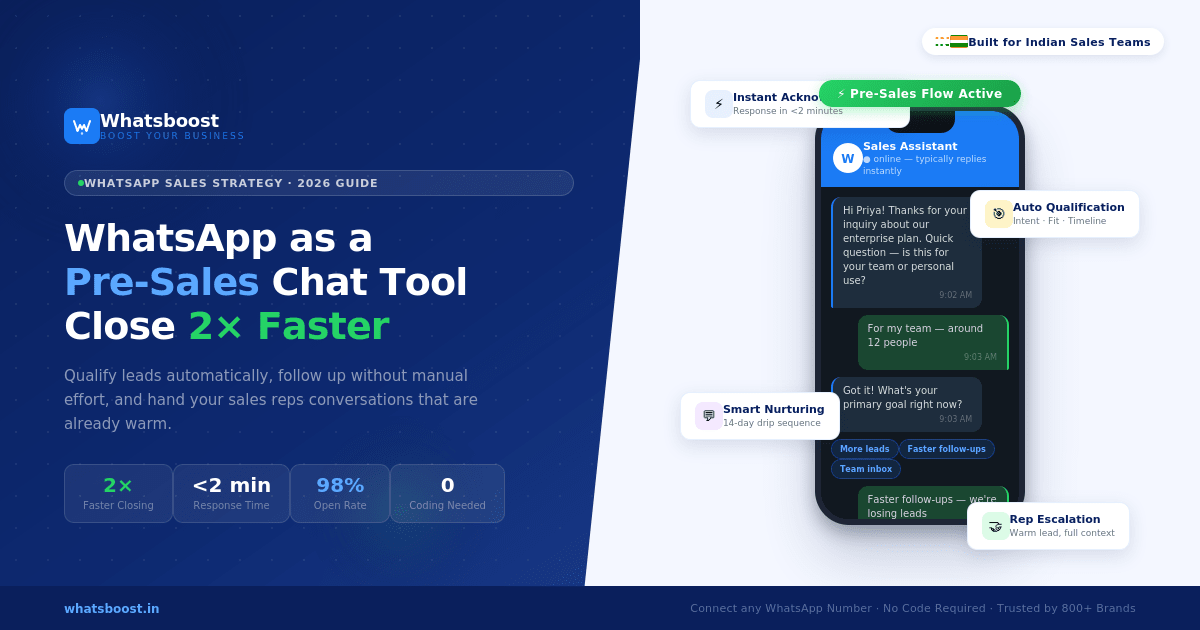
Instant acknowledgement — the moment a lead comes in through any channel (ad, form, website, referral), they receive a WhatsApp message within seconds that confirms their inquiry has been received and sets the expectation for next steps.
Structured qualification — instead of a sales rep calling to ask "so what are you looking for?", the WhatsApp conversation asks those questions first, collects the answers, and delivers a pre-qualified lead to the sales rep with context already gathered.
Drip-based nurturing — leads who aren't ready to buy today but expressed genuine interest receive a sequence of value-adding messages over the following days — a case study, a specific answer to a common question, a comparison — that keeps the brand present without being intrusive.
Intent-based escalation — when a lead takes a specific action (clicks a link, answers a question a certain way, requests a call), the system escalates them to a human sales rep immediately, with the full conversation history so the rep doesn't start from zero.
This entire structure can run largely without human involvement until the moment it makes sense for a human to step in. That's what makes it a multiplier for sales teams rather than just a communication tool.
The Speed Advantage: Why WhatsApp Converts Faster Than Any Other Channel
Indian buyers have a specific behavioral pattern that makes WhatsApp pre-sales particularly powerful.
They research on their phones. They make decisions on their phones. And when they reach out to a business, they're usually doing it between tasks — in a gap during their workday, in the evening, or during a commute. This is not the mental space of someone who wants to fill out a form, wait for an email, or schedule a call for three days later. They want a quick, informative exchange that helps them decide.
WhatsApp fits that mental state exactly. It's already open. It's familiar. The interaction feels conversational rather than transactional. A well-designed pre-sales WhatsApp flow can answer a lead's top three questions, understand their situation, and set up a next step — all within a 10-minute exchange that the lead initiated on their own schedule.
Compare this to the standard sales process: form submission → CRM entry → rep picks it up → call attempt → voicemail → callback → eventual conversation. At each step, time passes. At each step, the lead cools. The average Indian B2B lead makes a shortlist decision within 2-4 hours of initial inquiry. If your pre-sales process takes longer than that to establish meaningful contact, you're already behind.
Speed alone isn't enough, though. The quality of the first interaction matters just as much. A fast but irrelevant response is almost as damaging as a slow one, because it signals that the business doesn't understand what the lead needs.
Building the Pre-Sales Qualification Layer on WhatsApp
The highest-leverage thing most Indian sales teams can do right now is build a WhatsApp qualification flow that runs between the lead's first message and the first sales call.
The goal of this flow is to gather the information that allows a sales rep to have a genuinely useful first conversation — not to close the deal, not to pitch, but to arrive at the call knowing who the lead is, what they need, when they need it, and how serious they are.
A well-designed qualification flow typically covers five dimensions:
Intent — Why is this person reaching out now? What triggered the inquiry? Understanding intent tells you whether this is an exploratory conversation or an active buying decision.
Fit — Is this person the right kind of customer for what you offer? Business size, location, use case, budget range — enough to know whether there's a genuine match before committing sales rep time.
Timeline — Are they deciding this week, this month, or "at some point"? Timeline separates leads who need immediate attention from those who need a nurturing sequence.
Authority — In B2B sales, is the person you're talking to the decision-maker, or do they need to involve others? Knowing this early changes the entire direction of the sales conversation.
Previous experience — Have they tried other solutions? Are they switching from a competitor? This context shapes how you position your offer.
A WhatsApp bot can gather all of this in a friendly, conversational way — using quick reply buttons, simple questions, and short messages — in under five minutes of a lead's time. The output is a qualified, contextualized lead that lands in a sales rep's queue ready for a meaningful conversation.
This is exactly the kind of structured approach that WhatsApp automation for lead qualification enables — where instead of raw inquiries sitting in a chat or CRM waiting for a rep to manually investigate, they arrive pre-sorted, tagged, and ready to be worked.
The Follow-Up Problem That WhatsApp Solves Permanently
If there's one area where Indian sales teams leak the most revenue, it's follow-ups.
Not because salespeople don't know that follow-ups matter. Everyone knows. The problem is capacity. A single rep managing 50 active leads cannot follow up with each one at the right time, with the right message, in a way that feels personal rather than mechanical.
So what happens? The loudest leads get attention. The leads who are easy to reach get called. The quiet ones — sometimes the most serious ones — get left in the pipeline until they either reach out again or go to someone else.
WhatsApp-based follow-up automation eliminates this entirely. Once a lead is in the system, follow-ups happen automatically based on their behavior and timeline — not based on whether a rep remembered to check their CRM.
A lead who didn't respond to the initial qualification flow gets a gentle nudge 24 hours later. A lead who started the qualification but didn't finish gets a message that picks up exactly where they left off. A lead who expressed interest but said they'd decide in two weeks gets a timed sequence that delivers value across those two weeks without requiring any rep intervention.
When a lead takes a high-intent action — clicking a pricing link, asking about a specific feature, or saying "yes, I'm interested in moving forward" — that triggers an immediate escalation to a human rep with a full briefing on the conversation history.
This is the infrastructure that sales teams use to manage real-time lead alerts and smart follow-up sequences at scale — ensuring that no lead is dropped, no follow-up is forgotten, and every rep spends their time on conversations that have already been warmed up.
How to Structure Your Pre-Sales WhatsApp Flow: A Practical Framework
Most businesses that try WhatsApp pre-sales without a structure end up with a collection of disconnected messages rather than a system. Here's a framework that works across industries — real estate, education, B2B services, financial products, and high-consideration consumer purchases.
Stage 1: Instant Acknowledgement (0-2 minutes after inquiry)
The moment a lead enters your funnel, a WhatsApp message goes out immediately. This message should confirm receipt, set an expectation for next steps, and ask one simple question that begins the qualification. Keep it warm, specific, and short. Not "Thank you for your inquiry. We will contact you shortly." — but "Hi [Name], thanks for reaching out about [specific thing]. Quick question to help us give you the most relevant information — are you looking for this for personal use or your business?"
That first question does two things. It starts the qualification process. And it establishes that this isn't a generic autoresponse — this conversation feels like it's going somewhere.
Stage 2: Qualification Flow (2-10 minutes)
Using quick reply buttons and two to three short questions, collect the five qualification dimensions mentioned earlier. Keep each message to one question. Use buttons wherever possible — they reduce friction and get faster responses than open-ended text fields. By the end of this flow, you know exactly who you're dealing with.
Stage 3: Intelligent Routing (immediate)
Based on qualification answers, leads get routed to one of three tracks. High-intent, well-qualified leads get immediately flagged for sales rep follow-up. Interested but not-ready leads enter a nurturing sequence. Leads who are clearly not a fit receive a polite response that closes the conversation gracefully.
Stage 4: Nurturing Sequence (days 1-14)
For leads in the nurturing track, a sequence of messages goes out over the following two weeks. Day one: a relevant case study or result. Day three: an answer to a common question in your category. Day five: a soft invitation to have a conversation when they're ready. Day ten: a new development, offer, or relevant piece of content. Day fourteen: a final gentle check-in.
None of these messages feel like marketing. They're each a single useful piece of information. The cumulative effect is that the lead feels informed and remembered — which is exactly the mental state that makes a sales conversation easy to have.
Stage 5: Human Escalation (behavior-triggered)
At any point in the flow, when a lead takes a high-intent action, the automation hands off to a human immediately. The rep receives the full conversation context and can pick up the conversation without asking questions the lead has already answered.
Building this kind of end-to-end funnel is exactly what a well-structured WhatsApp sales funnel with AI enables — where the automation handles the pre-sales heavy lifting and your sales team focuses only on the conversations that are ready to be closed.
Industry-Specific Pre-Sales Patterns That Work in India
The framework above applies broadly, but the specifics change significantly by industry. Here's how pre-sales WhatsApp structures look in the categories where Indian sales teams are seeing the highest impact.
Real Estate
The buying decision timeline in real estate is long, but the window of highest intent is very narrow — the days immediately after a site visit or inquiry. A pre-sales WhatsApp flow in real estate acknowledges the inquiry instantly, asks about budget range, preferred location, and timeline using buttons, and then sends a curated selection of options based on those answers. High-intent leads (those who ask follow-up questions or click on specific listings) are escalated to the relationship manager within minutes. The nurturing track sends project updates, new launches, and market insights over weeks — keeping the brand present through the full consideration cycle.
Education and Coaching
In education sales, the first message a student or parent sends is almost always a question rather than a purchase intent. The pre-sales flow acknowledges that question, gathers context (which course, which batch, what goal, what timeline), and then delivers specific, useful information. The qualification phase segments serious prospects from casual explorers. Sales reps only engage with the prospects who have answered three or more qualification questions — a strong signal of genuine interest. The nurturing track includes student testimonials, faculty introductions, and outcome data.
B2B Services
In B2B, speed matters but so does relevance. A pre-sales WhatsApp flow for a B2B service business should qualify company size, specific need, current solution, and timeline in the first exchange. The nurturing track should be category-specific — a digital marketing agency should send performance benchmarks and case studies, not generic marketing content. The escalation trigger should be a specific question about pricing or process, which signals active evaluation.
Financial Products
Financial pre-sales WhatsApp flows need to be particularly careful about compliance and trust-building. The qualification phase should focus on goals and situation rather than financial details. The nurturing track should build credibility through relevant information — how the product works, who it's for, what outcomes to expect — before any sales conversation happens.
The Compounding Effect: Why This Doubles Closing Speed
The reason this approach closes deals faster isn't one big thing — it's the compounding effect of several small improvements happening simultaneously.
Response time goes from hours to seconds. Qualification happens in the background before the sales rep is involved. Every follow-up lands at the right time with the right message. Reps spend their time only on conversations that have been warmed up. No leads fall through the cracks. No context is lost between the inquiry and the call.
Each of these improvements on its own is meaningful. Together, they change the entire character of the sales process — from reactive and labor-intensive to proactive and systematic.
For growing sales teams specifically, this is where the most value is concentrated. A team of three reps running a structured WhatsApp pre-sales system can handle the lead volume that would typically require six, because the system handles everything up to the conversation that only a human can have.
This is the principle behind building a WhatsApp funnel that actually converts at scale for small Indian businesses — not just automating messages, but systematizing the entire pre-sales journey so that human attention is reserved for the moments that require it.
Where Whatsboost Fits Into This
Every part of the pre-sales structure described in this article — instant acknowledgement, qualification flows, behavior-based routing, timed nurturing sequences, and human escalation — requires a platform that can run these workflows on top of WhatsApp without requiring API-level technical setup.
Whatsboost is built specifically for this. The platform allows sales teams to design their entire pre-sales flow visually, connect it to their existing lead sources, and have the full system running without any development work. Lead routing, drip sequences, shared team inbox, conversation tagging, and rep escalation notifications are all part of the same environment.
For teams that are currently managing WhatsApp leads manually — copying numbers, forwarding chats, tracking follow-ups in spreadsheets — the shift to a structured pre-sales system on Whatsboost changes the entire experience of sales operations. Not gradually — immediately.
If you want to see what your specific pre-sales flow could look like before committing to a full setup, booking a demo with the Whatsboost team is the fastest way to map your lead journey to a working WhatsApp system.
The Shift That Changes Everything
Closing faster isn't about pressure tactics or relentless follow-up calls. It's about being present at the right moments, with the right information, without making the lead feel chased.
WhatsApp pre-sales, when built correctly, creates the conditions where buying feels easy. The lead has been answered quickly. They've been understood. They've been given relevant information across the consideration phase. By the time a sales rep talks to them, the decision is already mostly made.
Indian sales teams that build this infrastructure in 2026 won't just close faster. They'll close more, with less effort, and with customers who feel genuinely informed rather than sold to.
That's the version of sales that actually scales.
Want to automate WhatsApp for your business?
Set up campaigns, replies, and follow-ups in minutes.