WhatsApp Automation Solutions for Customer Onboarding and Follow-Ups
Learn how WhatsApp automation helps businesses streamline customer onboarding, automate follow-ups, reduce lead leakage, and build scalable customer engagement workflows that improve conversions and retention.
Most businesses don't lose customers because of poor products or services.
They lose customers because their onboarding and follow-up processes break down.
A prospect submits an inquiry form but doesn't receive a response for several hours. A sales executive forgets to follow up after a consultation call. A customer completes a purchase but receives no guidance on what happens next. A lead that showed strong buying intent simply disappears because nobody followed up at the right time.
These situations are far more common than most businesses realize.
For many Indian MSMEs, SMBs, educational institutions, clinics, agencies, and service providers, customer onboarding still depends heavily on manual communication. Leads arrive through websites, social media, referrals, advertisements, or WhatsApp itself. Teams then rely on spreadsheets, shared inboxes, and memory to manage the next steps.
As customer volume grows, this approach becomes unsustainable.
This is where WhatsApp automation changes the equation.
Instead of relying on employees to remember every interaction, businesses can create structured onboarding and follow-up systems that automatically guide prospects and customers through every stage of the journey.
The result is not simply faster communication. It is a more reliable operational process that reduces lead leakage, improves customer experience, and creates consistency at scale.
Why Customer Onboarding Is an Operational Challenge, Not a Communication Challenge
Many businesses view onboarding as a communication task.
In reality, onboarding is a process management challenge.
Every new lead or customer needs to move through a sequence of steps before becoming fully engaged.
These steps may include:
Information collection
Appointment scheduling
Product demonstrations
Document submission
Payment confirmation
Account activation
Training and orientation
Support assistance
When these activities are managed manually, bottlenecks quickly emerge.
A business may respond quickly to one customer while accidentally neglecting another. Different team members may follow different processes. Customers may receive inconsistent information depending on who handles their inquiry.
The issue is not the willingness to serve customers.
The issue is the absence of a structured onboarding system.
WhatsApp automation helps businesses standardize these interactions while reducing dependence on manual effort.
The Customer Activation Pipeline
Most businesses focus heavily on lead generation but pay less attention to what happens after a lead enters the system.
A more effective approach is to view onboarding as a customer activation pipeline.
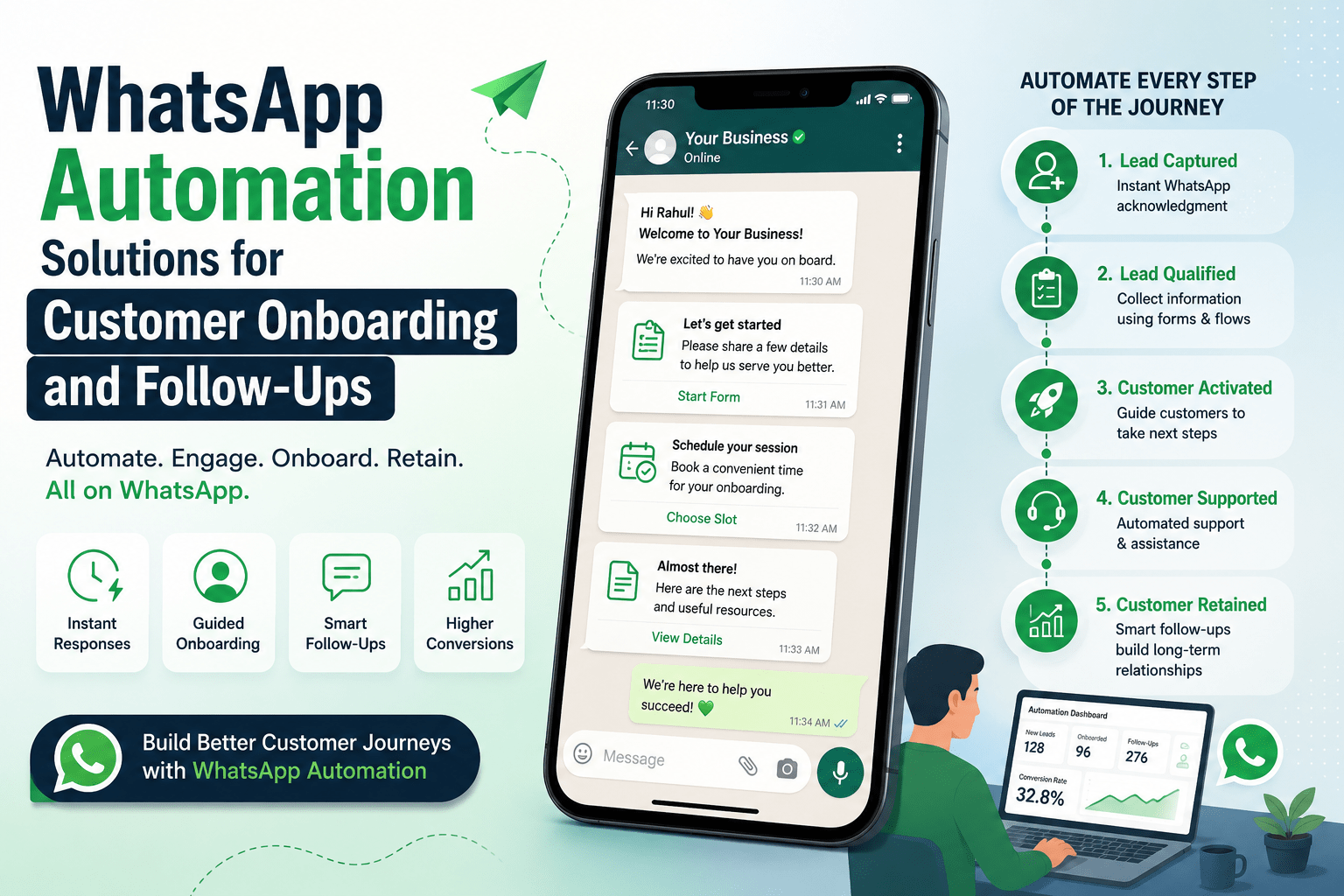
| Stage | Objective | Automation Opportunity |
|---|---|---|
| Lead Captured | Prevent lead leakage | Instant WhatsApp acknowledgment |
| Lead Qualified | Gather relevant information | Automated forms and workflows |
| Customer Activated | Move customer to next step | Guided onboarding sequence |
| Customer Supported | Answer questions and remove friction | Automated support workflows |
| Customer Retained | Maintain engagement | Follow-up campaigns and reminders |
This framework helps businesses understand that onboarding is not a single event.
It is a progression of connected interactions.
Each stage presents an opportunity for automation.
How WhatsApp Automation Improves Customer Onboarding
The biggest advantage of WhatsApp is that customers are already comfortable using it.
Unlike emails that may go unread or portals that require separate logins, WhatsApp conversations feel immediate and familiar.
Businesses can automate onboarding activities such as:
Welcome messages
Customer information collection
Appointment confirmations
Product walkthroughs
Document requests
Payment instructions
Training schedules
Feedback collection
For example, a coaching institute receiving a new admission inquiry can automatically send a welcome message, collect course preferences, schedule a counseling session, and share course brochures without requiring immediate human intervention.
Similarly, a healthcare clinic can automate appointment confirmations, document collection, and pre-consultation instructions.
The goal is not to eliminate human interaction.
The goal is to eliminate repetitive administrative work.
Why Manual Follow-Ups Often Fail
Most follow-up failures occur because businesses depend on human memory.
A sales representative intends to call a prospect next week but gets distracted by other priorities. A service provider forgets to check whether a proposal was reviewed. A consultant delays sending additional information after an inquiry.
Over time, these missed actions accumulate.
This creates a hidden cost that many businesses fail to measure.
| Manual Follow-Up Challenge | Business Impact |
|---|---|
| Delayed responses | Lower conversion rates |
| Missed follow-ups | Lost revenue opportunities |
| Inconsistent communication | Poor customer experience |
| Lack of visibility | Difficulty tracking lead status |
| Employee dependency | Operational risk |
Businesses often assume they have a marketing problem when the real issue is a follow-up problem.
Before investing more money in lead generation, organizations should evaluate how many existing opportunities are being lost because of inconsistent follow-up processes.
The Shift from Reminder-Based Follow-Ups to Workflow-Based Follow-Ups
Many businesses think automation means sending reminders.
Modern automation goes much further.
Instead of creating isolated messages, businesses can build complete communication workflows.
For example:
Lead submits inquiry →
Instant acknowledgment →
Information collection →
Consultation scheduling →
Reminder before meeting →
Follow-up after consultation →
Proposal sharing →
Payment reminder →
Customer onboarding
Each interaction is triggered automatically based on customer actions and predefined business rules.
This creates a predictable system that functions consistently regardless of employee workload.
Businesses looking to create these automated journeys can leverage behavior-driven workflows where customer actions determine the next communication step rather than relying on static messaging sequences.
https://whatsboost.in/blog/behavior-based-whatsapp-automation-using-forms-whatsboost
Customer Onboarding Maturity Model
Organizations typically evolve through several stages before building a fully automated onboarding system.
| Stage | Process Style | Primary Challenge |
|---|---|---|
| Manual | Team members manage everything manually | High dependency on people |
| Assisted | Templates and reminders support teams | Limited scalability |
| Structured | Standardized onboarding workflows | Process adoption |
| Automated | Workflow-driven onboarding | Continuous optimization |
| Intelligent | Data-driven personalization | Advanced orchestration |
Many businesses currently operate between the first and second stages.
The opportunity lies in moving toward structured and automated systems that scale more efficiently.
Key Use Cases Across Industries
WhatsApp onboarding automation is not limited to a specific sector.
Different industries use similar workflow principles to solve different operational challenges.
| Industry | Onboarding Use Case |
|---|---|
| Educational Institutions | Admission inquiry management |
| Healthcare Clinics | Patient onboarding and appointment preparation |
| Real Estate | Property inquiry qualification |
| Agencies | Client onboarding and project initiation |
| Consultants | Discovery call scheduling |
| Financial Services | Document collection and verification |
| Training Institutes | Course enrollment workflows |
| Service Businesses | Customer activation and support |
Although the industries differ, the underlying objective remains the same:
Move customers smoothly from interest to engagement.
How WhatsApp Flows Improve Onboarding Efficiency
Traditional onboarding often involves multiple back-and-forth conversations.
Customers ask questions.
Businesses request information.
Forms are shared.
Documents are collected.
Appointments are scheduled.
This process can quickly become fragmented.
Structured WhatsApp Flows help simplify these interactions by guiding customers through predefined onboarding journeys within WhatsApp itself.
Instead of repeatedly asking customers for information, businesses can create streamlined experiences that collect data, confirm actions, and route inquiries more efficiently.
The result is a smoother customer experience and reduced operational workload.
How CRM Integration Strengthens Follow-Up Automation
Automation becomes significantly more powerful when customer conversations connect with business systems.
Without integration, businesses often maintain separate records across WhatsApp, spreadsheets, emails, and CRM platforms.
This creates information silos.
When WhatsApp communication integrates with customer records, businesses gain:
Better lead visibility
Improved tracking
Automated status updates
More accurate reporting
Faster team collaboration
The objective is not simply storing customer information.
It is ensuring that every interaction contributes to a unified customer journey.
Common Mistakes Businesses Make When Automating Onboarding
Automating messages without automating processes
Automation should support business workflows rather than simply increasing message volume.
Collecting excessive information upfront
Customers are more likely to complete onboarding when information collection is gradual and relevant.
Ignoring follow-up logic
Not every customer requires the same communication sequence.
Failing to define ownership
Automation should clarify when human intervention becomes necessary.
Treating onboarding as a one-time activity
Customer onboarding often extends beyond the initial purchase or registration.
Measuring Success Beyond Message Delivery
Many businesses evaluate automation success using delivery rates or response rates.
These metrics provide only partial visibility.
More meaningful indicators include:
Lead-to-customer conversion rate
Customer activation rate
Time-to-onboard
Follow-up completion rate
Customer retention rate
Support ticket reduction
Revenue generated per onboarding workflow
These metrics focus on business outcomes rather than communication activity.
The Future of Customer Onboarding and Follow-Ups
Customer expectations continue to evolve.
People increasingly expect immediate responses, personalized communication, and frictionless experiences.
Businesses that rely entirely on manual processes will find it increasingly difficult to meet these expectations consistently.
The future of onboarding lies in combining:
WhatsApp automation
Workflow automation
CRM integration
AI-assisted communication
Customer behavior tracking
to create operational systems that scale without sacrificing personalization.
The businesses that gain the greatest advantage will not necessarily be the ones sending more messages.
They will be the ones building better systems.
WhatsApp automation is ultimately not about messaging.
It is about creating reliable customer journeys that ensure every lead, prospect, and customer receives the right information at the right time without depending entirely on manual effort.
Frequently Asked Questions
What is customer onboarding automation?
Customer onboarding automation is the process of automatically guiding prospects and customers through onboarding steps such as information collection, appointment scheduling, document submission, training, and activation using predefined workflows.
Why is WhatsApp effective for customer onboarding?
WhatsApp provides direct, familiar, and highly accessible communication. Customers are more likely to engage with onboarding instructions and follow-up messages delivered through WhatsApp than through many traditional channels.
Can WhatsApp automation replace human follow-ups?
Not entirely. Automation handles repetitive and predictable interactions while human teams focus on complex conversations, relationship building, and decision-making.
How many follow-ups should businesses automate?
The ideal number depends on the sales cycle and customer journey. Instead of focusing on quantity, businesses should design follow-ups around customer actions and milestones.
Which industries benefit most from onboarding automation?
Educational institutions, healthcare providers, agencies, consultants, financial service firms, real estate businesses, training companies, and service providers can all benefit significantly from onboarding automation.
What is the difference between onboarding automation and marketing automation?
Marketing automation focuses on generating and nurturing leads. Onboarding automation focuses on guiding prospects and customers through the steps required to become active, successful customers.
Want to automate WhatsApp for your business?
Set up campaigns, replies, and follow-ups in minutes.