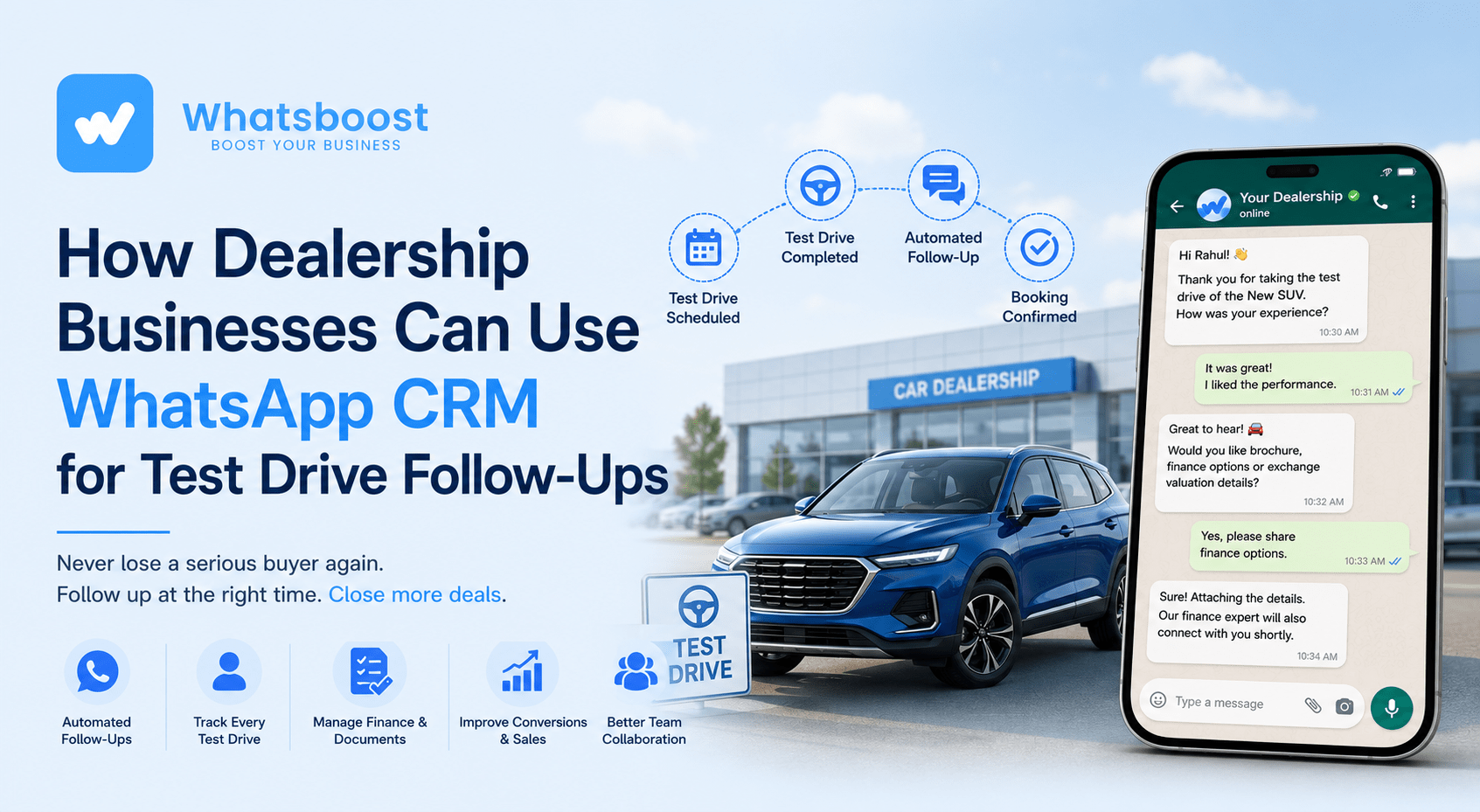
How Dealership Businesses Can Use WhatsApp CRM for Test Drive Follow-Ups
Discover how dealership businesses can use WhatsApp CRM to automate test drive follow-ups, track customer journeys, manage finance and exchange requests, and improve booking conversions. Learn practical workflows that help sales teams respond faster, reduce missed opportunities, and deliver a better customer experience.
A customer walks into a dealership on Saturday afternoon, spends 45 minutes comparing two SUVs, takes a test drive, says, "I'll discuss it with my family and get back to you," and leaves.
Three days later, another dealership calls first.
The sale is gone.
This isn't because the vehicle wasn't good or the price wasn't competitive. It happens because most dealerships don't have a structured follow-up system after the test drive. Sales executives rely on memory, handwritten notes, or personal WhatsApp chats. Once weekend traffic piles up, yesterday's prospects quickly disappear beneath today's enquiries.
WhatsApp is already where most buyers prefer to communicate. The missing piece is turning WhatsApp into a CRM-driven follow-up system instead of another messaging app.
Why Test Drive Follow-Ups Matter More Than Lead Generation
Most dealerships invest heavily in generating enquiries through:
Google Ads
Meta Ads
Car portals
OEM campaigns
Walk-ins
Referral programs
But the highest-intent prospect is the person who has already taken a test drive.
They have:
Seen the vehicle
Experienced the drive
Discussed pricing
Asked financing questions
Invested time
Losing these prospects because nobody followed up consistently is one of the costliest operational leaks in automobile retail.
The problem usually isn't the first conversation.
It's everything that happens afterwards.
Where Dealership Follow-Ups Usually Break Down
Most dealerships experience similar operational gaps.
| Breakdown | Root Cause | Business Impact |
|---|---|---|
| Test drive completed but no follow-up | Salesperson becomes busy with new walk-ins | Prospect buys elsewhere |
| Different executives contact the same customer | No shared customer history | Poor customer experience |
| Finance documents requested multiple times | Conversations scattered across personal chats | Delays in loan processing |
| Exchange valuation status unclear | No milestone tracking | Customer frustration |
| Booking reminders forgotten | Manual follow-up process | Lower booking conversions |
These aren't marketing problems.
They're workflow management problems.
Turning WhatsApp Into a Dealership CRM
Instead of treating WhatsApp as a messaging app, every conversation should represent a sales stage.
A customer journey typically looks like this:
| Stage | Trigger | Information Captured | Next Action |
|---|---|---|---|
| New Enquiry | Customer fills form or messages dealership | Vehicle interest, city, preferred branch | Auto acknowledgement |
| Qualification | Sales executive contacts customer | Budget, variant, purchase timeline | Schedule showroom visit |
| Test Drive | Customer visits dealership | Preferred date & time | Confirm appointment |
| Test Drive Completed | Drive finished | Customer feedback, objections | Automated follow-up sequence |
| Finance / Exchange | Customer interested | Loan requirement, exchange vehicle | Document checklist |
| Booking | Customer confirms | Booking amount, preferred delivery | Delivery preparation |
| Delivery | Vehicle handed over | Registration details | Ownership engagement |
Instead of asking "Who should call this customer?", the CRM asks:
"Which milestone is pending?"
That single shift changes dealership operations.
The Most Important Stage: After the Test Drive
This is where many dealerships lose buyers.
Immediately after the test drive, customers usually need time to:
Compare competitors
Discuss finances
Talk with family
Evaluate exchange offers
Finalize loan options
Silence during this period often results in losing the sale.
A WhatsApp CRM keeps communication active without becoming intrusive.
A structured follow-up could look like this:
| Timeline | WhatsApp Action |
|---|---|
| Immediately after test drive | Thank customer and request feedback |
| Day 2 | Share brochure, feature comparison, financing options |
| Day 4 | Address common questions or objections |
| Day 7 | Offer updated exchange valuation or finance assistance |
| Day 10 | Check purchase decision politely |
| Day 15 | Escalate to senior sales manager if still undecided |
The objective isn't to send more messages.
It's to send the right message at the right stage.
Automating Test Drive Follow-Ups
Automation doesn't replace salespeople.
It ensures prospects never disappear because someone forgot.
| Trigger | WhatsApp Automation |
|---|---|
| Test drive completed | Thank-you message with executive contact |
| Finance requested | Send loan document checklist |
| Exchange requested | Ask customer to upload vehicle details |
| No response for 3 days | Reminder assigned to sales executive |
| Appointment missed | Reschedule automatically |
| Booking confirmed | Share payment acknowledgement and next steps |
Each automation reduces manual work while keeping communication consistent.
Managing Finance and Exchange Conversations
Buying a vehicle usually involves multiple parallel discussions.
For example:
Vehicle variant
Loan approval
Down payment
Exchange valuation
Insurance
Accessories
Delivery timeline
Without a CRM, these discussions become fragmented across calls, Excel sheets, and individual WhatsApp chats.
A WhatsApp CRM keeps everything linked to the same customer record.
For instance:
| Process | WhatsApp Workflow |
|---|---|
| Loan processing | Request income documents securely |
| Exchange vehicle | Collect photos before inspection |
| Insurance | Share premium quotations |
| Accessories | Send catalogue after booking |
| Delivery | Share registration and delivery updates |
Every update becomes visible to the dealership team instead of remaining inside one employee's phone.
Integrating WhatsApp With the Dealership Workflow
The most effective setup connects WhatsApp with the dealership's existing systems instead of replacing them.
A practical workflow looks like:
WhatsApp → Automation Layer → CRM → DMS/ERP → Finance Team
This allows events such as:
Test drive completed
Finance approved
Exchange valuation updated
Booking confirmed
Vehicle allocated
to automatically update customer records.
If you're building these workflows, the trigger-based automation patterns explained in WhatsBoost's n8n WhatsApp Integration Guide can be adapted to dealership processes. Likewise, dealerships already using systems like Zoho CRM or HubSpot can synchronize customer conversations using WhatsBoost's CRM integration approach without changing their existing CRM.
Assigning Ownership at Every Stage
Even a small dealership benefits from clearly defined responsibilities.
| Role | Responsibility |
|---|---|
| Lead Coordinator | Assigns enquiries immediately |
| Sales Executive | Handles qualification and test drive |
| Finance Executive | Loan documentation and approvals |
| Exchange Manager | Vehicle inspection and valuation |
| Delivery Coordinator | Registration and handover |
When ownership is clearly defined, prospects don't fall through the cracks because everyone assumes someone else will follow up.
Measuring What Actually Improves Sales
Instead of measuring only leads generated, dealerships should monitor operational metrics.
Examples include:
Test drive-to-booking conversion rate
Average follow-up response time
Missed follow-up percentage
Loan approval turnaround time
Exchange valuation completion time
Booking conversion after automated reminders
These metrics reveal whether follow-up discipline is improving—not just whether marketing is generating more enquiries.
A Typical Return on Investment
Consider a dealership conducting around 180 test drives each month.
If only 10 additional customers convert because every prospect receives timely, structured follow-ups, the revenue impact can significantly outweigh the cost of implementing a WhatsApp CRM.
The benefits extend beyond additional sales:
Faster response times
Better customer experience
Higher executive accountability
Complete communication history
Reduced dependency on individual salespeople
Consistent follow-up across every branch
The real value lies in creating a repeatable sales process rather than relying on individual memory.
Getting Started Without Overcomplicating It
Most dealerships don't need to automate every customer interaction on day one.
A practical rollout looks like:
Start with one showroom or one vehicle category.
Automate only the post-test-drive follow-up sequence first.
Add finance and exchange document workflows.
Integrate customer status with the dealership CRM.
Review conversion rates after 30 days and expand gradually.
Small operational improvements after the test drive often produce bigger sales gains than spending more on generating new leads. By turning WhatsApp into a structured CRM workflow, dealerships can ensure every interested buyer receives timely, consistent follow-up—making it far less likely that a potential sale is lost simply because no one reached out at the right time.
Want to automate WhatsApp for your business?
Set up campaigns, replies, and follow-ups in minutes.