How Indian Factories Use WhatsApp Automation for Shift Scheduling and Attendance Tracking
Factories often struggle with shift communication, attendance tracking, overtime coordination, and workforce visibility. This article explores how Indian manufacturers are using WhatsApp automation to streamline workforce operations and improve productivity.
Every manufacturing unit runs on coordination.
Machines, raw materials, supervisors, production targets, and workers all need to operate in sync. Even small communication delays can impact production schedules, labor utilization, and operational efficiency.
For many Indian factories, workforce communication remains surprisingly manual.
Shift rosters are shared through notice boards, attendance records are updated manually, supervisors make dozens of phone calls to confirm worker availability, and last-minute shift changes create confusion across departments.
As factories scale, these communication challenges become operational bottlenecks.
Increasingly, manufacturers are turning to WhatsApp automation to simplify workforce coordination, improve attendance visibility, and streamline shift management.
The goal is not merely sending messages.
The goal is building a more responsive workforce communication system.
Why Traditional Shift Management Creates Operational Challenges
Many factories still rely on combinations of:
Printed shift schedules
Excel sheets
Phone calls
SMS communication
Manual attendance registers
These methods work at small scale but become difficult to manage as workforce size increases.
Common challenges include:
Shift Communication Delays
Workers may not receive schedule updates on time.
Changes due to maintenance, production demands, absenteeism, or overtime requirements often require supervisors to contact employees individually.
Attendance Visibility Issues
Production managers may not have real-time visibility into:
Who reported to work
Who is absent
Which shifts are understaffed
Workforce availability for overtime
Manual Coordination Burden
Supervisors spend significant time:
Calling employees
Confirming attendance
Managing replacements
Coordinating shift swaps
This reduces the time available for actual production management.
The Shift From Manual Coordination to Automated Workforce Communication
Manufacturers increasingly recognize that workforce management is fundamentally a communication challenge.
When employees receive timely information and managers have better visibility, operational efficiency improves.
WhatsApp provides a communication channel already familiar to workers across skill levels.
Automation adds structure, consistency, and scalability.
Instead of manually coordinating every interaction, factories can automate routine workforce communication processes.
How WhatsApp Automation Supports Shift Scheduling
A shift schedule is more than a timetable.
It is an operational workflow that affects labor allocation, production planning, and workforce utilization.
WhatsApp automation helps ensure schedules reach employees quickly and consistently.
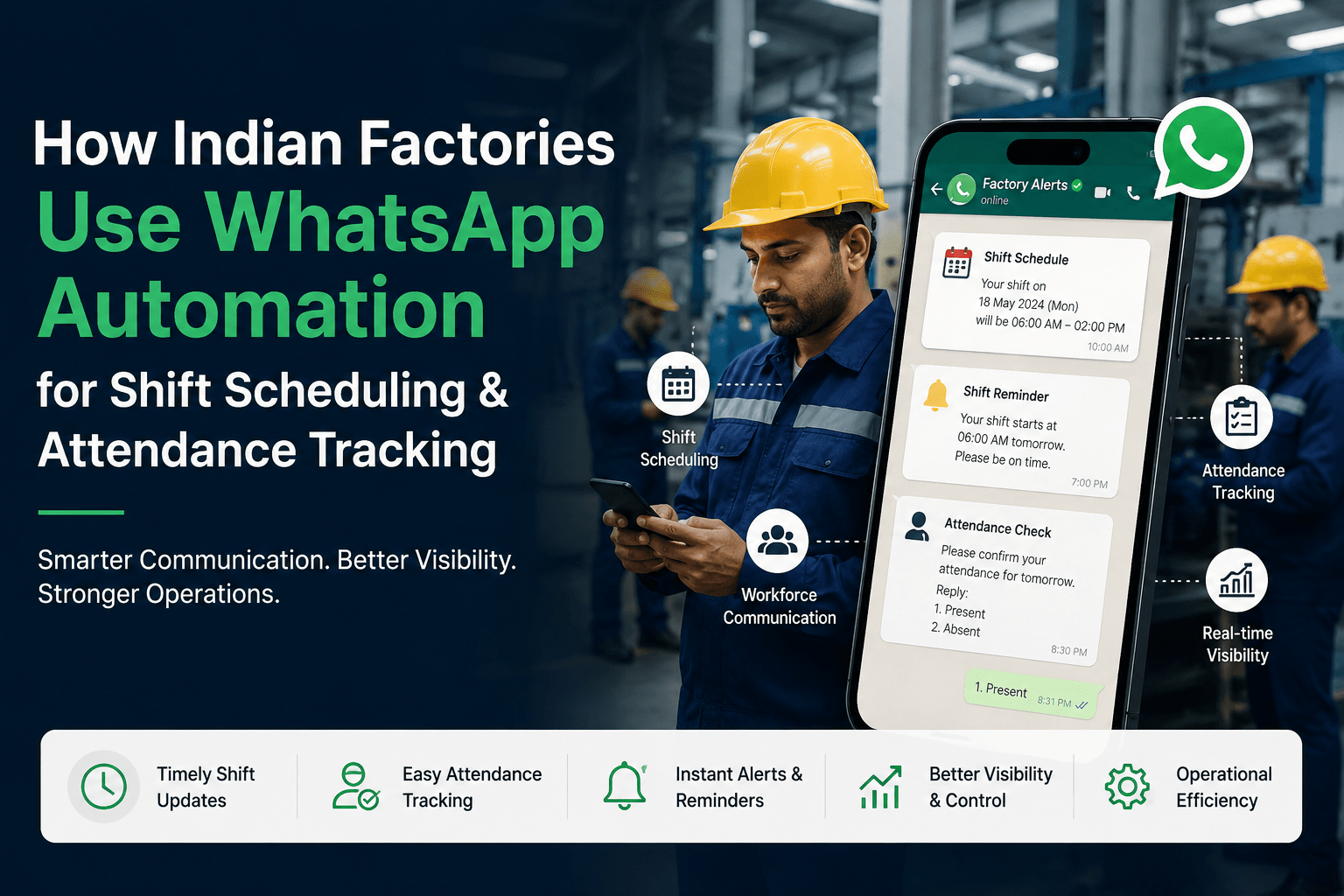
Automated Shift Notifications
Factories can automatically send:
Upcoming shift reminders
Weekly schedules
Shift allocation updates
Overtime opportunities
Schedule changes
This reduces dependence on manual communication.
Shift Change Alerts
Production requirements often change unexpectedly.
When schedules are updated, affected employees can receive immediate notifications.
This minimizes confusion and reduces communication delays.
Overtime Communication
Instead of supervisors calling workers individually, automation can notify eligible employees about available overtime shifts.
Interested workers can respond directly through WhatsApp.
Attendance Tracking Through Automated Workflows
Attendance management is one of the most time-consuming administrative processes in manufacturing operations.
Automation can simplify multiple aspects of attendance tracking.
Shift Start Confirmations
Employees can receive automated messages before shift start times and confirm availability.
This helps supervisors identify potential staffing gaps early.
Attendance Status Collection
WhatsApp workflows can collect employee responses such as:
Present
Absent
Late arrival
Leave request
These responses can be routed into attendance systems or workforce dashboards.
Supervisor Visibility
Instead of waiting for manual attendance consolidation, managers gain faster visibility into workforce status.
This enables quicker operational decisions.
Workforce Communication Is an Operational Function
Many factories treat workforce communication as an administrative activity.
However, communication directly impacts:
Production planning
Labor allocation
Overtime management
Workforce productivity
Operational continuity
A manufacturing operation can only move as efficiently as the information flowing between managers, supervisors, and workers.
This is why communication systems increasingly play a strategic role in factory operations.
Example: Managing Multiple Production Shifts
Consider a manufacturing unit operating:
Morning shift
Afternoon shift
Night shift
The facility employs several hundred workers.
Without automation:
Supervisors manually communicate schedule changes.
Attendance updates arrive slowly.
Shift replacements require multiple phone calls.
Overtime coordination becomes difficult.
With WhatsApp automation:
Shift notifications are delivered automatically.
Attendance responses are collected digitally.
Managers gain faster workforce visibility.
Communication becomes standardized across shifts.
The result is not simply faster messaging.
The result is better operational coordination.
Beyond Attendance: Additional Manufacturing Use Cases
Once workforce communication workflows are established, factories can automate additional operational processes.
Leave Requests
Workers can submit leave requests through structured WhatsApp workflows.
Training Notifications
Factories can notify employees about:
Safety training
Compliance sessions
Skill development programs
Policy Updates
Important operational announcements can be distributed instantly.
Payroll Notifications
Employees can receive salary-related updates and payroll communication through approved workflows.
Communication Visibility Improves Operational Control
One of the biggest challenges in manufacturing environments is visibility.
Managers often struggle to answer questions such as:
Which employees confirmed attendance?
Which shifts have staffing shortages?
How many workers accepted overtime?
Which notifications remain unanswered?
WhatsApp automation creates communication visibility.
Communication visibility refers to the ability to monitor workforce communication status, responses, and operational readiness in real time.
This helps managers make faster and better-informed decisions.
The Future of Workforce Operations in Manufacturing
Indian manufacturing is becoming increasingly digital.
Factories are investing in:
ERP systems
Production monitoring tools
Inventory management platforms
Workforce management solutions
Communication is becoming an important layer within this broader operational ecosystem.
WhatsApp automation helps connect workforce communication with operational workflows, reducing manual effort and improving responsiveness.
As manufacturing operations become more data-driven, structured communication systems will play an increasingly important role in workforce management.
Key Takeaways
Shift scheduling and attendance tracking are fundamentally coordination challenges.
Traditional communication methods often create delays, increase administrative workload, and reduce operational visibility.
WhatsApp automation helps manufacturers:
Automate shift notifications
Improve attendance visibility
Simplify workforce communication
Reduce manual coordination
Support overtime management
Enhance operational efficiency
The objective is not simply to automate messages.
The objective is to create a workforce communication system that supports smoother manufacturing operations at scale.
Want to automate WhatsApp for your business?
Set up campaigns, replies, and follow-ups in minutes.