How Multi-Outlet Restaurant Chains Use WhatsApp Campaigns for Local Promotions
Discover how multi-outlet restaurant chains use WhatsApp campaigns to run localized promotions, improve customer engagement, increase outlet-level sales, and scale marketing operations through automation.
For a single-location restaurant, marketing is relatively simple.
A new menu launch, festive offer, or weekend discount can be promoted to the entire customer base through a single campaign. Every customer receives the same message because every customer visits the same outlet.
Multi-outlet restaurant chains operate differently.
Customers associate themselves with specific locations. Someone who regularly visits your Ahmedabad outlet may have little interest in promotions running at your Vadodara branch. A lunch offer that performs exceptionally well in a business district may generate limited response in a residential area. Even menu availability, customer preferences, and peak dining hours can vary significantly between outlets.
As restaurant brands expand, the challenge shifts from marketing to coordination.
The question is no longer:
"How do we send more promotions?"
Instead, it becomes:
"How do we send the right promotion to the right customer for the right outlet?"
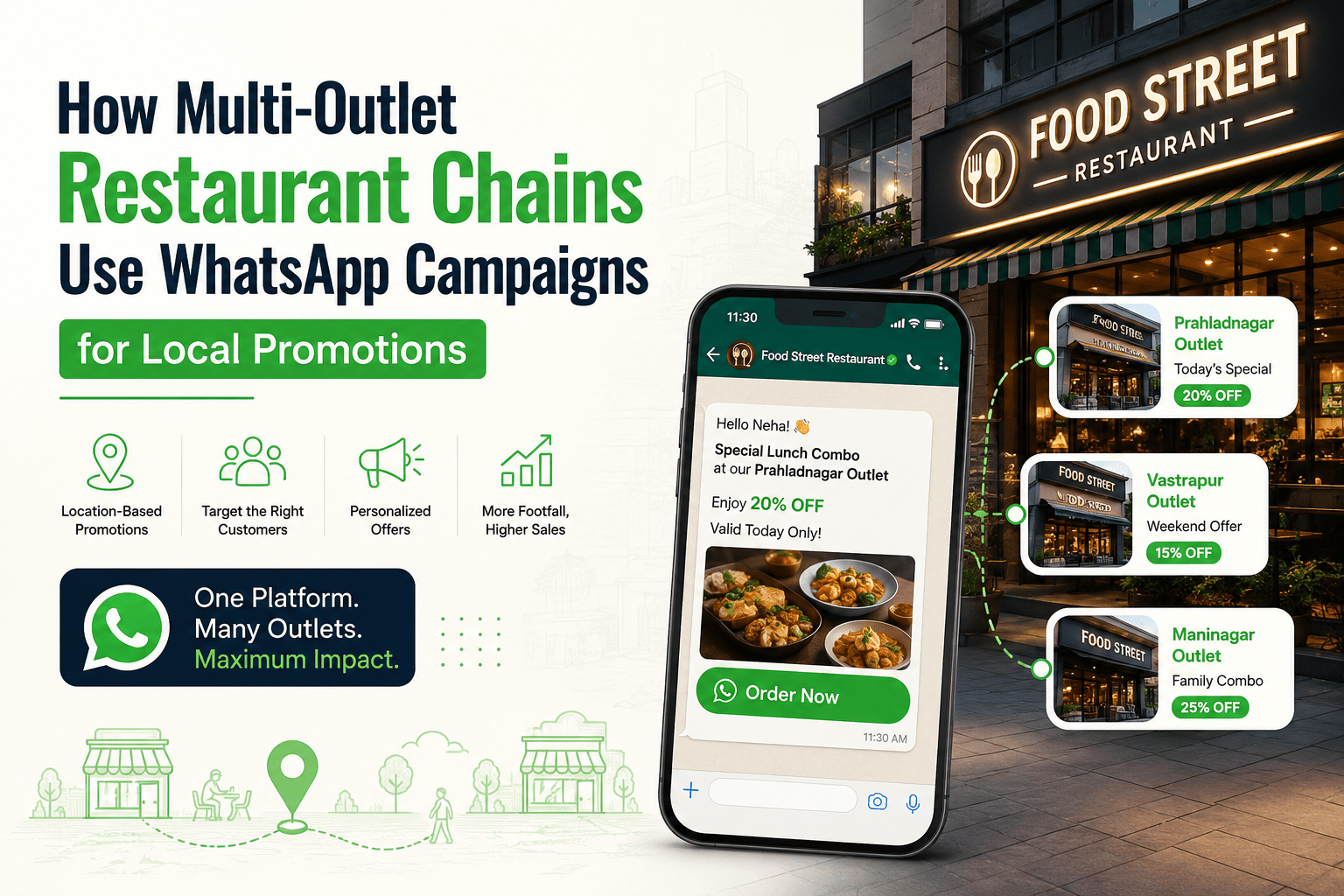
This is why leading restaurant chains increasingly use WhatsApp not just as a messaging platform, but as a localized promotion engine that connects customers, outlets, marketing teams, and operational workflows.
Why Local Promotions Matter More Than Brand-Wide Campaigns
Many restaurant chains continue to run centralized campaigns where every customer receives the same promotional message.
While this approach is easier to execute, it often reduces campaign relevance.
Consider a restaurant chain operating across multiple cities.
A monsoon-themed soup promotion may perform exceptionally well in one region while generating little interest elsewhere. A local festival offer relevant to customers in Surat may be completely irrelevant to customers in Pune. A newly launched menu item may only be available in selected outlets.
Customers engage with promotions that feel personally relevant.
In many cases, relevance drives stronger results than discount size.
This shift toward relevance is one reason why businesses are investing in more sophisticated customer engagement workflows instead of relying solely on bulk messaging. Restaurant operators exploring scalable communication strategies can learn from this broader guide to WhatsApp automation:
https://whatsboost.in/blog/whatsapp-automation-2-ways-to-do-it-use-cases-6-examples
The Operational Challenge Most Restaurant Chains Face
Most restaurant marketing articles focus on attracting customers.
Very few discuss the operational complexity of managing promotions across multiple locations.
In reality, restaurant chains frequently encounter challenges such as:
| Operational Challenge | Business Impact |
|---|---|
| Different inventory levels across outlets | Customers receive offers for unavailable items |
| Franchise-operated locations | Inconsistent promotion execution |
| Regional festivals and events | Generic campaigns lose effectiveness |
| Manual customer segmentation | Increased administrative workload |
| Lack of outlet-level reporting | Poor campaign visibility |
| Separate customer databases | Fragmented customer communication |
As the number of outlets increases, these challenges become harder to manage.
The issue is rarely creating offers.
The issue is managing localized promotions at scale without creating operational confusion.
The Three-Layer Promotion Model Used by Growing Restaurant Chains
Successful restaurant chains rarely treat all promotions equally.
Instead, they typically operate across three promotion layers.
| Promotion Layer | Objective | Example |
|---|---|---|
| Brand-Level Promotions | Build awareness across all outlets | New menu launch |
| Regional Promotions | Target city-specific demand | Festival offers for a particular region |
| Outlet-Level Promotions | Drive local footfall | Lunch combo for a specific branch |
This structure allows businesses to balance central control with local flexibility.
The marketing team maintains consistency while individual outlets retain the ability to respond to local market conditions.
Restaurant chains that adopt this approach often achieve better customer relevance while maintaining stronger operational control.
How Restaurant Chains Segment Customers for Local Promotions
One of the biggest mistakes restaurant brands make is treating every customer the same.
Effective local promotions require meaningful customer segmentation.
Modern restaurant chains often segment customers using factors such as:
Preferred outlet
Recent order location
Delivery zone
Visit frequency
Average order value
Loyalty membership status
Dining preferences
For example, customers who regularly order from a particular outlet should receive promotions relevant to that location rather than generic campaigns covering the entire chain.
The challenge is that maintaining these segments manually becomes increasingly difficult as customer databases grow.
This is where behavior-driven automation becomes valuable.
Instead of manually updating customer lists, businesses can use customer actions to trigger different communication journeys automatically. This approach is explained in detail here:
https://whatsboost.in/blog/behavior-based-whatsapp-automation-using-forms-whatsboost
The result is more accurate segmentation and significantly less administrative effort.
The Local Promotion Maturity Model
Restaurant chains typically evolve through multiple stages before creating a sophisticated local promotion system.
| Stage | Promotion Approach | Primary Challenge |
|---|---|---|
| Single Outlet | One campaign for all customers | Limited reach |
| Multi-Outlet Manual | Separate campaigns managed manually | Operational complexity |
| Segmented Campaigns | Customers grouped by location | Data management |
| Automated Campaigns | Promotions triggered automatically | Workflow design |
| Intelligent Campaigns | Data-driven optimization | Continuous improvement |
Most growing restaurant chains operate somewhere between the second and fourth stages.
The challenge is not technology adoption.
The challenge is building repeatable systems that continue to function as the business expands.
Why WhatsApp Is Particularly Effective for Multi-Outlet Restaurants
Restaurants have access to numerous marketing channels including email, SMS, social media advertising, and loyalty applications.
WhatsApp offers unique advantages that make it particularly effective for local promotions.
| Capability | Operational Benefit |
|---|---|
| Direct communication | Faster visibility |
| Rich media support | Better presentation of offers and menus |
| Interactive conversations | Immediate customer responses |
| Personalized messaging | Higher relevance |
| Workflow automation | Reduced manual effort |
| Customer engagement tracking | Improved optimization |
The value extends beyond marketing.
WhatsApp creates a direct operational connection between customers and individual outlets.
A promotional message can immediately lead to:
Table reservations
Order inquiries
Menu requests
Loyalty enrollment
Feedback collection
Customer support interactions
All within the same conversation.
Restaurants looking to create structured customer journeys can also leverage WhatsApp Flows to streamline reservations, promotions, and feedback collection. Learn more here:
https://whatsboost.in/blog/whatsapp-flows-explained-use-cases-benefits-how-to-build-structured-conversations
Centralized Control vs Localized Execution
One of the biggest strategic decisions restaurant chains face is determining how much control should remain centralized.
Excessive centralization often results in generic campaigns.
Excessive decentralization can create brand inconsistency.
A balanced approach typically works best.
| Activity | Central Team | Outlet Team |
|---|---|---|
| Brand Guidelines | ✓ | |
| Campaign Templates | ✓ | |
| Local Offer Creation | ✓ | |
| Festival Promotions | ✓ | ✓ |
| Performance Monitoring | ✓ | |
| Local Market Adjustments | ✓ |
This model allows outlets to remain responsive to local demand while maintaining overall brand consistency.
Real-World Examples of Local WhatsApp Promotions
Multi-outlet restaurant chains use WhatsApp campaigns in numerous practical scenarios.
| Scenario | Promotion Objective |
|---|---|
| New outlet launch | Generate initial footfall |
| Underperforming weekday sales | Increase visits during slow periods |
| Inventory surplus at one outlet | Promote limited-time offers |
| Regional festival celebration | Increase local engagement |
| New menu introduction | Encourage trial purchases |
These campaigns are effective because they solve specific operational challenges rather than simply broadcasting offers.
Measuring Outlet-Level Campaign ROI
Many restaurant brands evaluate campaign performance only at the corporate level.
This often hides significant outlet-level differences.
Effective restaurant chains monitor performance at both levels.
Key metrics include:
Message delivery rate
Customer response rate
Coupon redemption rate
Reservation bookings
Repeat visit frequency
Revenue generated per campaign
Outlet-specific retention rate
By analyzing these metrics separately for each location, restaurant chains gain clearer visibility into what drives local success.
Common Mistakes Multi-Outlet Restaurant Chains Make
Sending identical promotions to all customers
Not every outlet serves the same audience. Generic promotions often reduce engagement.
Ignoring outlet-level data
Campaign performance can vary dramatically between locations.
Managing campaigns manually
As the number of outlets grows, manual workflows become unsustainable.
Promoting unavailable products
Inventory mismatches can damage customer trust and create customer service issues.
Using WhatsApp only as a broadcast channel
The most successful restaurant brands use WhatsApp as a two-way engagement platform rather than a one-way announcement tool.
Restaurant operators looking for industry-specific implementation ideas can explore this comprehensive guide:
https://whatsboost.in/blog/whatsapp-business-for-restaurants-a-complete-guide-to-automate-engage-and-grow-with-whatsboost
The Future of Local Restaurant Marketing
Customer expectations are becoming increasingly personalized.
Generic promotions are losing effectiveness because customers expect communications that reflect their preferences, behavior, and location.
Over the coming years, restaurant chains are likely to combine:
WhatsApp campaigns
Customer data platforms
Loyalty programs
AI-powered recommendations
Automated workflows
to create highly personalized local marketing experiences.
The businesses that succeed will not necessarily be the ones sending the most messages.
They will be the ones delivering the most relevant messages to the right customer at the right outlet at the right time.
For multi-outlet restaurant chains, WhatsApp is no longer just a communication tool.
It is becoming a critical operational system for managing local promotions, improving customer engagement, and scaling personalized marketing across multiple locations without increasing complexity.
Want to automate WhatsApp for your business?
Set up campaigns, replies, and follow-ups in minutes.