N8N Self Hosted vs Zapier: Which Automation Platform Is Better for Businesses?
A detailed comparison of N8N self-hosted infrastructure and Zapier covering workflow flexibility, AI automation, WhatsApp integrations, scalability, pricing, and operational control for businesses.
Automation platforms used to be simple productivity tools.
Today, they are becoming operational infrastructure.
Businesses are no longer using automation only for:
sending email notifications
updating spreadsheets
syncing small workflows
They are now automating:
customer communication
AI workflows
sales pipelines
internal operations
WhatsApp systems
support coordination
CRM orchestration
payment workflows
backend business logic
And as automation becomes deeply connected to business operations, companies are starting to ask more serious questions:
Which automation platform is actually sustainable long term?
Can it scale operationally?
Does it support infrastructure control?
How flexible is the workflow architecture?
What happens when automation complexity grows?
This is exactly why the comparison between n8n Official Website and Zapier Official Website has become increasingly important for modern businesses.
Because while both platforms automate workflows, they are designed around fundamentally different philosophies.
And that distinction matters far more than most businesses realize initially.
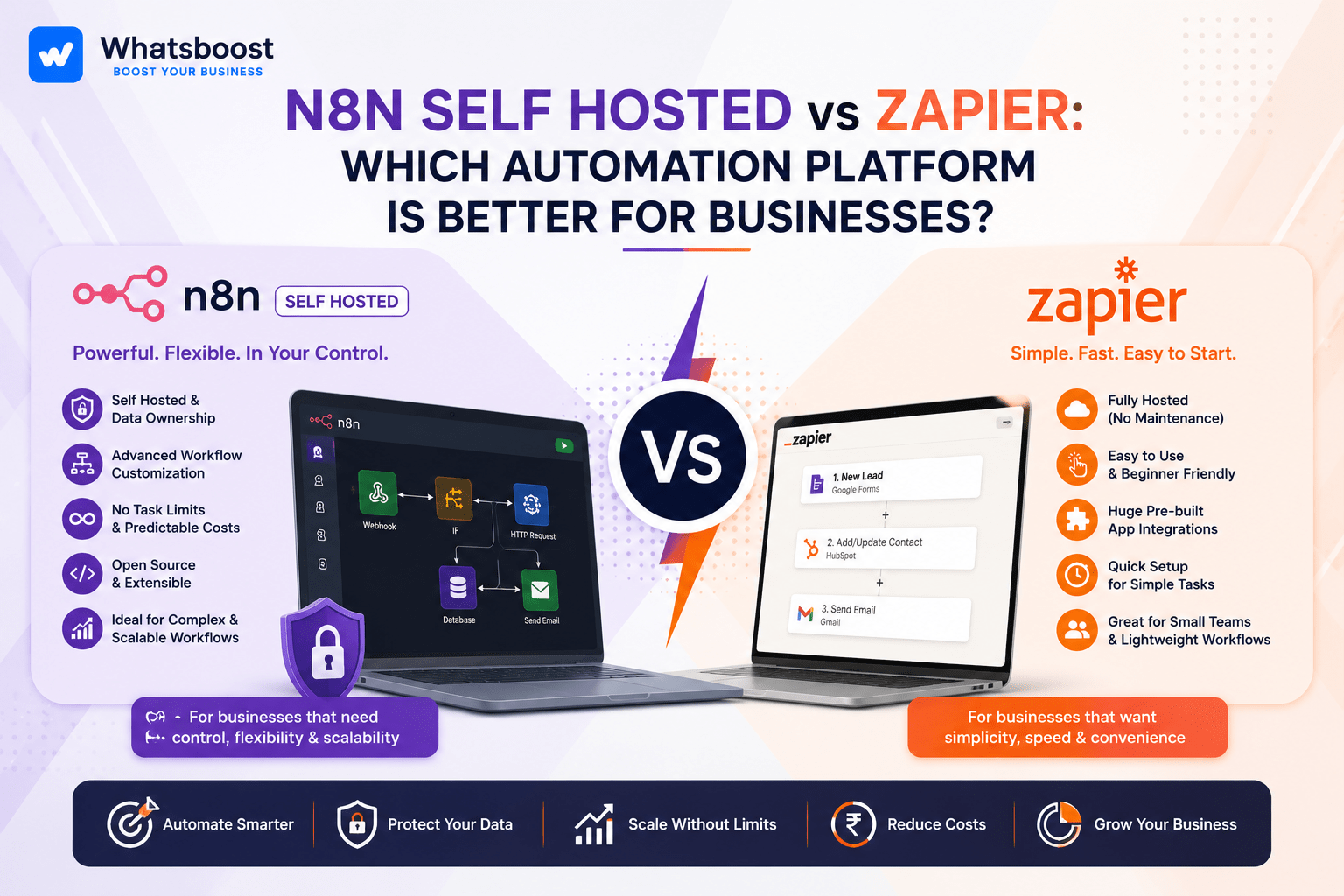
The Core Difference Between N8N and Zapier
At a surface level, both platforms automate workflows between applications.
But operationally, they are built for very different use cases.
| Zapier | N8N |
|---|---|
| SaaS-first automation platform | Workflow automation infrastructure |
| Designed primarily for simplicity | Designed for flexibility and control |
| Hosted ecosystem | Self-hosted and hosted options |
| Limited backend customization | Advanced workflow logic support |
| Beginner-friendly setup | More technical operational flexibility |
| Strong for simple integrations | Strong for scalable workflow orchestration |
| Subscription-based scaling | Infrastructure-based scaling |
| Limited workflow ownership | Greater infrastructure control |
This is why the “better” platform depends heavily on:
business maturity
workflow complexity
operational scale
security requirements
infrastructure expectations
There is no universal winner.
But there are very clear differences.
Why Zapier Became Popular So Quickly
Zapier became successful because it solved a major business problem:
non-technical automation.
It allowed businesses to connect apps without writing code.
For small operational tasks like:
form submissions
Slack notifications
Google Sheets updates
email automation
CRM syncing
Zapier dramatically simplified workflow creation.
Its strength is accessibility.
A business owner with almost no technical background can create useful workflows quickly.
That ease-of-use is still one of Zapier’s biggest advantages today.
Where Businesses Start Outgrowing Zapier
The problems usually begin when workflows become operationally critical.
As businesses scale automation, they often face:
rising execution costs
workflow limitations
restricted backend logic
limited infrastructure visibility
fragmented orchestration
scaling inefficiencies
advanced API limitations
This becomes especially noticeable for businesses automating:
WhatsApp communication
AI workflows
customer operations
internal systems
high-volume support workflows
multi-step operational pipelines
At that point, automation stops being a convenience layer.
It becomes infrastructure.
And infrastructure requires much deeper flexibility.
Why N8N Is Growing Rapidly Among Operationally Mature Businesses
N8N is increasingly popular because it approaches automation differently.
Instead of focusing primarily on beginner simplicity, N8N focuses on:
workflow flexibility
infrastructure control
custom orchestration
API extensibility
self-hosting
advanced logic handling
This makes it extremely attractive for:
SaaS companies
agencies
operationally intensive businesses
AI-first businesses
startups scaling automation systems
enterprises needing workflow control
Especially businesses building interconnected operational systems instead of isolated automations.
The Self Hosted Advantage Changes Everything
This is probably the biggest architectural difference between the two platforms.
Zapier operates primarily as a hosted SaaS platform.
N8N allows businesses to self-host workflows on:
VPS infrastructure
Docker environments
cloud instances
enterprise servers
Kubernetes clusters
This creates several operational advantages:
| Self Hosted N8N Advantages | Why It Matters |
|---|---|
| Infrastructure ownership | Greater workflow control |
| Data governance | Better operational visibility |
| Predictable scaling costs | Better long-term economics |
| Workflow flexibility | Advanced automation logic |
| AI orchestration capability | More customization |
| Internal system integration | Enterprise adaptability |
| Reduced vendor dependency | Operational independence |
For businesses automating sensitive or large-scale operational workflows, these advantages become strategically important over time.
Why Businesses Using AI Workflows Prefer N8N
AI automation is changing workflow architecture rapidly.
Businesses are now connecting:
OpenAI
Claude
CRMs
databases
WhatsApp APIs
support systems
internal dashboards
inside automated operational pipelines.
This requires:
advanced workflow branching
API orchestration
custom scripting
infrastructure flexibility
execution visibility
N8N is particularly strong in these environments because it behaves more like:
an orchestration layer
than a simple automation connector.
This is one reason many AI-focused operational teams increasingly prefer N8N over traditional no-code automation platforms.
Why WhatsApp Automation Workflows Often Need More Than Zapier
India’s business ecosystem is increasingly conversational.
Businesses now rely heavily on:
WhatsApp lead generation
automated follow-ups
customer onboarding
payment reminders
appointment coordination
support workflows
These systems often require:
conditional routing
CRM synchronization
AI integration
operational monitoring
multi-step orchestration
Businesses building advanced conversational systems often combine N8N infrastructure with structured WhatsApp automation and follow-up workflows to create more scalable customer communication ecosystems.
As workflow complexity increases, infrastructure flexibility becomes far more valuable than basic drag-and-drop simplicity.
Cost Structure: One of the Biggest Long-Term Differences
Initially, Zapier often feels easier and cheaper.
But as workflow volume increases, businesses frequently experience rapid cost growth because pricing scales based on:
tasks
workflow volume
premium integrations
operational usage
For smaller workflows, this may not matter much.
But for businesses automating:
customer support
WhatsApp communication
AI systems
lead management
backend operations
task-based pricing can become expensive quickly.
Self-hosted N8N changes the cost model entirely.
Businesses control:
infrastructure
execution environments
scaling architecture
which often creates more predictable long-term operational economics.
Especially for automation-heavy environments.
The Learning Curve Difference Is Real
This is important.
Zapier is easier for beginners.
N8N is more powerful but requires more operational thinking.
Businesses choosing N8N usually need:
workflow planning
infrastructure understanding
API familiarity
automation architecture thinking
This is why many businesses work with implementation partners instead of treating N8N like a simple plug-and-play tool.
The tradeoff is:
greater complexity for greater flexibility.
Why Security and Data Governance Matter More Today
Businesses are increasingly concerned about:
customer data
workflow visibility
AI governance
operational dependency
infrastructure ownership
According to IBM Cost of a Data Breach Report, operational data security remains one of the most important concerns for digitally scaling businesses.
Self-hosted infrastructure gives businesses stronger control over:
workflow execution
API access
authentication systems
operational visibility
internal integrations
This becomes especially important for:
healthcare businesses
SaaS companies
financial workflows
education systems
enterprise operations
where governance requirements are higher.
Businesses evaluating infrastructure ownership often explore the broader benefits of self-hosted N8N automation for data privacy and control before committing to long-term automation architecture decisions.
Why Businesses Fail With Automation Platforms
Interestingly, most automation failures are not caused by the platform itself.
They happen because businesses:
automate broken workflows
create disconnected systems
ignore operational dependencies
lack governance
overcomplicate architecture
scale without monitoring
A powerful platform does not automatically create good operations.
Workflow design matters more than tool popularity.
This is where operational maturity becomes far more important than feature comparisons alone.
When Zapier Is the Better Choice
Zapier is usually better when:
workflows are simple
teams are non-technical
automation volume is low
infrastructure ownership is unnecessary
quick setup matters more than customization
operational complexity is limited
For small businesses needing lightweight workflow automation, Zapier still remains extremely effective.
When N8N Is the Better Choice
N8N becomes stronger when businesses need:
self-hosted infrastructure
AI orchestration
advanced workflow logic
backend flexibility
operational scalability
WhatsApp workflow orchestration
infrastructure governance
cost control at scale
API-heavy automation systems
This is especially true for businesses treating automation as:
core operational infrastructure.
Why Many Businesses Eventually Move Toward Hybrid Automation
An interesting trend is emerging.
Some businesses use:
Zapier for lightweight team automation
N8N for operational infrastructure and scalable workflows
This hybrid approach allows teams to balance:
accessibility
flexibility
operational governance
infrastructure control
instead of forcing one platform to solve every operational requirement.
How WhatsBoost Helps Businesses Build Scalable Automation Systems
WhatsBoost helps businesses design and implement scalable automation ecosystems using self-hosted N8N infrastructure, conversational workflows, and operational orchestration systems.
Businesses can build:
WhatsApp automation systems
AI-powered workflows
CRM orchestration
operational automation pipelines
lead routing systems
customer communication workflows
appointment automation
support coordination systems
with infrastructure designed for long-term scalability and operational control.
Businesses planning large-scale automation infrastructure often begin with structured N8N self-hosted implementation services to build workflows that remain stable and scalable as operational complexity grows.
Final Thoughts
The N8N vs Zapier comparison is not really about:
“Which tool is better?”
It is about:
“What kind of operational future is the business building?”
Zapier optimizes for simplicity.
N8N optimizes for flexibility and infrastructure control.
For lightweight workflows, Zapier remains excellent.
But for businesses building:
AI systems
conversational operations
workflow infrastructure
scalable backend automation
operational orchestration environments
N8N increasingly becomes the stronger long-term architecture choice.
Because as automation becomes deeply embedded inside business operations, infrastructure ownership and workflow flexibility become far more valuable than simple convenience alone.
Want to automate WhatsApp for your business?
Set up campaigns, replies, and follow-ups in minutes.