
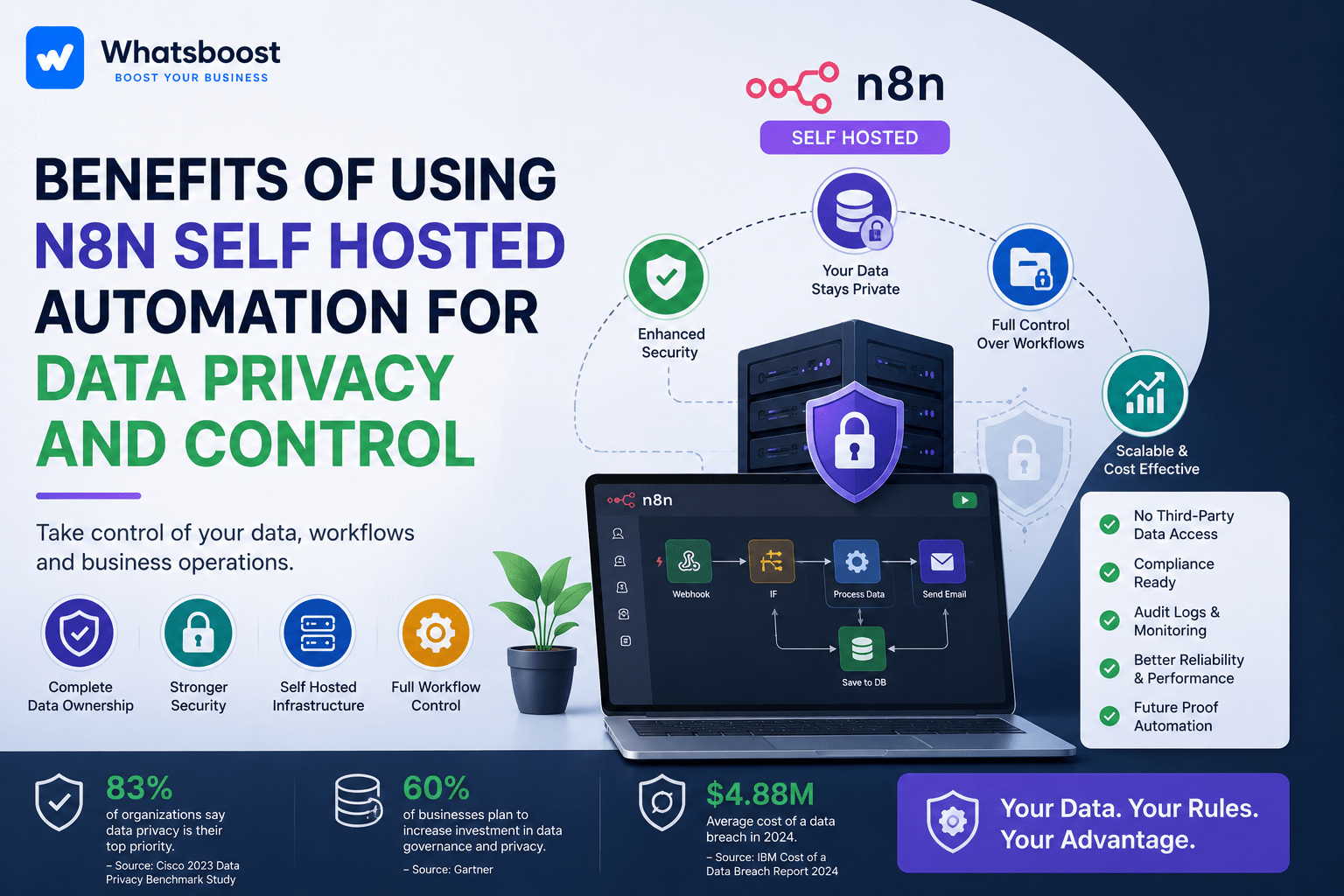
Benefits of Using N8N Self Hosted Automation for Data Privacy and Control
A detailed guide explaining how self-hosted N8N infrastructure improves data privacy, workflow control, operational governance, and automation security for modern businesses.
Most businesses start thinking about automation because they want efficiency.
Faster workflows.
Reduced manual work.
Better coordination.
Improved customer communication.
But as automation systems grow deeper inside business operations, another concern starts becoming far more important:
Who controls the data?
This question is becoming increasingly critical for businesses handling:
customer communication
payment workflows
healthcare information
internal operations
employee records
sales pipelines
AI workflows
business intelligence systems
Because modern automation platforms do not just process tasks anymore.
They process business infrastructure.
And for many companies, especially in India, that creates serious concerns around:
data visibility
third-party dependency
workflow governance
infrastructure ownership
operational security
compliance risks
This is one of the biggest reasons businesses are increasingly moving toward self-hosted automation infrastructure using n8n Official Website.
The shift is not only about automation flexibility anymore.
It is also about:
control.
Why Data Privacy Has Become a Major Business Concern
For years, many businesses adopted SaaS tools without thinking deeply about infrastructure ownership.
The priority was convenience.
But modern business systems now process enormous amounts of operationally sensitive information, including:
customer conversations
payment updates
CRM records
internal approvals
healthcare interactions
sales data
AI-generated insights
employee coordination
As automation expands across departments, businesses are becoming far more conscious about where this information flows and who ultimately controls it.
According to IBM Cost of a Data Breach Report, the global average cost of a data breach remains extremely high, with compromised operational systems creating both financial and reputational damage for businesses.
For growing companies, especially those automating customer communication and operational workflows, data governance is no longer an IT-only concern.
It is becoming a business continuity concern.
The Hidden Risk of Fragmented SaaS Automation
Most businesses do not realize how fragmented their operational data becomes over time.
A typical business may use:
one tool for CRM
another for WhatsApp
another for email automation
another for AI workflows
another for internal approvals
another for payment systems
Every platform processes customer and operational data independently.
This creates:
scattered data visibility
inconsistent governance
duplicated workflow handling
security blind spots
third-party dependency risks
And as automation complexity increases, businesses lose clarity over:
where workflows execute
how data moves
who accesses operational systems
what security layers exist
how workflow logs are managed
This is exactly why self-hosted infrastructure becomes strategically valuable.
What Self Hosted N8N Actually Changes
Self-hosted N8N gives businesses direct ownership over workflow execution infrastructure.
Instead of workflows running entirely inside third-party hosted environments, businesses can deploy N8N on:
private cloud servers
VPS infrastructure
dedicated environments
internal enterprise systems
Docker deployments
Kubernetes clusters
This fundamentally changes how businesses manage:
operational visibility
infrastructure governance
workflow access
security configuration
API control
execution monitoring
The result is not just better customization.
It is stronger operational control.
Why Data Control Matters More in AI Automation
This is becoming increasingly important as businesses adopt AI workflows.
Modern AI automation systems often process:
customer conversations
internal documents
CRM data
support tickets
business analytics
operational records
Without proper infrastructure governance, businesses may unintentionally expose sensitive operational information across multiple third-party systems.
This is one reason many companies are now using N8N as an orchestration layer between:
AI systems
databases
WhatsApp APIs
CRMs
support workflows
internal operational tools
instead of allowing disconnected AI tools to access business systems independently.
The Difference Between Hosted Automation and Self Hosted Infrastructure
Many businesses initially underestimate this difference.
But operationally, it becomes massive over time.
| Hosted Automation Platforms | Self Hosted N8N Infrastructure |
|---|---|
| Limited infrastructure visibility | Full infrastructure ownership |
| Shared execution environments | Dedicated workflow environment |
| SaaS dependency | Greater operational independence |
| Platform-controlled scaling | Business-controlled scalability |
| Restricted customization | Advanced workflow flexibility |
| Limited backend governance | Stronger workflow oversight |
| Subscription-led pricing growth | Predictable infrastructure costs |
| Vendor-controlled roadmap | Infrastructure-level adaptability |
This is why businesses moving toward long-term automation maturity increasingly prioritize infrastructure ownership.
Why Indian Businesses Are Becoming More Conscious About Data Governance
Indian businesses are rapidly digitizing operations.
But many still operate with:
WhatsApp-driven communication
spreadsheet-heavy workflows
fragmented customer management
multi-tool operational systems
As these systems scale, businesses become more vulnerable to:
workflow inconsistency
data leakage
operational dependency
coordination failures
This becomes especially critical for industries like:
healthcare
finance
education
legal services
enterprise consulting
customer support operations
where customer trust and operational confidentiality matter significantly.
How Self Hosted N8N Improves Operational Visibility
One of the biggest advantages of self-hosted infrastructure is workflow transparency.
Businesses gain greater visibility into:
workflow execution
API interactions
operational logs
automation dependencies
system performance
integration behavior
This makes troubleshooting, monitoring, and governance substantially easier compared to fragmented automation environments.
For operationally intensive businesses, this visibility becomes extremely valuable over time.
Why Businesses Prefer Self Hosted Automation for WhatsApp Workflows
India’s business ecosystem increasingly operates through conversational workflows.
Businesses now automate:
lead qualification
appointment reminders
payment notifications
customer support
onboarding workflows
sales coordination
through WhatsApp-based systems.
That means automation workflows increasingly process:
customer phone numbers
transactional information
conversation histories
internal coordination logic
Businesses building conversational systems often prefer infrastructure-level governance instead of relying entirely on external workflow processing systems.
Companies already implementing structured WhatsApp automation and follow-up workflows frequently adopt self-hosted infrastructure later as operational complexity grows.
Why Workflow Ownership Becomes a Competitive Advantage
Many businesses still view automation as:
“just another software layer.”
But mature businesses increasingly treat automation as:
core operational infrastructure.
That shift changes how companies think about:
scalability
governance
compliance
monitoring
business continuity
workflow reliability
Businesses with stronger infrastructure ownership often gain:
better operational resilience
greater flexibility
lower dependency risks
improved workflow adaptability
stronger long-term scalability
Especially as automation expands deeper into customer communication and AI systems.
Common Security Advantages of Self Hosted N8N
Self-hosted infrastructure gives businesses greater control over how security is implemented.
This may include:
private networking
access control layers
encrypted workflow handling
internal authentication systems
dedicated database management
custom backup strategies
role-based permissions
This does not automatically guarantee security.
But it gives businesses more direct control over how operational safeguards are implemented.
That distinction matters significantly.
Why Businesses Still Need Professional N8N Implementation
One of the biggest misconceptions about self-hosted automation is assuming infrastructure ownership automatically solves operational risks.
It does not.
Poorly implemented systems can still create:
security vulnerabilities
unstable workflows
monitoring gaps
API exposure risks
operational failures
This is why professional implementation matters.
Production-grade N8N systems require:
infrastructure planning
workflow architecture
security configuration
monitoring systems
scalability design
operational governance
Businesses treating automation as serious infrastructure usually invest properly in these areas.
What Businesses Should Evaluate Before Moving to Self Hosted Infrastructure
Before implementation, businesses should evaluate:
| Evaluation Area | Why It Matters |
|---|---|
| Workflow Complexity | Determines infrastructure needs |
| Security Requirements | Defines access and governance layers |
| AI Workflow Usage | Impacts data handling architecture |
| Integration Volume | Affects scalability planning |
| Operational Dependency | Measures workflow criticality |
| Compliance Expectations | Influences infrastructure strategy |
| Team Technical Capability | Impacts implementation planning |
This helps businesses avoid infrastructure decisions driven only by short-term convenience.
Why Operational Control Will Matter Even More in the Future
Automation systems are becoming deeply integrated into:
customer journeys
AI operations
sales coordination
internal approvals
support systems
business intelligence workflows
As businesses automate more critical operations, infrastructure governance will become increasingly important.
Because eventually the question stops being:
“Can we automate this?”
And becomes:
“How much operational visibility and control do we actually have over our automation systems?”
That distinction will matter enormously in the coming years.
How WhatsBoost Helps Businesses Build Secure Self Hosted N8N Systems
WhatsBoost helps businesses design and implement scalable self-hosted N8N infrastructure focused on operational automation, workflow governance, and conversational business systems.
Businesses can implement:
secure workflow environments
WhatsApp automation systems
AI-integrated operational pipelines
CRM orchestration
customer communication workflows
infrastructure monitoring systems
workflow governance layers
inside scalable self-hosted environments designed for operational reliability and long-term growth.
Businesses building structured conversational systems often combine N8N infrastructure with organized WhatsApp sales funnel workflows to improve customer coordination while maintaining stronger operational control.
Final Thoughts
The future of automation is not only about efficiency.
It is about governance.
As businesses automate deeper operational systems, questions around:
infrastructure ownership
workflow visibility
data governance
operational control
AI orchestration
security architecture
will become increasingly important.
Self-hosted N8N gives businesses something many SaaS automation platforms cannot fully provide:
infrastructure-level control.
And for businesses building long-term automation ecosystems, that control is becoming strategically valuable — not just technically useful.
Want to automate WhatsApp for your business?
Set up campaigns, replies, and follow-ups in minutes.