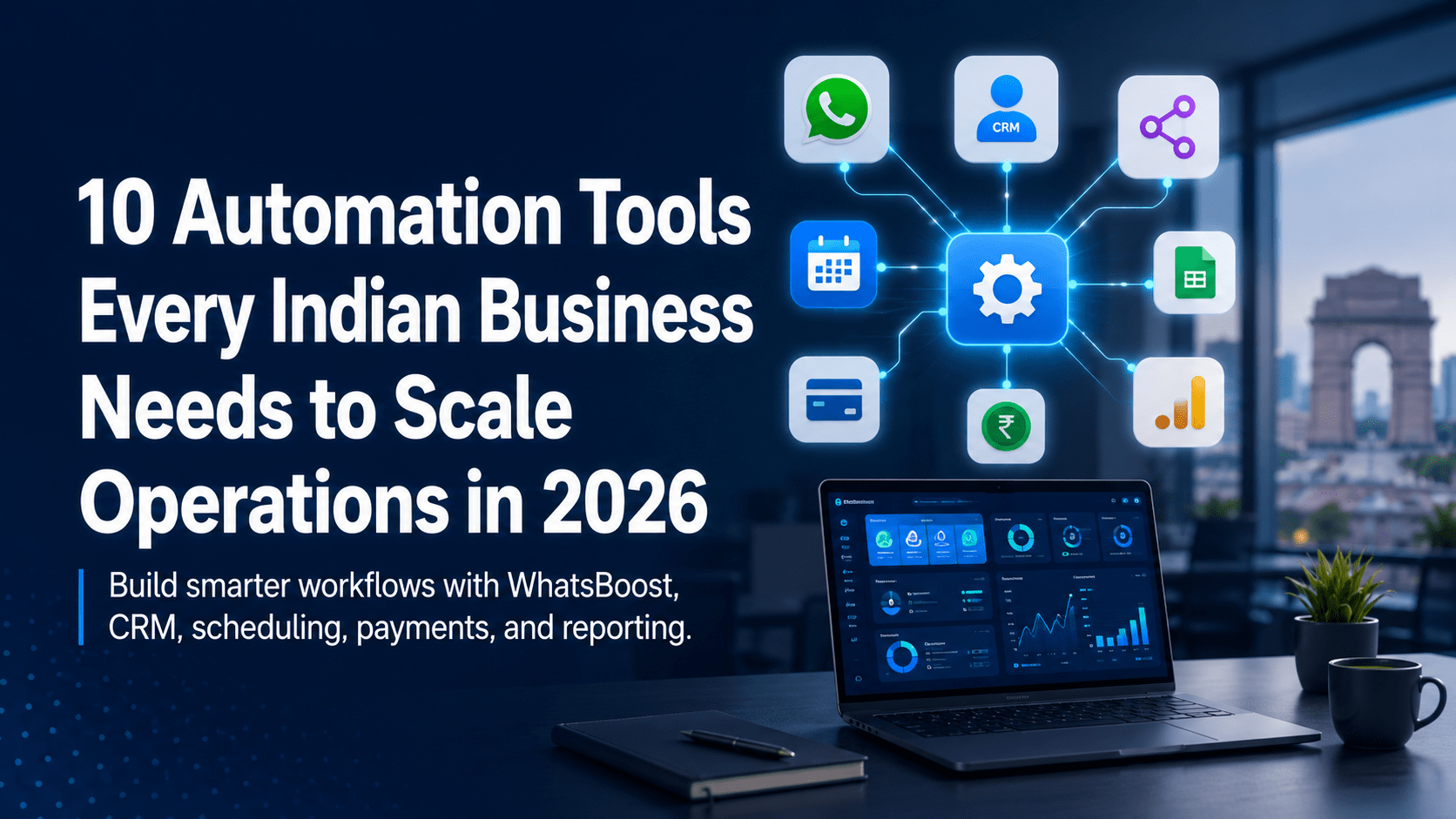
10 Automation Tools Every Indian Business Needs to Scale Operations in 2026
Explore the modern automation stack used by growing Indian businesses to automate communication, scheduling, CRM management, workflows, payments, and reporting for sustainable growth.
Indian businesses are reaching a point where growth is no longer limited by demand.
It is limited by operations.
Leads arrive through WhatsApp, websites, Facebook Ads, IndiaMART, Justdial, referrals, and marketplaces. Customer conversations happen across multiple channels. Sales teams manage follow-ups manually. Appointment scheduling depends on phone calls. Data sits in spreadsheets. Managers struggle to understand where opportunities are being lost.
As businesses grow, these inefficiencies multiply.
The traditional solution has been hiring more people.
The smarter solution is building systems.
The businesses scaling efficiently in 2026 are not necessarily those with the largest teams. They are the ones using automation to eliminate repetitive work, connect fragmented processes, and improve operational visibility.
This article explores the modern automation stack that Indian businesses can use to scale without creating operational chaos.
Why Most Businesses Fail With Automation
Many business owners assume automation means buying software.
In reality, automation is about connecting processes.
Consider a common scenario:
Leads arrive from Facebook Ads
Sales teams manage conversations on WhatsApp
Customer information sits in Excel
Appointments are booked over phone calls
Follow-ups depend on memory
Each tool may work independently.
The problem is that nothing works together.
As a result:
The goal of automation is not simply replacing manual tasks.
The goal is creating connected workflows.
The Modern Business Automation Stack
Most growing businesses require five operational layers:
The tools below help businesses build these layers.
1. WhatsBoost: The Communication and Engagement Layer
A lead that waits hours for a response becomes significantly harder to convert.
This is why communication automation has become one of the most important parts of modern business operations.
WhatsBoost enables businesses to automate:
Lead engagement
Customer communication
Follow-ups
Lead qualification
Appointment reminders
Customer support workflows
Instead of relying on sales representatives to manually respond to every inquiry, businesses can initiate conversations instantly through WhatsApp.
For example:
A prospect submits a website inquiry
Within seconds:
A personalized WhatsApp message is triggered
Product information is delivered automatically
Basic qualification questions are asked
Qualified leads are routed to sales teams
You can explore WhatsBoost's full capabilities on the features page to see how automation, analytics, and campaign management work together.
Businesses exploring conversational automation can also review how to integrate website leads directly into WhatsApp workflows:
Integrate Website Leads to WhatsApp & Get Instant Lead Alerts Using WhatsBoost
The objective is reducing response delays while improving customer experience.
2. Cal.com: The Scheduling Layer
Many businesses still manage appointments manually.
This creates unnecessary back-and-forth communication.
Examples include:
Sales demos
Property site visits
Consultation calls
Discovery meetings
Customer onboarding sessions
Cal.com automates scheduling by allowing customers to select available time slots directly.
Key benefits include:
Automatic calendar synchronization
Time zone management
Meeting reminders
Rescheduling workflows
Reduced scheduling friction
For service businesses, agencies, consultants, and real estate teams, automated scheduling can significantly reduce administrative workload.
3. HubSpot CRM: The Customer Intelligence Layer
As lead volumes increase, spreadsheets become difficult to manage.
Customer relationship management platforms provide structure.
HubSpot CRM helps businesses:
Store customer information
Track interactions
Monitor sales pipelines
Score leads
Assign ownership
The platform creates a centralized record of customer activity, making it easier for teams to coordinate.
Instead of searching through emails and spreadsheets, teams can access a complete customer timeline from one dashboard.
4. Zoho CRM: The Indian SMB-Friendly Alternative
For many Indian businesses, Zoho CRM offers an attractive balance between functionality and affordability.
Common use cases include:
Lead tracking
Sales pipeline management
Contact management
Workflow automation
Reporting
Its strong ecosystem and local market adoption make it particularly relevant for:
SMEs
Manufacturers
Educational institutions
Healthcare providers
Service businesses
Businesses looking to formalize sales operations often start here before expanding their automation stack.
5. n8n: The Workflow Automation Engine
If CRM platforms store information and communication platforms engage customers, workflow engines connect everything together.
This is where n8n becomes powerful.
n8n enables businesses to create automated workflows between different applications.
For example:
textWebsite Form Submission
        ↓
Create CRM Contact
        ↓
Send WhatsApp Message
        ↓
Assign Sales Representative
        ↓
Notify Team
        ↓
Schedule Follow-Up Task
All without human intervention.
Unlike many traditional automation platforms, n8n provides extensive customization capabilities, making it popular among businesses seeking greater control over operational workflows.
For businesses serious about automation, workflow orchestration is often the layer that creates the greatest efficiency gains.
Want 50+ practical WhatsApp + n8n + Claude automation ideas for Indian businesses? Check out 50 WhatsApp + n8n + Claude Automation Ideas for Indian Businesses 2026 Guide.
6. Google Workspace: The Operational Foundation
Automation often begins with the tools businesses already use.
Google Workspace remains one of the most important operational platforms because it centralizes:
Email communication
Document management
Team collaboration
Spreadsheet automation
Calendar management
Businesses frequently integrate Google Sheets, Gmail, and Google Calendar into broader automation workflows.
While it may not appear as sophisticated as specialized automation software, it often serves as the foundation for many business processes.
7. Notion: Centralized Knowledge Management
Growth creates information fragmentation.
Processes live in emails
Documentation lives in PDFs
Training materials live in WhatsApp groups
Knowledge becomes difficult to access
Notion helps businesses centralize:
Standard operating procedures
Team documentation
Project management
Knowledge bases
Internal workflows
This becomes increasingly valuable as teams expand.
Without proper documentation, businesses become dependent on individual employees rather than systems.
8. Razorpay: Payment Automation
Many businesses still handle payment collection manually.
This creates inefficiencies in:
Invoice generation
Payment tracking
Reminder management
Reconciliation
Razorpay automates many of these processes.
Key capabilities include:
Payment links
Subscription billing
Automated reminders
Payment tracking
Financial reporting
For service providers and subscription-based businesses, payment automation improves cash flow management while reducing administrative overhead.
9. TallyPrime: Financial Operations Automation
Accounting remains one of the most important operational functions in Indian businesses.
TallyPrime helps automate:
Bookkeeping
GST compliance
Financial reporting
Inventory management
Accounting workflows
Many businesses integrate financial systems with CRMs and operational platforms to create better visibility across departments.
This reduces duplicate data entry while improving accuracy.
10. Power BI: The Visibility Layer
Automation generates data.
Data alone does not create better decisions.
Visibility does.
Power BI helps businesses transform operational information into actionable insights.
Examples include:
Lead source performance
Sales conversion rates
Customer acquisition trends
Team productivity metrics
Revenue forecasting
Without reporting systems, businesses often operate reactively.
With reporting systems, they gain the ability to identify bottlenecks before they become problems.
How These Tools Work Together
The real value emerges when these tools function as a connected system.
Consider a modern lead management workflow:
Instead of isolated tasks, businesses create end-to-end workflows.
This reduces delays, improves customer experience, and increases operational efficiency.
A Real-World Example
Imagine a manufacturing company receiving inquiries through its website.
Without automation:
Lead enters email inbox
Staff manually enters data
Sales team follows up later
Information gets lost
Appointments are delayed
With automation:
Lead enters website form
n8n creates CRM record
WhatsBoost initiates WhatsApp conversation
Product brochure is shared automatically
Cal.com schedules a consultation
Sales representative receives notification
Activity is logged in CRM
The prospect receives immediate attention while the business maintains operational consistency.
For Indian exporters and manufacturers dealing with IndiaMART leads, see how to automate follow-ups:
Automating IndiaMART Follow-ups on WhatsApp Using WhatsBoost
Choosing the Right Automation Stack
Not every business requires all ten tools immediately.
A practical starting framework is:
Early-Stage Businesses
WhatsBoost
Cal.com
Google Workspace
Growing Businesses
WhatsBoost
CRM
n8n
Cal.com
Google Workspace
Scaling Businesses
WhatsBoost
CRM
n8n
Cal.com
Razorpay
Power BI
Notion
The objective is gradual systemization rather than implementing everything at once.
The Future of Business Growth Is Operational Efficiency
The next phase of business growth will not be driven solely by advertising budgets.
It will be driven by operational systems.
Businesses that automate communication, scheduling, workflows, customer management, and reporting will scale more efficiently than those relying on manual coordination.
Automation is no longer a competitive advantage.
It is becoming a business requirement.
The companies that grow successfully in 2026 will not necessarily be the ones generating the most leads.
They will be the ones managing those leads, customers, and operations more effectively.
Want to automate WhatsApp for your business?
Set up campaigns, replies, and follow-ups in minutes.