Automating WhatsApp Form Responses and Google Sheet Entries With Claude AI
A detailed guide on automating WhatsApp form responses, AI-powered lead qualification, and Google Sheet updates using Claude AI and N8N workflows.
Most businesses do not realize how much operational friction is hidden inside their inquiry handling process.
A customer fills a form.
The business receives a WhatsApp message.
Someone manually copies details into Google Sheets.
A sales executive reviews the inquiry later.
Follow-ups happen inconsistently.
Lead notes remain incomplete.
Customer intent is interpreted differently by different team members.
Individually, these tasks appear manageable.
Collectively, they create one of the biggest operational inefficiencies inside growing businesses:
manual conversational coordination.
This becomes even more problematic when businesses start generating leads from:
Meta ads
landing pages
WhatsApp campaigns
lead generation forms
webinar registrations
consultation requests
website inquiries
because operational volume increases faster than coordination systems can handle manually.
That is exactly why businesses are increasingly building AI-assisted workflows connecting:
WhatsApp
forms
Claude AI
Google Sheets
lead qualification systems
CRM workflows
automation infrastructure
inside one centralized operational ecosystem.
The goal is no longer just collecting leads.
The goal is:
transforming conversational inquiries into structured operational intelligence automatically.
Why Traditional Lead Collection Workflows Break as Businesses Scale
Most businesses initially manage inquiries manually because the process seems simple.
But operational cracks start appearing quickly.
Teams begin facing:
delayed responses
inconsistent data entry
lost follow-ups
duplicate leads
incomplete qualification
poor reporting visibility
scattered communication histories
This usually happens because form submissions and WhatsApp conversations exist in disconnected systems.
The customer journey becomes fragmented.
For example:
| Stage | What Usually Happens Manually |
|---|---|
| Lead fills website form | Email notification received |
| Team checks inquiry later | Delay begins |
| Sales rep messages on WhatsApp | Context may already be incomplete |
| Lead details copied to Sheets | Manual entry errors happen |
| Qualification notes added later | Inconsistency increases |
| Follow-ups depend on memory | Revenue leakage begins |
The operational issue is not lead generation itself.
It is:
workflow fragmentation.
Why WhatsApp Has Become the Operational Center of Modern Lead Management
For Indian businesses especially, WhatsApp is no longer simply a messaging app.
It is increasingly functioning as:
the first-response channel
the lead qualification layer
the sales coordination environment
the support communication system
the onboarding workflow
According to Statista WhatsApp Usage Research, India remains the world’s largest WhatsApp market by user volume.
That changes customer expectations significantly.
Modern customers expect businesses to:
reply instantly
continue conversations contextually
maintain continuity across interactions
avoid repetitive questioning
coordinate smoothly
Businesses that fail operationally often lose conversions even when they generate strong lead volume.
Why Google Sheets Still Remains Operationally Important
Despite the rise of CRMs, Google Sheets remains deeply embedded in business operations because it is:
flexible
collaborative
lightweight
easy for teams
operationally familiar
highly customizable
Businesses still rely heavily on Sheets for:
lead management
campaign tracking
inquiry categorization
follow-up coordination
operational reporting
sales visibility
The challenge is:
manual updates do not scale reliably.
As inquiry volume increases:
data quality declines
updates get delayed
reporting becomes inconsistent
lead visibility weakens
This is where automation becomes operationally transformative.
Where Claude AI Changes the Entire Workflow Architecture
Most automation systems only move data from one platform to another.
Claude AI changes this fundamentally.
Instead of simply transferring form responses into Google Sheets, Claude AI can:
analyze inquiry intent
summarize customer requirements
categorize lead quality
detect urgency
identify buying signals
organize conversational context
generate operational summaries
classify service interest automatically
This transforms workflows from:
basic automation
into:
AI-assisted operational intelligence systems.
That distinction matters enormously.
Because businesses no longer only need:
faster workflows.
They increasingly need:
smarter workflows.
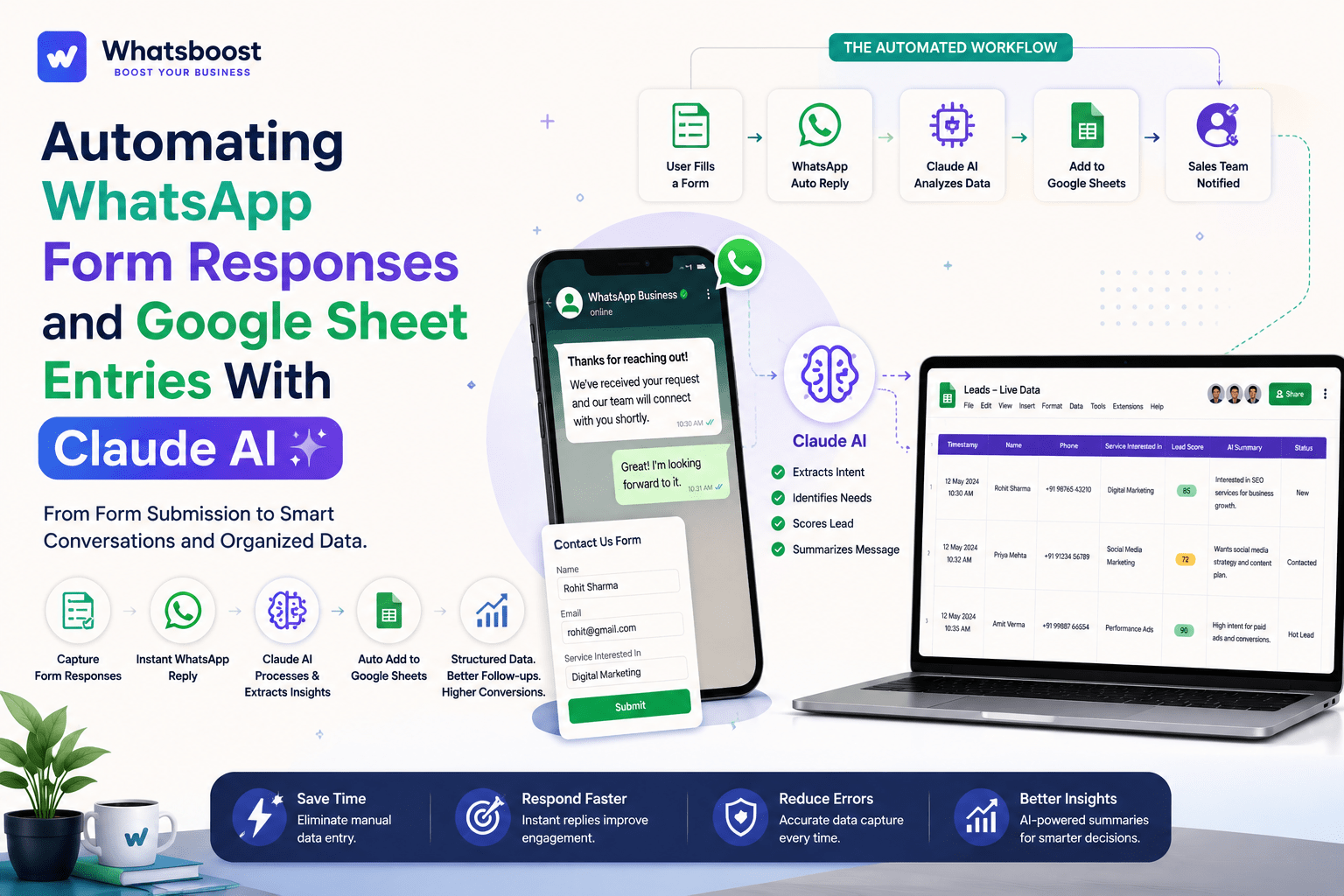
What the Workflow Actually Looks Like
A properly designed workflow usually operates like this:
| Workflow Stage | Operational Action |
|---|---|
| Customer submits form | Lead enters automation pipeline |
| WhatsApp auto-response triggers | Customer engagement begins instantly |
| Claude AI processes inquiry | Intent and requirements analyzed |
| AI generates structured output | Summary, category, urgency, qualification |
| Google Sheets updates automatically | Lead records organized |
| Sales or support teams receive insights | Faster prioritization and follow-up |
The result is not merely convenience.
It is:
structured operational continuity.
Why Businesses Are Moving Toward AI-Assisted Lead Qualification
Manual qualification creates several hidden operational problems:
inconsistent lead scoring
subjective interpretation
missed intent signals
delayed prioritization
weak reporting accuracy
Claude AI helps standardize this process.
For example, instead of sales teams manually deciding:
“Is this lead serious?”
AI workflows can automatically classify:
high-intent inquiries
pricing-focused leads
urgent consultation requests
support-related queries
repeat inquiries
low-priority interactions
based on conversational context.
This creates far stronger operational visibility.
A Major Shift Is Happening: Businesses Are Automating Context — Not Just Tasks
Traditional automation focused mainly on repetitive execution.
Example:
“If form submitted → send message.”
Modern AI workflows are evolving beyond this.
Businesses now want systems that understand:
conversational nuance
emotional tone
buying signals
customer hesitation
inquiry complexity
urgency indicators
This is where Claude AI becomes operationally powerful.
Because conversational business workflows contain:
fragmented communication
informal language
emotional context
incomplete information
Claude performs particularly well in contextual interpretation environments like these.
Why N8N Is Becoming the Preferred Workflow Layer
Businesses increasingly use n8n Official Website because modern automation workflows require much deeper orchestration flexibility than traditional no-code systems often provide.
N8N allows businesses to connect:
WhatsApp APIs
forms
Claude AI
Google Sheets
CRMs
payment systems
dashboards
internal operational workflows
inside one scalable infrastructure environment.
This becomes especially important when workflows involve:
conditional logic
AI processing
multi-step orchestration
conversational automation
operational branching
Businesses implementing advanced WhatsApp automation and follow-up workflows often eventually evolve toward AI-assisted orchestration systems like these because workflow complexity increases naturally over time.
Why Instant WhatsApp Responses Improve Lead Conversion Rates
One of the biggest reasons businesses lose leads is:
response delay.
When customers submit forms and receive no immediate engagement:
trust weakens
buying momentum drops
competitors gain advantage
Automated WhatsApp responses solve this operational gap immediately.
But there is an important distinction:
Bad automation feels robotic.
Good automation feels responsive and contextual.
For example:
Instead of:
“Your response has been recorded.”
Businesses can trigger:
“Hi Rahul 👋 Thanks for reaching out. We received your inquiry regarding digital marketing services. Our team is reviewing your requirements and will guide you shortly.”
That small contextual difference significantly improves customer perception.
Why Structured Operational Data Matters More Than Ever
Many businesses still underestimate how valuable structured conversational data becomes over time.
Once inquiries are automatically organized inside Sheets with AI-generated summaries, businesses can analyze:
common objections
campaign quality
service demand trends
inquiry categories
sales bottlenecks
lead source performance
operational delays
This transforms automation from:
a workflow tool
into:
a business intelligence layer.
That shift is extremely important for scaling businesses.
Common Use Cases Across Industries
Real Estate Businesses
Automatically:
capture property preferences
summarize budget requirements
categorize location interest
organize site-visit intent
from WhatsApp inquiries into Sheets.
Coaching and Consulting Businesses
Automatically track:
consultation requests
coaching goals
discovery call summaries
urgency levels
follow-up stages
inside operational dashboards.
Businesses already using structured WhatsApp sales funnel automation often integrate AI-powered lead qualification workflows into their sales process.
Educational Institutions
Organize:
course inquiries
student interest areas
callback requests
admission stages
counseling requirements
without manual coordination overload.
Healthcare Clinics
Automate:
appointment inquiries
treatment categories
urgency detection
patient coordination
follow-up reminders
inside centralized workflows.
Businesses heavily dependent on appointment systems often combine these workflows with structured WhatsApp appointment reminder automation to improve operational continuity.
Why Businesses Fail With Automation Projects
Interestingly, most automation failures do not happen because of the tools.
They happen because businesses:
automate broken workflows
lack operational structure
overcomplicate systems
ignore governance
create disconnected automations
fail to standardize processes
Technology alone does not create operational efficiency.
Workflow design matters far more.
This is why successful automation projects usually begin with:
operational clarity.
Why AI Workflows Must Still Feel Human
One major mistake businesses make:
over-automating communication.
Customers still want:
contextual understanding
conversational continuity
human trust
responsive coordination
The purpose of AI workflows is not replacing relationships.
It is:
removing operational friction.
The best systems use AI to:
organize workflows
improve visibility
reduce repetitive coordination
support decision-making
while keeping conversations natural.
How WhatsBoost Helps Businesses Build AI-Powered WhatsApp Workflows
WhatsBoost helps businesses build scalable automation systems connecting WhatsApp, forms, Claude AI, Google Sheets, and operational workflow infrastructure.
Businesses can automate:
lead capture
form responses
AI-powered qualification
operational reporting
customer categorization
conversational workflows
follow-up automation
inquiry routing systems
inside centralized automation environments designed for scalable business operations.
Final Thoughts
The future of customer operations will not depend only on generating more leads.
It will depend on:
how intelligently businesses manage conversations.
As WhatsApp becomes central to customer communication, businesses that can:
structure inquiries
automate coordination
organize operational data
improve response speed
extract conversational intelligence
will build far more scalable operational systems.
Connecting WhatsApp, Google Sheets, and Claude AI is not merely about automation anymore.
It is about:
building AI-assisted conversational infrastructure for modern business operations.
And that shift is becoming increasingly important across industries.
Want to automate WhatsApp for your business?
Set up campaigns, replies, and follow-ups in minutes.