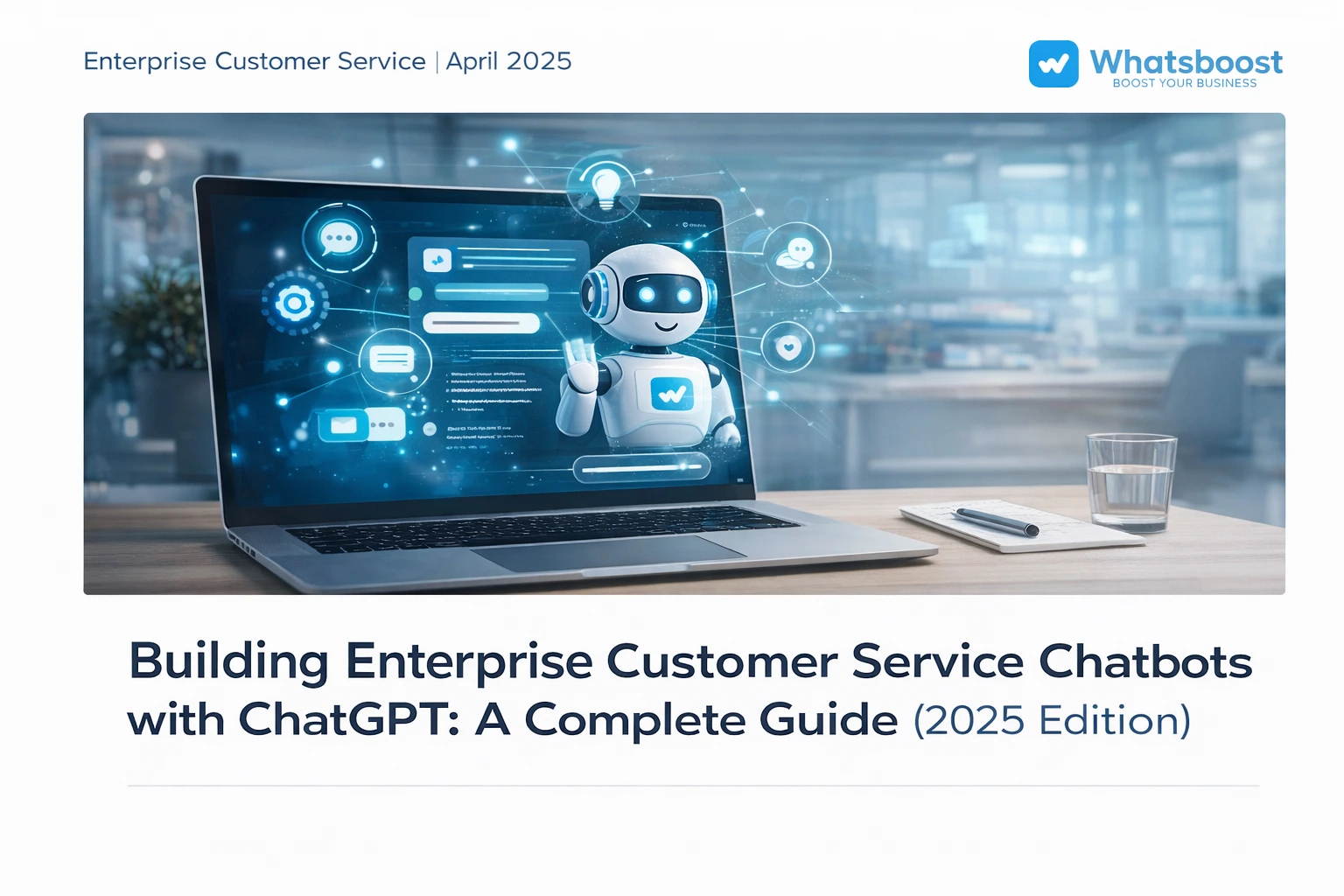
Building Enterprise Customer Service Chatbots with ChatGPT: A Complete Guide (2025 Edition)
Learn how to build enterprise customer service chatbots with ChatGPT in 2026. Explore GPT-4o features, integrations, scalability, security, and step-by-step implementation strategies for enterprises.
In today’s hyper-competitive digital landscape, enterprises are constantly under pressure to innovate faster than their competitors. Customer expectations have skyrocketed. They want instant answers, personalized responses, multilingual support, and 24/7 availability — all without friction.
For enterprises handling thousands (or even millions) of customers, delivering that level of service manually is nearly impossible.
That’s where enterprise customer service chatbots powered by ChatGPT come in.
With the rapid evolution of generative AI, businesses now have access to intelligent systems that can handle massive customer volumes while maintaining personalization, context awareness, and enterprise-grade security.
This guide walks you through everything you need to know about building enterprise customer service chatbots with ChatGPT in 2026.
What’s New in ChatGPT for Enterprise Customer Service (2026)
The enterprise AI landscape has evolved significantly since the release of ChatGPT by OpenAI in November 2022. In 2026, the platform is far more advanced, secure, and enterprise-ready.
Here’s what makes it powerful today:
GPT-4o Multimodal Capabilities
GPT-4o enables enterprises to build chatbots that understand not just text, but also voice and images. Customers can now:
Upload a damaged product image
Share screenshots of technical errors
Speak naturally instead of typing
This dramatically improves customer support experiences, especially in industries like e-commerce, fintech, SaaS, healthcare, and telecom.
Custom GPTs for Enterprise
Enterprises can now create Custom GPTs trained on:
Internal documentation
Standard Operating Procedures
Product catalogs
Legal policies
Knowledge bases
This eliminates generic answers and ensures responses are brand-aligned, accurate, and compliant.
Seamless Integrations (Connectors)
ChatGPT integrates with major business systems like:
CRM platforms
Helpdesk systems
Marketing automation tools
This allows chatbots to fetch real-time customer data, update tickets, and log conversations without manual intervention.
Enterprise-Grade Security
Security is a non-negotiable requirement for enterprise chatbot development. ChatGPT Enterprise provides:
Advanced encryption
SOC 2 compliance
Data privacy controls
Guarantee that enterprise data is not used for model training
Function Calling
Modern AI customer service chatbots can now execute actions directly:
Process refunds
Book appointments
Update subscriptions
Track orders
This transforms chatbots from simple Q&A tools into fully functional digital assistants.
Understanding AI Customer Service Chatbots
An AI customer service chatbot is a conversational system trained to understand user queries, maintain context, and provide intelligent responses based on training data.
Unlike traditional rule-based bots that rely on rigid intent trees, generative AI chatbots:
Understand natural language
Maintain multi-turn conversation context
Interpret vague or incomplete questions
Continuously improve from interactions
They can be deployed across:
Websites
Mobile apps
WhatsApp
Instagram
Facebook Messenger
Telegram
For enterprises looking to deploy AI chatbots on WhatsApp, platforms like WhatsBoost allow seamless WhatsApp automation combined with generative AI intelligence.
The Rise of ChatGPT and AI Dominance in Enterprise
Since its launch by OpenAI, ChatGPT has reshaped enterprise AI adoption. While competitors such as Google Gemini and Microsoft Copilot have made significant advancements, ChatGPT remains a leading choice for enterprise chatbot development.
Why?
Because it combines:
Advanced conversational intelligence
API flexibility
Strong developer ecosystem
Enterprise-ready infrastructure
Rapid iteration cycles
With millions of active users and widespread enterprise integration, ChatGPT has become the foundation for modern AI-powered customer service.
Why ChatGPT Is Ideal for Enterprise Chatbot Creation
When building enterprise customer service chatbots with ChatGPT, several technical advantages stand out.
Advanced Language Understanding
ChatGPT can interpret complex, multi-part questions and extract intent with high accuracy. Customers no longer need to phrase queries perfectly.
Context Retention
It maintains conversation history, enabling seamless multi-turn interactions — critical for troubleshooting or issue escalation.
Massive Scalability
ChatGPT-powered systems can handle thousands of simultaneous conversations without performance degradation.
Deep Customization
Through prompt engineering and custom training, enterprises can define:
Tone of voice
Escalation rules
Compliance safeguards
Brand guidelines
Intelligent Routing
When a query exceeds automation scope, the chatbot can detect complexity and transfer the conversation to a human agent — along with a summarized context.
Benefits of ChatGPT-Powered Enterprise Chatbots
Enterprises implementing AI-driven customer service see measurable results.
24/7 Availability
Customer support without downtime.
Reduced Response Time
Average response time drops from hours to seconds.
Cost Savings
Automation can reduce operational costs by up to 30%.
Improved Customer Satisfaction
Instant, accurate responses increase trust and loyalty.
Multilingual Support
Support global audiences in 50+ languages natively.
Omnichannel Deployment
Deploy once and operate across multiple channels.
For WhatsApp-first enterprises, integrating with WhatsBoost allows businesses to combine AI chatbot intelligence with WhatsApp broadcast automation, CRM syncing, and lead segmentation.
Step-by-Step: How to Build an Enterprise Customer Service Chatbot with ChatGPT
1. Define Strategy and Objectives
Start by answering:
Are you reducing ticket volume?
Improving first-response time?
Driving upsell through support?
Automating repetitive queries?
Clarity here shapes everything.
Define user personas and map conversation journeys before writing a single line of code.
2. Collect and Prepare Data
AI models rely on quality data.
Gather:
Historical support tickets
Chat transcripts
FAQ documentation
Product manuals
Clean and categorize them properly.
3. Integrate the ChatGPT API
Using the API provided by OpenAI, you can:
Generate API keys
Configure system messages
Send conversation prompts
Capture AI responses
Store logs for analysis
Carefully craft system prompts to define tone, compliance rules, and escalation triggers.
4. Add Advanced Functionalities
To elevate your enterprise chatbot:
Integrate CRM systems
Enable order tracking APIs
Add payment or subscription management
Enable function calling
This transforms the chatbot from an informational tool to a transactional assistant.
5. Test, Optimize, and Improve
Testing is ongoing.
Simulate:
Frustrated customers
Multilingual queries
Complex technical questions
Compliance-sensitive issues
Use conversation analytics to identify weak spots and refine prompts continuously.
Deploying ChatGPT Chatbots on WhatsApp with WhatsBoost
WhatsApp has become a primary communication channel for enterprises globally.
With WhatsBoost, businesses can:
Deploy AI-powered WhatsApp chatbots
Automate customer replies
Segment users intelligently
Send targeted broadcast campaigns
Sync conversations with CRM
This creates a unified AI-driven support ecosystem across web and messaging channels.
For enterprises focused on WhatsApp automation, integrating ChatGPT with WhatsBoost ensures scalability without losing personalization.
Common Enterprise Challenges (And How to Solve Them)
Even the most advanced AI systems require governance.
Challenges include:
Model hallucinations
Compliance constraints
Bias in historical data
Security requirements
Mitigation strategies:
Guardrail prompts
Regular content updates
Human-in-the-loop reviews
Monitoring conversation logs
AI is powerful — but responsible deployment is essential.
The Future of Enterprise Customer Service
The future of enterprise customer service is not just chat-based.
We’re seeing rapid growth in:
Voice-first AI bots
Video-enabled assistants
Emotion-detection AI
Predictive customer support
Enterprises that invest today will gain a lasting competitive edge tomorrow.
Frequently Asked Questions
Is ChatGPT suitable for enterprise-level deployment?
Yes. With enterprise-grade security, scalability, and customization, it is designed for large-scale business applications.
Can ChatGPT integrate with CRM systems?
Yes. It integrates with major CRM and helpdesk tools through APIs and connectors.
How much cost reduction can enterprises expect?
Many studies suggest up to 30% reduction in customer support operational costs.
Can AI customer service chatbots handle multilingual users?
Yes. Modern generative AI models support 50+ languages natively.
FAQs About WhatsBoost Automation
What is WhatsBoost?
WhatsBoost is a WhatsApp automation platform that helps enterprises automate customer engagement, support, and broadcast campaigns.
Can WhatsBoost integrate with ChatGPT?
Yes. It enables AI-powered WhatsApp chatbot deployment using generative AI models.
Is WhatsBoost suitable for enterprises?
Yes. It supports CRM integration, segmentation, analytics, and high-volume messaging.
Does WhatsBoost support multilingual automation?
Yes. Businesses can automate conversations in multiple languages across WhatsApp.
Final Thoughts
Building enterprise customer service chatbots with ChatGPT is no longer optional — it is strategic.
Enterprises must:
Design thoughtfully
Train with high-quality data
Integrate securely
Continuously optimize
When combined with omnichannel automation platforms like WhatsBoost, AI-powered chatbots become a scalable growth engine — not just a support tool.
The future of enterprise customer service is intelligent, conversational, and automated.
The only question is: how quickly will your enterprise adapt?
Want to automate WhatsApp for your business?
Set up campaigns, replies, and follow-ups in minutes.