
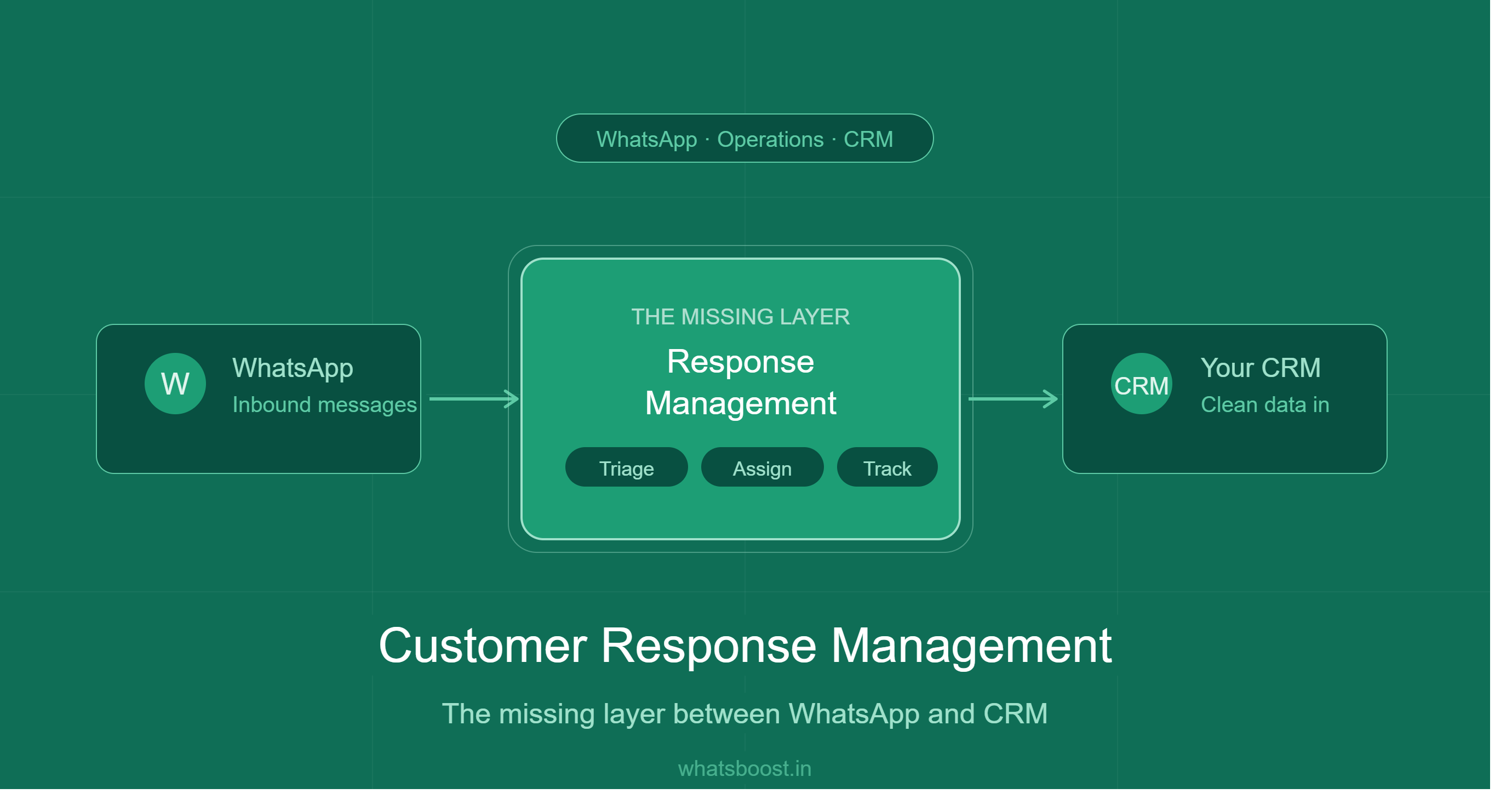
Customer Response Management: The Missing Layer Between WhatsApp and CRM
Most businesses connect WhatsApp to their CRM and assume the problem is solved. It isn't. This article breaks down the operational layer that sits between the two — and shows exactly how to build it.
There is a version of this story that plays out in thousands of Indian businesses every day. A prospect messages on WhatsApp. The message is seen. Someone means to respond. The CRM exists, the integration is live, the automations are running — and the lead still goes cold.
If you have already connected WhatsApp to your CRM and you are still watching conversations die before they convert, the integration is not your problem. The gap lives somewhere else entirely — in the unmanaged space between a message arriving and a meaningful response going out. That space has a name: customer response management. And for most SMBs and MSMEs, it does not exist as a deliberate system.
This article is written for businesses that are past the setup stage. You have the tools. What you are missing is the operational layer that turns tool connectivity into conversation accountability.
What Customer Response Management Actually Means
Customer response management is not a software category. It is a set of deliberate decisions about who responds to which message, within what time, with what level of authority, and according to what context — and how that response activity feeds back into the business's operational intelligence.
Most WhatsApp guides focus on what happens before a message arrives (campaigns, broadcasts, automation triggers) or what happens after a conversation closes (CRM logging, pipeline movement, retargeting). Very few address what happens during the conversation — the triage, the context-matching, the handoff, the follow-through.
That middle layer is where conversion actually lives. A well-designed CRM integration ensures that data flows correctly. A well-designed response management system ensures that conversations are handled correctly. These are two different problems, and solving one does not solve the other.
A workable definition: Customer response management on WhatsApp is the operational system that governs how inbound messages are received, triaged, assigned, responded to, and tracked — independently of whether those messages are eventually logged in a CRM.
The CRM records the outcome. Response management determines the outcome.
Why CRM Integration Alone Does Not Solve the Response Problem
When a business connects WhatsApp to its CRM, it typically gains three things: contact syncing, conversation logging, and trigger-based automations. These are genuinely useful. They eliminate manual data entry, reduce follow-up gaps on known contacts, and create a paper trail for every interaction.
What they do not create is response discipline.
Consider what actually happens when three messages arrive simultaneously from three different prospects — one asking about pricing, one following up on a proposal sent two days ago, and one who has messaged twice before without receiving a reply. A CRM integration logs all three. But it does not tell your team which one to answer first, which one carries the highest risk of losing the relationship, or which one requires a senior response rather than a templated reply.
That judgement — the triage judgement — belongs to a response management layer that most businesses have never formally designed. Instead, it defaults to whoever happens to pick up the phone, whoever is least busy in the moment, or whoever remembers that a particular conversation was pending. This is not a technology failure. It is an operational design failure.
The businesses that consistently convert WhatsApp leads are not necessarily running better CRMs. They are running better response systems.
The Four Operational Failures That Live in the Gap
Before designing a response management system, it helps to name the specific failure modes that occur when this layer is absent. Most businesses recognise at least two or three of these from direct experience.
The Visibility Failure occurs when no one has a clear view of which conversations are open, which are waiting for a response, and which have been silently abandoned. WhatsApp's native interface was not built for team accountability. In a shared inbox without proper triage logic, messages get seen by multiple people and responded to by none — because everyone assumes someone else is handling it.
The Context Failure occurs when the person responding to a message has no access to the history of that relationship. A prospect who messaged three weeks ago, received a brochure, went silent, and has now returned with a question is not a new contact. But if the responding agent has no visibility into that history, the conversation starts from scratch — and the prospect notices. This failure is particularly common when response duties shift across team members or across shifts.
The Priority Failure occurs when response order is determined by recency rather than intent. The most recent message is not always the most urgent. A prospect who has been waiting 48 hours for a follow-up on a ₹5 lakh decision represents a higher-priority response need than a fresh inquiry that arrived two minutes ago. Without a triage framework, businesses consistently respond in the wrong order.
The Accountability Failure occurs when there is no closed-loop system to confirm that a response was actually sent, what was said, and what the next action is. This failure produces the characteristic pattern of "I thought you were handling it" — conversations that were assigned but never completed, or completed but never updated in any shared system.
Each of these failures is invisible in aggregate CRM data. A CRM will show you that a conversation exists. It will not show you that the conversation was handled badly.
Building the Response Management Layer: A Framework for SMBs
Designing a functional response management system does not require enterprise software. It requires three things: a triage protocol, an assignment logic, and a response accountability loop. Each of these can be implemented with tools most SMBs already have.
Triage Protocol: Sorting Before Responding
Triage is the practice of assessing a message before responding to it. Most teams skip this step — they read the message and immediately type a reply. The problem is that an unassessed response is often the wrong response: wrong tone, wrong depth, wrong escalation level.
A workable triage protocol for WhatsApp assigns every inbound message one of four status categories before response begins.
| Message Category | Definition | Target Response Time | Responder Level |
|---|---|---|---|
| High-intent return | Prospect who previously engaged, now re-initiating | Within 15 minutes | Senior sales or owner |
| Fresh high-intent inquiry | New contact with specific product/service question | Within 30 minutes | Sales team |
| Information request | General query, pricing, availability | Within 2 hours | Support or junior sales |
| Passive engagement | Reply to broadcast, general acknowledgment | Same day | Automated or junior |
The purpose of this table is not to create bureaucracy. It is to ensure that a returning prospect who is ready to decide does not wait three hours because the team was busy responding to broadcast replies.
Triage does not need to be a manual scoring exercise. With WhatsApp automation tools, message content can trigger automatic categorisation — a message containing "finalise," "ready to proceed," or "when can we sign" can be flagged as high-intent and routed to a specific team member instantly.
Assignment Logic: Deciding Who Responds
Once a message is triaged, it needs to be assigned — not left open for whoever picks it up. Assignment logic is the set of rules that governs which team member receives which conversation, and under what conditions a conversation escalates.
For most SMBs, effective assignment logic has three components.
The first is relationship continuity. A returning contact should always be assigned to the team member who handled their last conversation, unless that person is unavailable. Continuity signals respect and avoids the context failure described earlier. Automation tools that route by contact history rather than round-robin ensure this without manual intervention.
The second is capacity awareness. Assignment based purely on relationship history breaks down when team members are at capacity. A practical override rule: if the designated respondent has not replied within the defined triage window, the conversation automatically reassigns to the next available team member, with a context note transferred alongside it.
The third is escalation triggers. Certain conversation signals — price negotiation, complaint language, legal or regulatory questions, repeat unanswered attempts — should automatically escalate to a senior team member or owner. Defining these triggers in advance prevents the scenario where a high-stakes conversation is handled by someone without the authority to resolve it.
Response Accountability Loop: Closing the Circle
The accountability loop is the mechanism that confirms responses were sent, tracks what was said, and records the agreed next action. Without it, assignment is a theoretical exercise — conversations get assigned and then drift.
A functional accountability loop has three closure points. The first is response confirmation: a mechanism that marks a conversation as responded, not merely as open. The second is next-action recording: every closed conversation should carry a tagged next action — follow up in three days, send proposal, escalate to owner, or mark as not interested. The third is escalation visibility: any conversation that has not been responded to within the defined triage window should surface automatically to a supervisor or owner for intervention.
This loop does not need to be complex. What it needs to be is consistent. The single most common failure in SMB response management is a system that works during business hours and collapses on evenings, weekends, and holidays — precisely when high-intent buyers are most active on WhatsApp.
The Handoff Problem: When WhatsApp Conversations Need to Move
One of the least-discussed dimensions of response management is the handoff — the moment when a WhatsApp conversation needs to transfer from one team member, function, or system to another without losing context or momentum.
Handoffs in WhatsApp are structurally fragile. Unlike email, which carries a visible thread that can be forwarded with history intact, a WhatsApp conversation reassigned from one agent to another starts visually fresh for the new responder. Unless context is explicitly transferred — through internal notes, CRM tags, or a structured handoff message — the new agent is responding blind.
The handoff problem is especially acute in businesses where sales and support are separate functions. A prospect who closes a sale through the sales team and then messages with a post-purchase query is often treated as a new contact by the support team — because the conversation history lives in the sales agent's WhatsApp thread and not in a shared system. This produces the experience, familiar to many Indian consumers, of having to explain their situation from scratch every time they contact a business.
Solving the handoff problem requires two commitments. First, all contextually significant WhatsApp conversations must be summarised and stored before they are reassigned — not just logged as conversation records, but summarised with the key facts, the agreed terms, and the current status. Second, the receiving agent must be required to acknowledge receipt of that context before initiating contact with the customer. A response sent without context acknowledgement is a response that may undo previous relationship work.
Response Time as a Conversion Variable
The relationship between response time and conversion probability in WhatsApp-based sales is not linear. It follows a step-function pattern with three distinct thresholds that matter operationally.
The first threshold is the first five minutes. A response within five minutes of an initial message from a high-intent prospect has significantly higher conversion probability than a response at thirty minutes — not because the quality of the response is different, but because the prospect's attention window is still open. After five minutes, the prospect has typically moved to another tab, another conversation, or another activity. Your response is now competing with whatever recaptured their attention.
The second threshold is the 24-hour mark. For prospects who have received an initial response and are in the evaluation stage, a follow-up that arrives after 24 hours of silence is frequently perceived as disinterest. Buyers in competitive categories — education, real estate, financial services, healthcare — are often evaluating multiple providers simultaneously. The provider who follows up within the day maintains presence in the consideration set. The one who waits three days often does not.
The third threshold is the re-engagement window. For prospects who have gone silent after initial engagement, a re-engagement message sent between day four and day seven has meaningfully higher open and response rates than one sent after two weeks. After fourteen days, a dormant WhatsApp conversation is rarely revived through outbound effort alone.
Understanding these thresholds allows a business to move from reactive response management — answering messages when they can — to proactive response management — engineering response timing as a deliberate conversion lever.
What a Functioning Response Management System Looks Like in Practice
To make this concrete, consider how a mid-sized coaching institute managing 200 to 400 WhatsApp inquiries per month could implement this framework without adding headcount.
All inbound messages route into a shared WhatsApp inbox managed through an automation platform. Every message receives an automatic first response within 60 seconds — not a generic greeting, but a contextually appropriate acknowledgment that reflects the nature of the inquiry. This buys response time without sacrificing presence.
In the background, the message is simultaneously categorised by intent signal — a question about the next batch date is categorised differently from a message saying "I want to enrol, what is the process." High-intent messages trigger an immediate assignment notification to the sales team. Information-only messages route to a support queue with a two-hour response window.
All conversations assigned to team members carry a visible expiry timer. If no response is logged within the triage window, the conversation surfaces on the supervisor's dashboard as an overdue item. This replaces the informal "I forgot to reply" failure mode with a visible accountability structure.
Every conversation that reaches a close state — whether the outcome is enrollment, not interested, or follow up later — is tagged with a disposition and a next-action date. That data flows into the CRM not as a raw conversation log but as a structured record: contact, intent category, conversation summary, outcome, next action.
What the CRM now receives is not just data about conversations. It receives intelligence about conversations. That distinction drives the quality of every downstream workflow — retargeting, nurturing, and re-engagement sequences — because those sequences are now built on characterised intent rather than on raw contact lists.
The Connection Between Response Management and CRM Data Quality
There is a feedback relationship between response management and CRM data quality that most businesses overlook when they think about integration.
When conversations are handled without a response management layer, CRM data degrades quickly. Contacts are logged without context. Pipeline stages are updated inconsistently. Tags are applied based on the respondent's interpretation of the conversation rather than a defined categorisation standard. Over time, this produces a CRM that contains hundreds or thousands of records that cannot be acted upon reliably — because no one is confident about what the data actually means.
A response management system solves this upstream. When every conversation is triaged, assigned, and closed with a structured disposition, the data that enters the CRM is clean by construction. The triage category becomes a reliable intent signal. The disposition tag becomes a reliable pipeline stage. The next-action date becomes a reliable trigger for automation.
This means that the ROI of a response management system is not limited to improved conversion rates on individual conversations. It compounds into better retargeting, better segmentation, better campaign performance, and better business forecasting — because all of those downstream operations are running on data that was captured correctly at the point of conversation.
If you are evaluating how WhatsApp automation fits into your broader response and CRM workflow, see how WhatsBoost handles CRM integration for Indian businesses and how to build retargeting workflows on top of your conversation data.
Want to automate WhatsApp for your business?
Set up campaigns, replies, and follow-ups in minutes.