
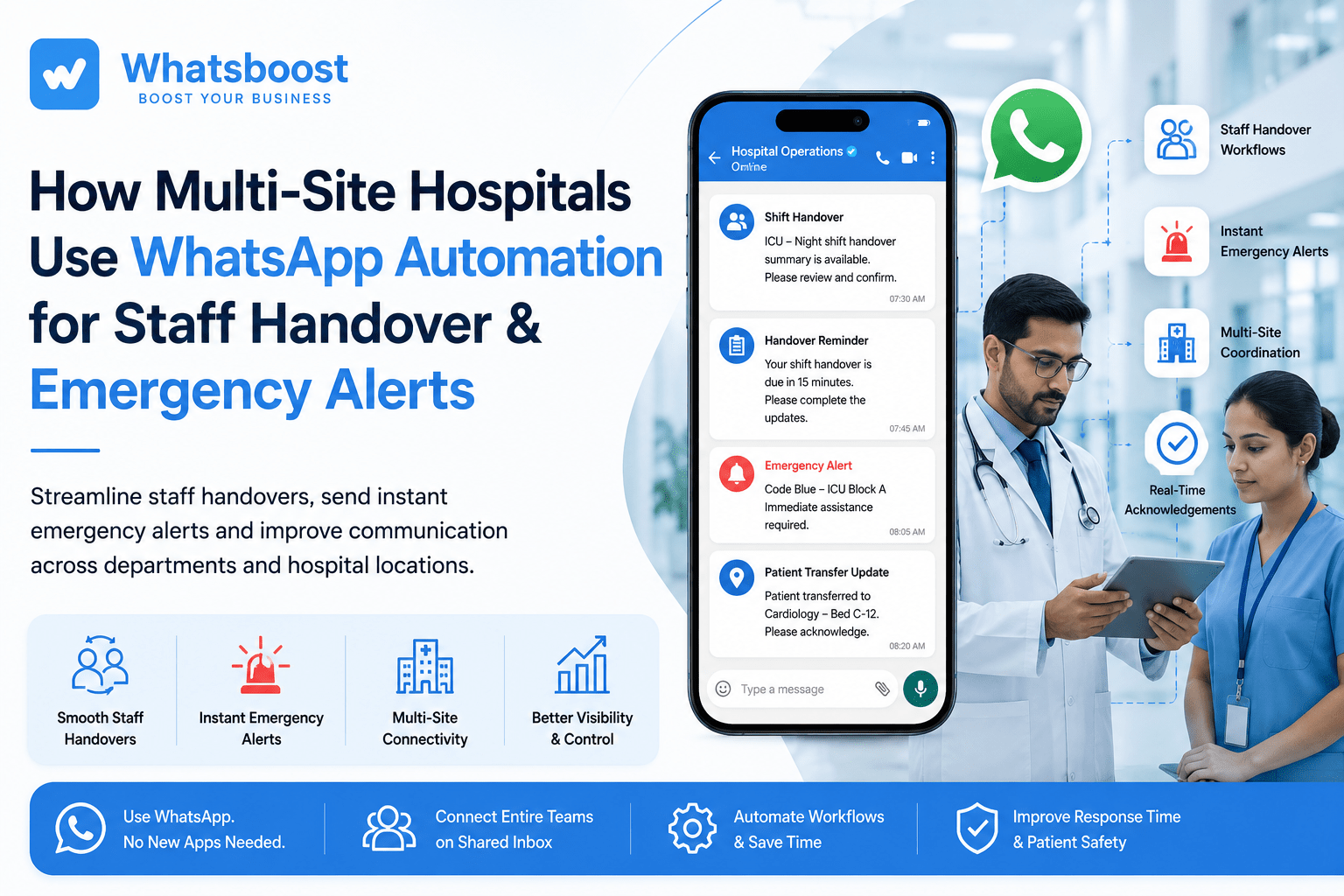
How Multi-Site Hospitals Use WhatsApp Automation for Staff Handover & Emergency Alerts
Managing communication across multiple hospital locations is challenging. Learn how hospitals use WhatsApp automation to improve staff handovers, emergency alerts, shift coordination, and operational visibility across departments.
In healthcare, delays are costly.
Not just financially.
Operationally.
Clinically.
A missed handover update, delayed emergency notification, or incomplete communication between teams can affect patient care, staff efficiency, and hospital operations.
The challenge becomes even greater for healthcare organizations operating multiple facilities.
A hospital group may have:
Multiple hospitals
Specialty centers
Diagnostic facilities
Emergency departments
Outpatient clinics
Satellite healthcare locations
Each location generates a constant stream of operational communication.
Staff handovers.
Emergency escalations.
Patient transfers.
Resource requests.
Critical updates.
Managing all of this through phone calls, emails, and scattered WhatsApp groups often creates communication gaps.
This is why many healthcare organizations are exploring WhatsApp automation as a structured communication layer for hospital operations.
Why Communication Becomes Complex in Multi-Site Hospitals
As healthcare networks expand, communication complexity grows rapidly.
Information must move between:
Doctors
Nurses
Department heads
Emergency teams
Administrative staff
Facility managers
Ambulance coordination teams
The challenge is rarely a lack of communication.
The challenge is coordination.
Common Operational Issues
| Challenge | Operational Impact |
|---|---|
| Shift handover delays | Missing information |
| Emergency alerts shared manually | Slower response times |
| Communication spread across channels | Reduced visibility |
| Staff relying on personal calls | Inconsistent updates |
| Multiple facilities operating independently | Coordination gaps |
Healthcare operations can only move as efficiently as the information flowing between teams.
Staff Handover Is One of the Most Critical Communication Processes
Every hospital relies on handovers.
When shifts change, information must transfer accurately.
This may include:
Patient status updates
Pending procedures
Medication schedules
Critical observations
Escalations
Resource requirements
Traditional handover processes often rely on:
Verbal communication
Notes
Phone calls
Emails
Department WhatsApp groups
As hospitals grow, these approaches become harder to manage consistently.
How WhatsApp Automation Supports Staff Handover Workflows
WhatsApp automation helps standardize routine communication during shift transitions.
Instead of relying entirely on manual coordination, hospitals can automate operational notifications and workflow triggers.
Shift Change Notifications
Automated messages can notify incoming staff about:
Shift assignments
Department allocation
Reporting instructions
Coverage requirements
This reduces last-minute confusion.
Handover Reminders
Staff can receive reminders before shift transitions to ensure critical information is documented and communicated.
Escalation Tracking
When important updates require attention, automated workflows can ensure the right teams are informed immediately.
The objective is not replacing clinical systems.
The objective is improving operational communication.
Emergency Alerts Require Speed and Consistency
Emergency situations demand immediate coordination.
Examples include:
Code Blue events
Critical patient escalations
Equipment failures
Facility incidents
Disaster response scenarios
Infrastructure disruptions
Many hospitals still depend heavily on phone calls and manual notification chains.
These processes often create delays.
The Problem With Manual Emergency Communication
Consider a situation where multiple departments must be informed quickly.
Staff may need to:
Call supervisors.
Inform department heads.
Notify support teams.
Escalate to leadership.
Each additional step increases response time.
How WhatsApp Automation Improves Emergency Communication
Automated workflows can distribute alerts instantly to predefined groups and stakeholders.
For example:
| Event | Automated Notification |
|---|---|
| Critical incident reported | Alert sent to emergency response team |
| Equipment failure | Maintenance team notified |
| Emergency admission surge | Staffing coordinators informed |
| Facility disruption | Leadership and operations teams alerted |
This reduces dependency on manual notification chains.
The goal is not simply faster messaging.
The goal is faster operational awareness.
Communication Visibility Matters in Healthcare
Many healthcare organizations struggle with a visibility problem.
Managers often ask:
Was the alert delivered?
Which teams acknowledged the update?
Has the handover been completed?
Which departments have responded?
Are escalations still pending?
Without visibility, communication becomes difficult to track.
Communication visibility is the ability to understand the status, progress, and acknowledgement of operational communication in real time.
As healthcare systems grow, visibility becomes increasingly important.
Multi-Site Hospitals Need Structured Communication Systems
Many healthcare organizations eventually reach a point where informal communication stops scaling.
What works for a single facility often becomes difficult across multiple locations.
Common challenges include:
Different communication practices across sites
Information silos
Delayed escalations
Limited operational oversight
Structured communication workflows help create consistency across the organization.
Real-World Example
Imagine a healthcare group operating:
Three hospitals
Two specialty clinics
One diagnostic center
Every day, hundreds of operational messages are exchanged.
Without structured workflows:
Staff handovers vary by department.
Emergency notifications depend on individual actions.
Important updates may be missed.
Leadership lacks communication visibility.
With WhatsApp automation:
Shift notifications are standardized.
Emergency alerts are distributed instantly.
Escalations follow predefined workflows.
Operational visibility improves across facilities.
The result is not merely better communication.
The result is better coordination.
Beyond Emergency Alerts and Handovers
Hospitals can also automate additional operational workflows.
Staff Scheduling Updates
Communicate:
Shift changes
On-call schedules
Coverage requirements
Department rotations
Training Notifications
Notify staff about:
Compliance programs
Medical training
Certifications
Internal workshops
Administrative Alerts
Automate updates regarding:
Facility operations
Resource availability
Maintenance activities
Policy changes
These workflows help reduce manual coordination overhead.
WhatsApp as an Operational Communication Layer
Many healthcare organizations already use WhatsApp informally.
The challenge is that informal communication becomes difficult to manage at scale.
WhatsApp automation introduces structure.
Instead of relying on scattered conversations, hospitals can build repeatable workflows around operational communication.
This approach is similar to how healthcare providers use automated patient communication systems for reminders, follow-ups, and appointment coordination. Related reading: How to Send WhatsApp Reminders to Patients from Google Sheets and 24/7 Healthcare WhatsApp Support: Complete Implementation Guide for Hospitals & Clinics. These examples demonstrate how automation improves communication consistency across healthcare operations. (whatsboost.in)
How WhatsBoost Supports Healthcare Communication Workflows
WhatsBoost helps organizations automate WhatsApp communication workflows across departments, teams, and operational processes.
Healthcare organizations can use WhatsBoost to support:
Staff notifications
Shift communication
Escalation workflows
Emergency alerts
Operational updates
Internal coordination
The objective is not to replace healthcare systems.
The objective is to ensure critical information reaches the right people at the right time.
Key Takeaways
Multi-site hospitals face unique communication challenges.
Staff handovers, emergency alerts, and operational coordination become increasingly complex as healthcare networks expand.
WhatsApp automation helps hospitals:
Standardize communication workflows
Improve staff handovers
Accelerate emergency notifications
Increase communication visibility
Reduce manual coordination
Support operational consistency across facilities
In modern healthcare operations, communication is not just an administrative function.
It is operational infrastructure.
Frequently Asked Questions
How do hospitals use WhatsApp automation?
Hospitals use WhatsApp automation for staff communication, shift notifications, emergency alerts, appointment reminders, escalation workflows, and operational coordination.
Can WhatsApp automation improve staff handovers?
Yes. Automated reminders, notifications, and workflow-driven communication help improve consistency during staff transitions and shift changes.
Why are emergency alerts important in hospital communication?
Emergency alerts help ensure critical information reaches the right teams quickly, enabling faster coordination and response during urgent situations.
Is WhatsApp suitable for multi-site hospital communication?
Many healthcare organizations already use WhatsApp. Automation helps standardize communication and improve operational visibility across multiple facilities.
How can WhatsBoost help hospitals?
WhatsBoost enables healthcare organizations to automate WhatsApp communication workflows, helping improve coordination, notifications, escalations, and operational communication across teams and locations.
Want to automate WhatsApp for your business?
Set up campaigns, replies, and follow-ups in minutes.