How Our Team Uses Whatsboost to Keep WhatsApp Leads Accessible, Not Lost on Personal Phones
Most Indian businesses manage WhatsApp leads on personal phones — and lose everything the moment a rep leaves, goes on leave, or simply forgets to follow up. This guide explains exactly why that's a structural problem rather than a discipline one, and how moving to a shared WhatsApp team inbox through Whatsboost keeps every lead conversation accessible to the business, not held hostage by an individual device.
There's a specific kind of panic that every sales manager in India has felt at least once.
A sales rep resigns. Or goes on leave. Or simply changes their phone number.
And then the question arrives — quietly at first, then louder: where are all the leads they were talking to?
The answer, almost always, is sitting in a personal WhatsApp inbox on a phone the company doesn't own, can't access, and has no visibility into. Months of conversations, follow-ups, pricing discussions, and warm relationships — gone. Not because someone was careless, but because that's how most Indian businesses have structured their WhatsApp sales process without realising the structural risk they were creating.
This article isn't about blaming sales reps for using personal phones. It's about how our team identified that problem, understood exactly why it happens, and built a system using Whatsboost that keeps every lead accessible to the business — not trapped on a personal device.
The Scope of What Gets Lost
Before getting to the solution, it's worth sitting with the scale of the problem for a moment.
80% of small and medium businesses in India use WhatsApp as a primary customer communication tool — making it the single most important channel for lead management in the country. Yet the dominant operating model for most of these businesses is the same: individual reps use their personal numbers or personal WhatsApp Business accounts to manage leads, with no shared visibility and no organisational backup.
The consequences compound in ways that aren't immediately visible:
When a rep leaves, studies consistently show that businesses using personal WhatsApp numbers for sales lose the entire conversation history along with the contact — because the number, the chats, and the relationships all belong to the individual, not the company.
When a rep is sick or on leave, leads who message during that window either get no response or get redirected to start the conversation over — one of the fastest ways to lose a lead that was already warm.
When a rep handles the same lead that another rep has already spoken to, neither knows — because there's no shared context, no conversation history, and no way to see what's already been said.
With 80% of recipients reading WhatsApp messages within five minutes, the speed advantage of WhatsApp is real. But that advantage is entirely wasted when the lead's message arrives in a personal inbox that nobody else can see, and the rep who owns it is unavailable.
Why This Problem Is Structural, Not Behavioural
The instinct when this comes up in team meetings is to frame it as a discipline issue. "Reps should share lead details." "Everyone should update the CRM." "We need to be more organised."
None of these instincts are wrong, but they all treat the symptom rather than the cause.
The real problem is architectural. Personal WhatsApp numbers are not designed for team collaboration. They have no shared inbox. No conversation assignment. No visibility controls. No way for a manager to see what's happening across the team's conversations. No audit trail of what was said and when.
When you use a tool for a purpose it wasn't designed for — and then hold people accountable for the tool's structural limitations — you get frustration on all sides and the same problem every three months when the next rep leaves.
The right solution isn't more discipline. It's a different tool.
What "Accessible" Actually Means for a Sales Team
Before describing what changed when our team implemented Whatsboost, it's worth defining what "accessible" actually needs to mean in a functioning sales operation.
A lead is truly accessible when:
Any authorised team member can pick up a conversation without the customer having to repeat context, re-introduce themselves, or restart the relationship.
The conversation history is owned by the business, not the individual rep — so it survives role changes, resignations, and leaves.
A manager can see the status of any lead in the pipeline without having to ask the rep directly or wait for a manual update.
Leads can't fall through the cracks just because one person is unavailable — there's always a path for the lead's message to reach someone who can respond.
The response time standard is consistent across the team, regardless of which rep is handling which conversation.
None of this is complicated to understand. The complication was always in finding a system that delivers it on top of WhatsApp specifically — because WhatsApp is where Indian leads actually communicate, and moving them to email or a ticketing system is not a realistic solution.
What Changed When We Moved to a Shared Inbox on Whatsboost
The shift our team made was moving from individual personal numbers to a single business number managed through Whatsboost's shared team inbox.
Here's what that looks like in practice — not in theory, but in the actual day-to-day:
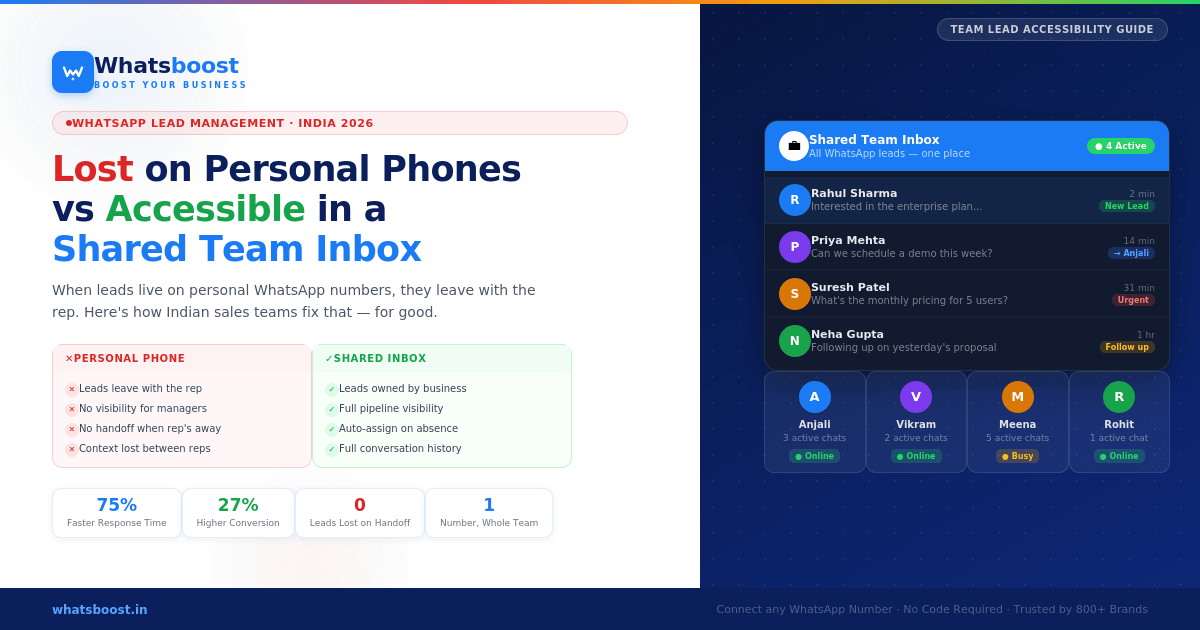
One number, visible to the whole team. Every conversation that comes into our WhatsApp business number appears in the shared inbox. Every team member with access sees it. No conversation exists only in one person's phone.
Conversations are assigned, not assumed. When a new lead messages, the conversation is either auto-assigned based on routing rules or manually assigned by the team lead. The assigned rep sees it in their queue. Everyone else can see who owns it without asking.
Conversation history is permanent and shared. If a rep who handled a conversation is unavailable, any other team member can pick it up and read the full thread — including previous messages, what was offered, what the lead said, and where the conversation was left. No "can you forward me that chat" conversations. No context lost.
Managers can see everything without asking. Response times, open conversations, stale leads, team workload distribution — all visible in real time without requiring any rep to report anything manually.
Leads belong to the business, not the rep. When a rep leaves, their conversations stay in the system. The next person picks up exactly where they left off.
The Operational Difference: Before and After
The clearest way to describe what changed is to walk through a few scenarios that used to create problems and explain what happens now.
Scenario 1: A rep goes on leave
Before: Lead messages the rep's personal number. Rep is in a hill station with intermittent network. Lead doesn't get a response for 36 hours. By the time the rep returns, the lead has either gone to a competitor or has gone cold. Nobody on the team knew this was happening.
After: Lead messages the business number. The conversation appears in the shared inbox. Team lead sees it's unassigned or the assigned rep is marked unavailable. Conversation is reassigned to another team member in minutes. Lead gets a response the same day with full context from previous messages.
Scenario 2: A rep leaves the company
Before: HR asks the rep to "hand over leads." Rep shares some names, forgets others, and the WhatsApp conversations stay on their phone. Three months later, a lead that was warm reaches out again — but messages the rep's personal number, which now belongs to someone else entirely.
After: All conversations from the departing rep's assignments are already in the shared system. The account manager can see every thread, every prior discussion, and every lead's status. The handover is a matter of reassigning — not reconstructing from memory.
Scenario 3: Two reps unknowingly contact the same lead
Before: Rep A spoke to a lead three weeks ago about a proposal. Lead went quiet. Rep B found the same lead through a different channel and reached out fresh. Lead receives two different messages from the same company with different pricing references. It damages trust and looks unprofessional.
After: When Rep B opens a conversation with that number, the system shows the existing conversation history. Rep B can immediately see Rep A's prior context, pick up the thread correctly, and avoid the duplication entirely.
The Lead Qualification Layer That Makes It Scalable
Shared visibility is necessary but not sufficient on its own. A shared inbox that gets flooded with unqualified inquiries creates its own kind of chaos — every rep sees every message, nobody knows who should respond to what, and response quality drops.
The second piece our team added was automated qualification running before leads ever reach a human. This means that by the time a lead lands in the shared inbox for team assignment, they've already answered the qualification questions — intent, budget range, timeline, and use case — automatically.
The rep who picks up the conversation isn't starting cold. They're picking up a conversation that has already established context. The lead doesn't feel like a machine is processing them, because the qualification flow is designed to feel conversational. And the team's time is spent on conversations that are worth having, not on figuring out whether an inquiry is real.
This combination — shared inbox plus automated qualification — is what makes the system actually scale rather than just making the chaos more visible to more people.
What the Data Says About Teams That Make This Shift
The business case isn't just operational. The numbers are clear on what happens when businesses move from personal-number chaos to structured team WhatsApp management.
A retail brand operating across multiple time zones using WhatsApp Business API via Whatsboost saw a 75% improvement in response time and a significant reduction in missed leads after moving to a centralised team inbox.
Companies report saving up to 30% on communication costs after switching to WhatsApp Business API, largely because better lead visibility means fewer leads needing to be re-acquired.
WhatsApp can increase sales conversion rates by up to 27% when used for lead nurturing — but that nurturing can only happen consistently when the lead's conversation is accessible to whoever is available to continue it.
The pattern across all of these outcomes is the same: the improvement doesn't come from WhatsApp being a better channel. It comes from the team being able to actually use the channel properly — which requires the structural layer that personal phones cannot provide.
The Common Objections (And What We Learned)
When our team first discussed moving to a shared WhatsApp system, a few concerns came up consistently. They're worth addressing because they're genuine.
"Our leads are used to our personal numbers."
Most leads don't care which number they're messaging — they care about the quality and speed of the response. A business number that responds quickly and with full context feels more professional than a personal number that responds slowly or not at all.
"Our reps will feel like they're being monitored."
This is worth taking seriously. The framing that worked for our team was positioning shared visibility as coverage rather than surveillance. "If you're unavailable, your leads get taken care of. If you're overwhelmed, someone can help. Nothing gets lost because you were in a meeting." That framing shifted the conversation entirely.
"Setting this up sounds technically complex."
Setting up WhatsApp Business for multiple agents through Whatsboost doesn't require API expertise or a developer. The onboarding process is guided, the interface is familiar to anyone who uses WhatsApp, and most teams are operational within a day or two of starting. The technical barrier is far lower than it appears from the outside.
"We're a small team — do we really need this?"
Small teams are often the ones who feel this problem most acutely, because there's less redundancy to absorb the impact when one person is unavailable. Building a multi-agent WhatsApp system that protects your lead pipeline doesn't require a large budget or a large team — it requires the right structure, which scales up as the team does rather than breaking at every growth stage.
The Three-Layer System That Keeps Leads From Getting Lost
Distilling what our team built down to its essential structure, it works in three layers:
Layer 1 — Capture: All leads arrive at a single business WhatsApp number. No lead enters the system through a personal phone. Ad CTAs, website chat buttons, referral links, and manual outreach all route to the same number.
Layer 2 — Qualify and Route: Automated qualification runs on every new conversation before human involvement. Qualified leads are tagged, routed based on criteria (product interest, location, deal size), and assigned to the right team member automatically.
Layer 3 — Manage and Track: All assigned conversations live in the shared inbox. Managers see response times, conversation status, and workload distribution. Follow-up sequences run automatically when leads go quiet. No conversation lives only on one person's device.
The result is a pipeline where every team member can access, contribute to, and continue any lead conversation — with full historical context, regardless of who originally handled it.
That's the definition of accessible.
What Gets Unlocked When Leads Stop Being Personal Property
Beyond the operational improvements, something less tangible but equally important changes when leads move from personal phones to a shared system: the company starts to actually understand its own pipeline.
When lead conversations are distributed across ten personal phones, management is making decisions based on what reps choose to report. When those conversations are in a shared system, management is making decisions based on what's actually happening — which leads are being followed up, which have gone cold, which reps are responsive, and where the pipeline is genuinely strong versus optimistically described.
This visibility doesn't just protect leads. It improves how the team operates — because everyone is working from the same picture rather than each person's private version of it.
78% of Indian SMBs already use WhatsApp for business, and 65% report increased sales after adoption according to the IAMAI Digital India Report 2026. The businesses seeing those results aren't just the ones that adopted WhatsApp — they're the ones that adopted it with a structure that makes it work at scale rather than just at the individual level.
The difference between WhatsApp being a growth channel and WhatsApp being a liability is entirely in whether the business controls the conversations or individual phones do.
Making the Shift
If this article is describing a problem your team recognises, the shift is more straightforward than it probably feels right now.
Whatsboost is built specifically for Indian businesses that are already using WhatsApp as their primary sales and communication channel and need a system layer that makes it work for a team rather than just for individuals. The shared inbox, automated qualification, conversation assignment, manager visibility, and CRM sync are all part of the same platform — there's no need to stitch together multiple tools.
Most teams see a meaningful change in lead accessibility within the first week of switching. The leads that would have been lost simply aren't lost anymore — because for the first time, the business actually owns the conversation.
If you want to see exactly how this translates to your team's structure before committing to anything, booking a demo with the Whatsboost team is the fastest way to map your current setup to a working system.
Want to automate WhatsApp for your business?
Set up campaigns, replies, and follow-ups in minutes.