How to Use WhatsApp Group Poll Automation for Market Research in 2026 | Whatsboost
Learn how to use WhatsApp group poll automation for market research in 2026. Discover practical workflows, setup steps, and how Whatsboost helps Indian businesses collect consumer insights faster and more accurately on WhatsApp.
Market research in India has a participation problem. Email surveys get ignored. Phone interviews are intrusive. Web-based survey platforms produce low response rates from audiences that are not accustomed to clicking links and filling in multi-page forms. And by the time the data is collected, analysed, and acted on, the market has often moved.
WhatsApp changes this equation entirely. Indian consumers respond to WhatsApp messages. They participate in WhatsApp group conversations. And when a poll is presented directly in a WhatsApp group — requiring a single tap to respond — participation rates are dramatically higher than any traditional market research channel.
In 2026, Indian businesses that use WhatsApp group poll automation for market research are collecting consumer insights faster, from larger audiences, and with significantly higher data quality than competitors relying on conventional research methods. This blog explains how to build this capability — and how Whatsboost powers the automation layer that makes it systematic and scalable.
Why WhatsApp Group Polls Are a Superior Market Research Tool for Indian Businesses
Before exploring the automation, it is worth being precise about why WhatsApp group polls outperform traditional market research methods for Indian audiences specifically.
Participation happens where attention already is. Indian consumers spend hours on WhatsApp daily. A poll that arrives in a WhatsApp group they are already engaged in captures attention in the natural flow of their day — rather than requiring them to navigate to a separate platform, click a link, and engage with an interface they may not trust.
Single-tap response reduces friction to near zero. WhatsApp's native poll feature presents options as tappable buttons within the message. Responding requires one tap — no typing, no form filling, no account creation. The lower the participation friction, the higher the response rate and the more representative the data.
Real-time results enable faster decisions. WhatsApp poll responses are visible as they arrive — no waiting for a survey to close, no export, no manual compilation. For Indian businesses operating in fast-moving markets where research-to-decision cycles need to be short, real-time poll visibility is a meaningful competitive advantage.
Group context provides qualitative depth alongside quantitative data. When a poll is posted in a WhatsApp group, it naturally invites conversation. Respondents who feel strongly about a poll option often follow up with a comment — providing qualitative insight that structured surveys never capture. This combination of quantitative poll data and organic qualitative commentary is uniquely valuable.
Whatsboost enables businesses to move beyond one-off WhatsApp polls to systematic, automated market research programmes — scheduling polls, collecting responses, routing data, and generating insights automatically. Visit Whatsboost.in to explore the platform.
What WhatsApp Group Poll Automation for Market Research Looks Like in Practice
A manual WhatsApp poll requires someone to open WhatsApp, navigate to the group, compose the poll, post it, and then manually review and compile the results. For a single occasional poll, this is manageable. For a systematic market research programme — running multiple polls across multiple groups on a regular schedule — it is neither sustainable nor reliable.
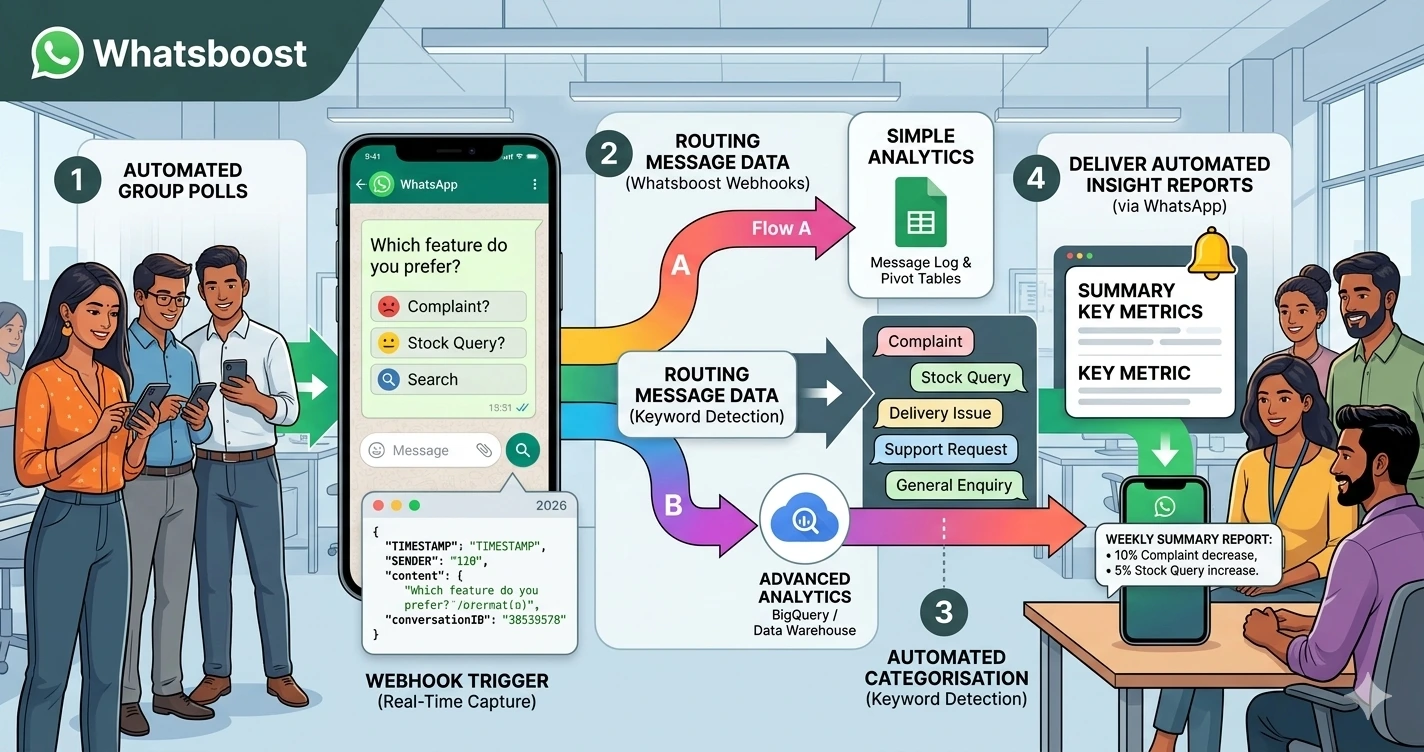
WhatsApp group poll automation with Whatsboost transforms this process. Polls are scheduled in advance and deployed automatically at the right time to the right groups. Responses are captured in real time and routed to your analytics layer — a Google Sheet, a CRM, or a business intelligence dashboard — without any manual compilation. Follow-up messages are triggered automatically based on poll outcomes. And summary reports are delivered to decision-makers on a schedule they define.
The research programme runs systematically — collecting insights continuously rather than in isolated one-off exercises — giving Indian businesses a live pulse on their market rather than a periodic snapshot.
Building Your WhatsApp Group Poll Automation for Market Research
Step 1: Activate WhatsApp Business API via Whatsboost
Systematic poll scheduling, automated response collection, and real-time data routing all require the WhatsApp Business API. Whatsboost is an authorised WhatsApp Business Solution Provider that activates your API with guided onboarding — giving your business the messaging infrastructure that all downstream poll automation runs on. Start at Whatsboost.in.
Step 2: Define Your Research Programme Structure
Before building any automation, map out your market research programme:
Research objectives — What specific questions does your business need answered? Product-market fit validation, pricing sensitivity, feature preference ranking, brand perception, or competitive positioning are common objectives for Indian businesses using WhatsApp polls.
Audience segmentation — Which WhatsApp groups represent which audience segments? Customer community groups, dealer networks, alumni groups, and industry association groups each represent a different demographic or stakeholder profile — and polling each group produces different, complementary insights.
Poll frequency and scheduling — How often should polls be deployed to each group without generating audience fatigue? For most Indian business WhatsApp groups, one to two polls per week is the maximum before participants begin ignoring them. Design your schedule to stay within this threshold while still collecting the data frequency your research objectives require.
Step 3: Build Your Poll Library in Whatsboost
Create a library of scheduled poll messages in Whatsboost — each poll containing a clear, concise question and two to four well-defined answer options. Effective WhatsApp market research polls share three characteristics:
One question, one insight. Each poll should address a single, specific research question. Multi-part questions reduce response rates and produce ambiguous data. If you have five things to learn, deploy five separate polls across five sessions — not one complex poll that tries to do everything.
Answer options that are mutually exclusive and collectively exhaustive. Every respondent should be able to find an option that accurately reflects their position. Gaps in the option set produce forced responses that distort your data. Always include an "Other" or "None of these" option for polls where the full range of responses cannot be anticipated.
Neutral, unbiased question framing. Leading questions produce data that confirms what you already think rather than revealing what you need to know. Frame every poll question to present each option with equal neutrality — particularly important for pricing, competitor, and preference research where biased framing is a common mistake.
Step 4: Configure Automated Response Collection and Data Routing
Use Whatsboost's webhook integration with Zapier, Make, or Pabbly Connect to capture poll response data in real time as votes are submitted and route it automatically to your research data layer:
Google Sheets — Append each response as a new row with the respondent identifier, their chosen option, the poll question, the group name, and the timestamp — building a continuously updated research dataset that can be filtered, segmented, and visualised without manual compilation.
CRM enrichment — For polls deployed to customer groups where respondents can be identified by phone number, route poll responses to enrich the corresponding CRM contact record — adding preference data, sentiment indicators, and engagement signals that make future sales and marketing interactions more personalised and effective.
Real-time dashboard — For businesses wanting live visibility into poll results, route the webhook data to a Google Data Studio or Power BI dashboard that updates automatically as each response arrives — giving research and product teams real-time market intelligence without waiting for a data export.
Visit Whatsboost.in to explore the full range of webhook and integration options.
Step 5: Automate Follow-Up Actions Based on Poll Outcomes
The most powerful element of WhatsApp group poll automation is what happens after the responses arrive. Configure conditional follow-up workflows that trigger different actions based on specific poll outcomes:
When a significant majority selects a specific option — Trigger an automated WhatsApp message to the group acknowledging the collective preference and sharing what the business plans to do with the insight — closing the feedback loop and demonstrating that participation in the poll led to a real business response.
When responses reveal unexpected patterns — Trigger an internal alert to the research or product team with the poll results summary — enabling rapid response to insights that require immediate attention rather than waiting for a scheduled report review.
When a poll reveals strong interest in a specific product or feature — Trigger a follow-up WhatsApp message to the group sharing more information about the product or feature in question — converting research participation into a sales engagement opportunity naturally and relevantly.

Market Research Use Cases for WhatsApp Group Poll Automation
Product development validation — Deploy feature preference polls to customer community groups before committing development resources — validating that the features your team plans to build are the ones your customers actually want, prioritised in the order they value most.
Pricing and packaging research — Run pricing sensitivity polls across customer and prospect groups to identify the price points that maximise both perceived value and purchase intent — replacing gut-feel pricing decisions with data collected directly from the target market.
Brand perception tracking — Deploy monthly brand perception polls to customer and community groups — tracking awareness, association, and satisfaction scores over time — creating a longitudinal brand health dataset that identifies trends and flags reputation changes early.
Competitive intelligence — Post competitor comparison polls in industry and community groups — "which of these tools do you currently use," "what would make you switch providers" — collecting competitive landscape data directly from the audience whose switching decisions matter most to your business.
Best Practices for WhatsApp Group Poll Automation in Market Research
Always close the feedback loop with the group. After a poll closes, send an automated message to the group sharing the results and what the business will do with them. Groups that see their input acted on participate more actively in future polls — increasing data quality and community engagement simultaneously.
Rotate poll topics to maintain group engagement. Running the same type of poll repeatedly produces diminishing returns on both participation and insight quality. Alternate between product, pricing, experience, and preference research topics to keep participation fresh and data collection comprehensive across your research objectives.
Segment poll audiences deliberately. A pricing poll deployed to a customer group of established buyers will produce different data than the same poll deployed to a prospect group. Understanding which audience segment each poll is representing is essential for interpreting the data correctly and avoiding decisions based on the wrong respondent profile.
Your Market Is Already Talking — Start Listening Systematically
Indian consumers and business stakeholders are active, engaged WhatsApp group participants. The insights your business needs to make better product, pricing, and positioning decisions are already present in the communities your WhatsApp groups contain. WhatsApp group poll automation, powered by Whatsboost, transforms these communities from social spaces into systematic research panels — collecting real-time market intelligence continuously, automatically, and at a fraction of the cost of traditional research methodologies.
Visit Whatsboost.in and start using WhatsApp group poll automation for market research today.
Want to automate WhatsApp for your business?
Set up campaigns, replies, and follow-ups in minutes.