
How WhatsApp Fits Into a Modern Customer Communication Strategy
Most businesses add WhatsApp to their communication mix without deciding what role it should play. This article defines that role — and shows how to build a channel strategy where WhatsApp works with your other systems, not against them.
Most businesses discover WhatsApp's business potential the same way — a salesperson starts using their personal number to follow up on leads because it gets faster replies than email, and within a few months, half the team is doing the same thing. There is no policy. There is no strategy. There is just the pragmatic realisation that customers respond to WhatsApp in ways they do not respond to anything else.
This organic adoption is understandable, and in the early stages, it works. The problem arrives when volume grows, teams expand, and the informal WhatsApp habit that served ten customers a week starts failing at a hundred. Messages get missed. Context gets lost. No one knows which conversations are open and which are closed. And the business, having never formally decided what role WhatsApp should play, has no framework to fix what is going wrong.
Building a modern customer communication strategy means making deliberate decisions about channel roles — not just adding tools as they prove convenient. This article addresses that question directly: what role does WhatsApp actually play in a mature business communication system, and how should it relate to the other channels your customers use to reach you?
The Multi-Channel Reality of Indian Business Communication
The Indian SMB and MSME customer does not communicate through a single channel. They discover a business on Instagram, check reviews on Google, call to ask a question, get a quote on WhatsApp, receive a follow-up email, and then come back to WhatsApp when they are ready to decide. The journey is fragmented, non-linear, and heavily mobile-dependent.
This creates a structural challenge for businesses: every channel generates expectations that the others must meet. A customer who received a personalised WhatsApp message last week will notice immediately if the next interaction — whether by phone, email, or in person — treats them as a stranger. Communication continuity across channels is not a nice-to-have feature for Indian customers. It is the baseline expectation that distinguishes a professional business from an amateur one.
Most SMBs manage this poorly not because they lack good intentions but because they have never mapped their channels against each other. Each tool is adopted separately, managed separately, and evaluated separately. WhatsApp is the sales team's domain. Email is for invoices and formal communication. Phone is for escalations. The CRM is something the manager checks on Fridays. None of these channels knows what the others are doing, and the customer, who moves between all of them, experiences the dissonance.
A modern customer communication strategy does not add channels. It organises them — assigning each channel a specific role based on what it does well, and defining how information flows between them so that every touchpoint builds on the last.
What Makes WhatsApp Structurally Different from Other Channels
Before deciding where WhatsApp fits in a communication strategy, it helps to understand what makes it functionally distinct from the channels it most commonly sits alongside.
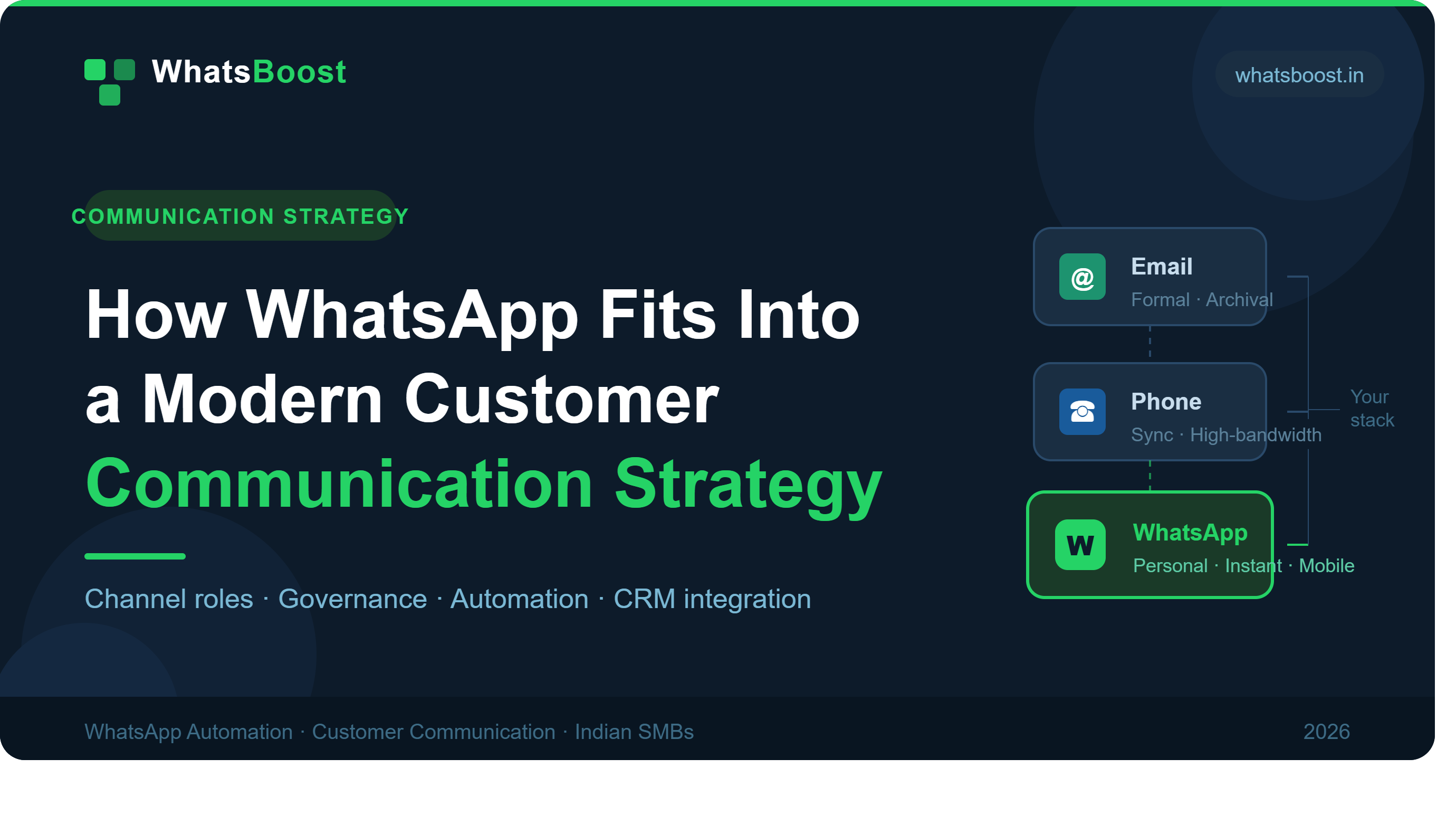
Email is asynchronous, formal, and archival. It is well-suited for documentation, proposals, invoices, and communications that the recipient needs to reference later. Its open rates in Indian B2C contexts are declining, but its role as a record-keeping channel remains intact. Email is where businesses send things customers need to keep.
Phone calls are synchronous and high-bandwidth — they carry tone, urgency, and the ability to negotiate in real time. They are appropriate for complex conversations where written language is insufficient: a complaint that requires empathy, a negotiation that requires flexibility, or a decision that requires immediate back-and-forth. Their limitation is availability: a customer who cannot pick up a call at noon is simply unreachable through that channel until they choose to be.
WhatsApp sits in a structurally unique position. It is asynchronous like email but carries the informality and immediacy expectations of a text message. It is conversational like phone but leaves a written record. It operates in the same interface customers use to talk to their friends and family, which means the psychological register is personal rather than transactional. And critically, its notification behaviour — a sound, a badge, a preview on the lock screen — creates an attention mechanism that email simply does not replicate in mobile-first markets.
These structural differences are not cosmetic. They define what WhatsApp is good for and what it is poor at. Businesses that use WhatsApp as an email replacement — sending long formal communications, attaching PDFs, treating it as a broadcast channel — are fighting the medium's nature. Businesses that use it for what it is genuinely designed for: rapid, contextual, conversational exchange at the moments that matter most to a buying decision, find it disproportionately effective.
Mapping WhatsApp's Role Across the Customer Journey
A communication strategy that assigns WhatsApp a clear role needs to think through where in the customer journey that role is most valuable. The answer is not uniform across all businesses, but there is a pattern that holds across most SMB contexts.
At the awareness and inquiry stage, WhatsApp functions as a friction-reducer. A customer who sees an ad, a listing, or a referral and wants to ask a quick question faces a decision about how much effort they are willing to invest. Filling out a contact form requires more commitment than sending a WhatsApp message. The lower the effort, the higher the inquiry rate — which is why click-to-WhatsApp mechanisms consistently outperform traditional lead capture forms in Indian digital marketing contexts. At this stage, WhatsApp's role is to convert passive interest into an active conversation.
At the consideration and evaluation stage, WhatsApp becomes a context-carrying channel. The customer is comparing options, asking follow-up questions, requesting specific information, and evaluating responsiveness as a signal of the business's operational quality. This is where response time, message quality, and conversation continuity matter most. A business that responds within minutes with relevant, personalised information creates a trust signal that a competitor responding hours later with a generic brochure cannot match. At this stage, WhatsApp's role is to accelerate trust formation.
At the decision and conversion stage, WhatsApp is often where the final push happens — a confirmation, a payment link, a personalised offer, or a reassurance that addresses a lingering concern. This is the stage where human judgment matters most and where automation should step back to allow genuine conversation. The irony of many WhatsApp automation strategies is that they apply maximum automation exactly when the customer most needs a human. At this stage, WhatsApp's role is to close with warmth and immediacy.
At the post-purchase and retention stage, WhatsApp serves a different function: operational communication. Order confirmations, delivery updates, appointment reminders, renewal notices, and check-in messages are all appropriate here. These are not marketing messages in the traditional sense — they are service messages that reduce customer anxiety and reinforce the sense that the business is organised and attentive. At this stage, WhatsApp's role is to operationalise the relationship.
| Customer Journey Stage | WhatsApp's Primary Role | What to Avoid |
|---|---|---|
| Awareness / Inquiry | Friction reduction — easy first contact | Long formal messages, PDF dumps |
| Consideration / Evaluation | Trust acceleration — fast, contextual replies | Generic templates, delayed response |
| Decision / Conversion | Human-led closing — warmth and immediacy | Over-automating at the critical moment |
| Post-purchase / Retention | Operational communication — updates and reminders | Promotional messages disguised as service messages |
The Channel Governance Problem Most Businesses Ignore
Adding WhatsApp to a communication strategy without defining its governance is one of the most common and costly mistakes Indian SMBs make. Governance here means a specific set of decisions: who owns WhatsApp communication, what types of messages belong on this channel versus others, what response standards apply, and how WhatsApp conversations connect to the business's broader data and operational systems.
Without governance, three things happen reliably. First, WhatsApp becomes a dumping ground — every type of communication that is too informal for email or too slow by phone eventually migrates there, regardless of whether it belongs. This dilutes the channel's effectiveness and trains customers to expect everything through WhatsApp, which creates an unmanageable operational burden. Second, knowledge silos form around individual team members. The sales manager who handles WhatsApp directly becomes the single point of failure for an entire customer relationship layer. When that person is unavailable, sick, or leaves, the business loses context it never formally captured. Third, compliance and accountability gaps emerge. Conversations that happen informally on personal WhatsApp numbers cannot be audited, tracked, or reviewed. Commitments made in those conversations exist only in the thread, accessible only to the person who sent them.
Channel governance is not about bureaucracy. It is about making the channel reliable and scalable. A governed WhatsApp channel has clear ownership, defined message types, documented response standards, and integration with the systems that hold the business's customer data. An ungoverned one is just a faster, more personal version of the inbox chaos most businesses are already managing badly.
How WhatsApp Should Relate to Your CRM
The relationship between WhatsApp and a CRM is one of the most consequential technical and operational decisions in a modern customer communication strategy — and one of the most frequently misunderstood. Many businesses treat integration as a technical checkbox: connect WhatsApp to the CRM, enable conversation logging, declare the problem solved.
The problem is not solved. Integration handles data flow. It does not handle the quality of the data flowing through it, the decisions that govern which conversations get recorded and how, or the way CRM data is used to make WhatsApp conversations more contextually intelligent. Businesses that get this right use their CRM not just as a destination for WhatsApp data but as a source of intelligence that improves every WhatsApp interaction. When a customer messages, the responding team member already knows who they are, what they have purchased, what they asked last time, and what stage of the relationship they are at. That context transforms a transactional reply into a relationship-building one.
Businesses exploring how sales and support teams can operationalise this context will find the practical use cases for WhatsApp and CRM integration worth reviewing in detail — the real value of integration shows up not in the connection itself but in the specific workflows it enables across different functions.
Automation's Proper Place in a WhatsApp Communication Strategy
Automation is where most WhatsApp communication strategies either create significant leverage or create significant damage, depending on where it is applied and how it is designed.
The leverage case is straightforward. Automated first responses ensure no inquiry goes unacknowledged. Automated follow-up sequences prevent leads from going cold when the sales team is focused elsewhere. Automated operational messages — reminders, confirmations, status updates — remove the manual overhead of routine communication and free the team for conversations that actually require human judgment. When automation handles the mechanical layer of communication, the human layer becomes genuinely better — more attentive, more personalised, more strategic.
The damage case is equally straightforward. Automation applied to the wrong conversations — complex negotiations, complaints, nuanced objections, emotional moments in a customer relationship — produces responses that feel tone-deaf. The customer who messages with a genuine concern and receives an automated template does not just feel unheard in that moment. They update their mental model of the business: this is an organisation that has replaced people with bots. That perception is difficult to reverse.
The design principle that governs this distinction is deceptively simple: automate communication that does not require human judgment, and protect human attention for communication that does. Identifying the boundary between those two categories is the actual strategic work, and it varies by business type, customer segment, and conversation stage. A business that sells a high-involvement product — a property, a financial service, an educational programme — has a much narrower automation window than one selling a repeat-purchase commodity. Understanding what different types of WhatsApp chatbots can and cannot do is a necessary input to that boundary-drawing exercise — the choice between an AI chatbot, a button-based flow, and a keyword-triggered response has significant implications for where the human handoff happens and how gracefully it occurs.
Building a WhatsApp Communication Policy for Your Business
A communication strategy that identifies WhatsApp's role across the customer journey, defines its governance structure, and determines its automation boundaries still needs one more component to function reliably in practice: a documented policy that the entire team operates from.
A WhatsApp communication policy does not need to be a lengthy document. It needs to answer seven questions clearly.
What types of messages belong on WhatsApp? Defining this boundary prevents the channel dilution problem. If WhatsApp is for sales conversations and operational updates but not for formal proposals or invoicing, that decision needs to be explicit — otherwise individual team members will make their own calls, and the channel's character will drift.
What is the expected response time for each message category? Response time is a customer experience variable, not just an operational one. Setting explicit standards — fifteen minutes for a high-intent inquiry, two hours for an information request, same day for a post-purchase query — creates accountability and prevents the slow-response failure mode that costs businesses conversion every day.
Who owns each type of conversation, and how are handoffs managed? This addresses the knowledge silo problem. Every conversation should have a defined owner, and every handoff should follow a defined protocol that preserves context for the receiving team member.
Which conversations should never be automated? Explicitly protecting certain conversation types from automation is as important as deciding what to automate. Complaints, refund requests, and high-value sales conversations are typically on this list.
How do WhatsApp conversations connect to the CRM? This is a technical and operational question. The policy should specify what information must be logged, how it is tagged, and what triggers a CRM update.
What message tone and format standards apply? WhatsApp is a personal channel and formal corporate language feels jarring in it. Defining tone — conversational but professional, personalised but not overly casual — ensures consistency across team members.
How is compliance managed? For regulated industries — finance, healthcare, education — certain communications have compliance implications regardless of channel. The policy needs to address how those requirements are met in a WhatsApp context.
Businesses looking to understand how a complete operational stack connects these policy decisions to actual tooling will find the modern WhatsApp sales automation stack for 2026 a useful reference point — it maps the specific tools and workflows that operationalise the strategic decisions outlined above.
The Integration Mindset: WhatsApp as One Layer, Not the Whole Stack
Perhaps the most important strategic reframe for businesses building a modern customer communication strategy is this: WhatsApp is a layer, not a platform. It is one channel in a coordinated system, with a specific role, specific strengths, and specific limitations. Treating it as the whole system — routing everything through WhatsApp, building all customer relationships there, using it to replace rather than complement other channels — creates fragility.
When WhatsApp is the only channel a business actively manages, every platform policy change, every API restriction, every service disruption affects the entire communication system simultaneously. Businesses that experienced the global WhatsApp outage of October 2021 and had no alternative communication pathway for customers learned this vulnerability directly. A mature communication strategy maintains channel redundancy — not as a technical backup plan but as a genuine strategic commitment to serving customers wherever they choose to engage.
The integration mindset also means that WhatsApp data must flow into shared systems. Conversations that exist only within the WhatsApp interface, visible only to the team member who conducted them, are a liability. They represent business relationships that the business does not actually own — the data lives on a channel controlled by a third party and accessible only to an individual who may one day leave. Moving that data into a CRM, a shared inbox, or a structured log is not an IT requirement. It is a business continuity decision. For businesses building towards this integrated model, the journey of turning WhatsApp conversations into CRM-connected conversions is where strategy becomes operational reality.
Frequently Asked Questions
How do you measure WhatsApp communication effectiveness? The metrics that matter depend on the role WhatsApp is playing in the journey. At the inquiry stage, the relevant metric is inquiry-to-conversation rate — what percentage of people who initiate a WhatsApp contact proceed to a substantive conversation. At the consideration stage, the relevant metric is response time and its correlation with conversion probability. At the conversion stage, the metric is close rate on WhatsApp-sourced leads. At the retention stage, the metrics are message open rate, opt-out rate, and repeat purchase rate among customers who receive operational WhatsApp communication. Measuring WhatsApp only on broadcast open rates — as many businesses do — misses the more consequential performance dimensions.
What is the right balance between automated and human communication on WhatsApp? There is no universal ratio. The right balance is determined by three variables: the complexity of the product or service being sold, the stage of the customer journey, and the nature of the specific conversation. High-complexity, high-involvement products require more human communication at every stage. Early-stage awareness conversations can absorb more automation than late-stage decision conversations. Operational messages — confirmations, reminders, status updates — are almost always appropriate for automation. The practical approach is to start with more human involvement than you think you need, identify the conversation types that are genuinely routine and non-judgement-dependent, and automate those progressively while protecting human attention for everything else.
When is WhatsApp not the right channel? WhatsApp is the wrong channel when the communication is inherently formal and document-dependent, when the customer has not opted into WhatsApp contact, when the message contains sensitive information better protected by more secure channels, or when the content would benefit from features WhatsApp does not support well — threaded discussions, file management, or formal workflow tracking. It is also the wrong channel for resolving complex multi-party disputes or conducting formal compliance-required communications. Knowing when not to use WhatsApp is as important as knowing when to use it.
Want to automate WhatsApp for your business?
Set up campaigns, replies, and follow-ups in minutes.