
Managing Franchise, Dealer, and Branch WhatsApp Numbers From One Dashboard
For franchises, dealers, and branch-based businesses, the WhatsApp challenge is not just volume. It is coordination across many local identities without losing control, visibility, or brand consistency.
The Real WhatsApp Problem in Distributed Businesses
Most distributed businesses do not fail because they lack leads. They fail because every location manages communication differently.
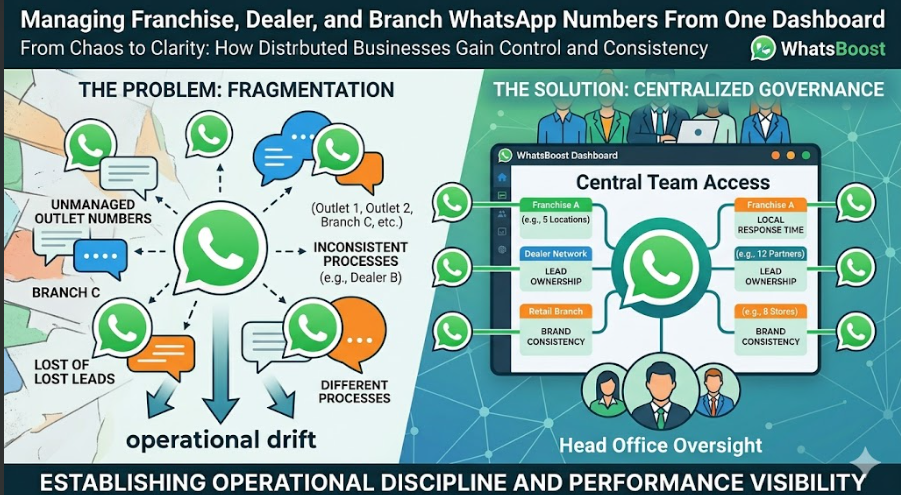
A franchise owner may have one standard process, but each outlet often runs its own WhatsApp account, its own follow-up style, and its own response timing. A dealer network may have many branches, but no central way to see which location replied first, which outlet dropped the lead, or which team handled the customer poorly. A branch-based business may look active on the outside while internally it is simply fragmented.
That fragmentation creates operational drift. The customer experience changes from one location to another. Leads get duplicated. Follow-ups go missing. Managers cannot compare branch performance with confidence. The business grows in locations, but not in coordination.
A distributed business does not need more WhatsApp numbers in isolation; it needs one control layer that can manage many local numbers with consistency, visibility, and accountability.
That is where one dashboard becomes important. It allows local teams to stay local while head office keeps the system under control.
Why One Number Is Not Enough
A single shared WhatsApp number works poorly for networks that operate across cities, districts, or regions. Customers usually prefer to talk to the nearest location, not a generic central desk. Dealers want leads assigned to the right showroom. Franchisees want local identity. Branch managers want autonomy.
At the same time, central leadership wants brand consistency, response visibility, and reporting. Those goals often clash when WhatsApp is run manually.
The right model for a franchise or dealer network is not one WhatsApp number for everyone, but many WhatsApp numbers governed through one operating system.
This is the key distinction. One number creates bottlenecks. Many unmanaged numbers create chaos. One dashboard gives you the middle path: local presence with central governance.
What One Dashboard Actually Changes
A centralized WhatsApp dashboard turns disconnected branch communication into a managed business system. Instead of logging into separate devices or asking every outlet to “just handle it,” leadership can monitor all numbers in one place.
That means:
- Each branch can have its own WhatsApp number.
- Each dealer location can maintain local identity.
- Each franchise outlet can respond independently.
One dashboard is not just a convenience feature; it is the control room for customer communication across a distributed business network.
The head office can view conversations, assign ownership, and enforce standards.
It changes WhatsApp from a personal messaging app into an operational layer. That shift matters because the real value is not sending messages. The real value is ensuring every inquiry reaches the right location, at the right time, with the right follow-up logic.
Who Needs This Model Most
This structure is especially useful for businesses where customer conversations are naturally tied to geography, ownership, or outlet-level service.
The pattern is the same in all of them. Customers want local relevance. The business needs centralized oversight. One dashboard supports both.
How the Operating Model Should Work
The best distributed WhatsApp setup follows a simple principle: centralize the rules, localize the execution.
Head office should define:
Brand voice.
Response standards.
Follow-up timing.
Template structure.
Escalation rules.
Reporting metrics.
Branches should handle:
First response.
Local conversations.
Lead qualification.
Appointment booking.
Service-specific follow-up.
Dealers or franchisees should not be left to invent their own process. At the same time, they should not lose the ability to respond quickly in their local context.
The strongest WhatsApp systems are not centralized in conversation ownership; they are centralized in governance, visibility, and workflow design.
That is the difference between control and micromanagement. A good system gives local teams freedom to act inside a common structure.
What WhatsBoost Enables for Branch Networks
WhatsBoost is designed for exactly this kind of operational coordination. It allows businesses to manage multiple WhatsApp numbers from one dashboard, which makes it easier to control branch-wise, dealer-wise, or franchise-wise communication.
A typical setup can include:
One number per branch.
One number per dealer outlet.
One number per business unit.
One dashboard for the whole network.
Role-based access for local staff and central managers.
The value is not just in seeing all chats together. It is in being able to assign, monitor, and standardize communication across the full network without forcing everyone into the same number.
How to Manage Unlimited WhatsApp Numbers From One Dashboard
How to Set Up WhatsApp Business for Multiple Agents or Team Members
How to Use WhatsApp Business With Multiple Users for Customer Support Teams
A Practical Setup Framework
Use this structure if you are building a multi-location WhatsApp system.
This setup is simple, but it solves a complex business problem. It creates structure without slowing teams down.
Where the Business Value Shows Up
The biggest return from this model is not in messaging speed alone. It is in operational discipline.
When every branch follows the same communication structure:
Leads are assigned faster.
Customers receive more consistent replies.
Branch managers become accountable.
Head office gets real visibility.
Franchise performance becomes measurable.
Dealer networks stop relying on guesswork.
When WhatsApp is managed as a networked system, it becomes a source of operational intelligence, not just a chat channel.
That matters because many businesses think their problem is marketing. In reality, they are losing revenue because communication is not properly coordinated across locations.
A well-run dashboard helps you see:
Which branch responds fastest.
Which location converts better.
Which outlet misses leads.
Which team needs training.
Which customer issues repeat across the network.
That is not just communication efficiency. That is management insight.
Common Mistakes To Avoid
Many businesses create multi-location WhatsApp systems but still fail because the operational design is weak.
1. Letting every branch invent its own process
This creates inconsistency. The customer experience changes by location, not by business policy.
2. Using personal phones as branch systems
This makes the business dependent on individuals instead of infrastructure. It also makes handover and reporting difficult.
3. Sharing one number across many outlets
This sounds simple, but it destroys local identity and makes lead ownership unclear.
4. Ignoring permission structure
Not every team member needs access to every branch. Access should reflect responsibility.
5. Measuring activity instead of outcomes
The goal is not “messages sent.” The goal is branch-level lead handling, response quality, and conversion.
A multi-location WhatsApp strategy fails when it is treated as a messaging task instead of a governance system.
Adoption Barriers You Should Expect
Franchise and dealer networks often resist centralized WhatsApp systems at first. That resistance is normal.
Franchisees may worry that central control will reduce their autonomy. Dealers may want to keep their own habits. Branch staff may prefer familiar personal phones. Head office may struggle to define clear operational rules.
The solution is not to force adoption through software alone. It is to explain the business logic clearly:
Local numbers improve customer trust.
Shared visibility improves accountability.
Standardization protects the brand.
One dashboard reduces operational friction.
If the system is positioned as support rather than surveillance, adoption becomes much easier.
ROI Implications For Multi-Location Businesses
The return from this model usually appears in three places.
Faster lead handling
Customers contacting the nearest branch get faster responses and fewer handoff delays.
Better conversion visibility
Leadership can finally see which outlet is converting and which is losing leads.
Lower coordination cost
Teams spend less time chasing messages, checking devices, or asking who replied last.
For a growing network, this matters more than people realize. A small improvement in response time across multiple outlets can create a meaningful lift in conversions. A small improvement in consistency can reduce lost leads and customer complaints. Over time, the dashboard becomes a management asset, not just a communication tool.
Implementation Playbook
If you are a franchise, dealer network, or branch-based business, start with this sequence:
Define the number structure by outlet or location.
Decide who owns each number.
Establish one standard workflow for greetings, qualification, and follow-up.
Give the head office visibility into all branches.
Give local teams limited, role-based access.
Track branch-wise response time and conversion performance.
Review the system monthly and refine routing rules.
This is the simplest path from fragmented WhatsApp handling to controlled multi-location communication.
FAQ
Closing Perspective
A franchise network, dealer ecosystem, or branch-based business should not run WhatsApp like a collection of disconnected phones. It should run it like an operating system.
The future of multi-location customer communication is not a single inbox for everyone; it is a coordinated dashboard that gives each location its own identity while giving leadership full visibility.
That is the real advantage of WhatsBoost for distributed businesses. It helps you move from scattered conversations to managed communication infrastructure, which is where scalable customer operations begin.
Want to automate WhatsApp for your business?
Set up campaigns, replies, and follow-ups in minutes.