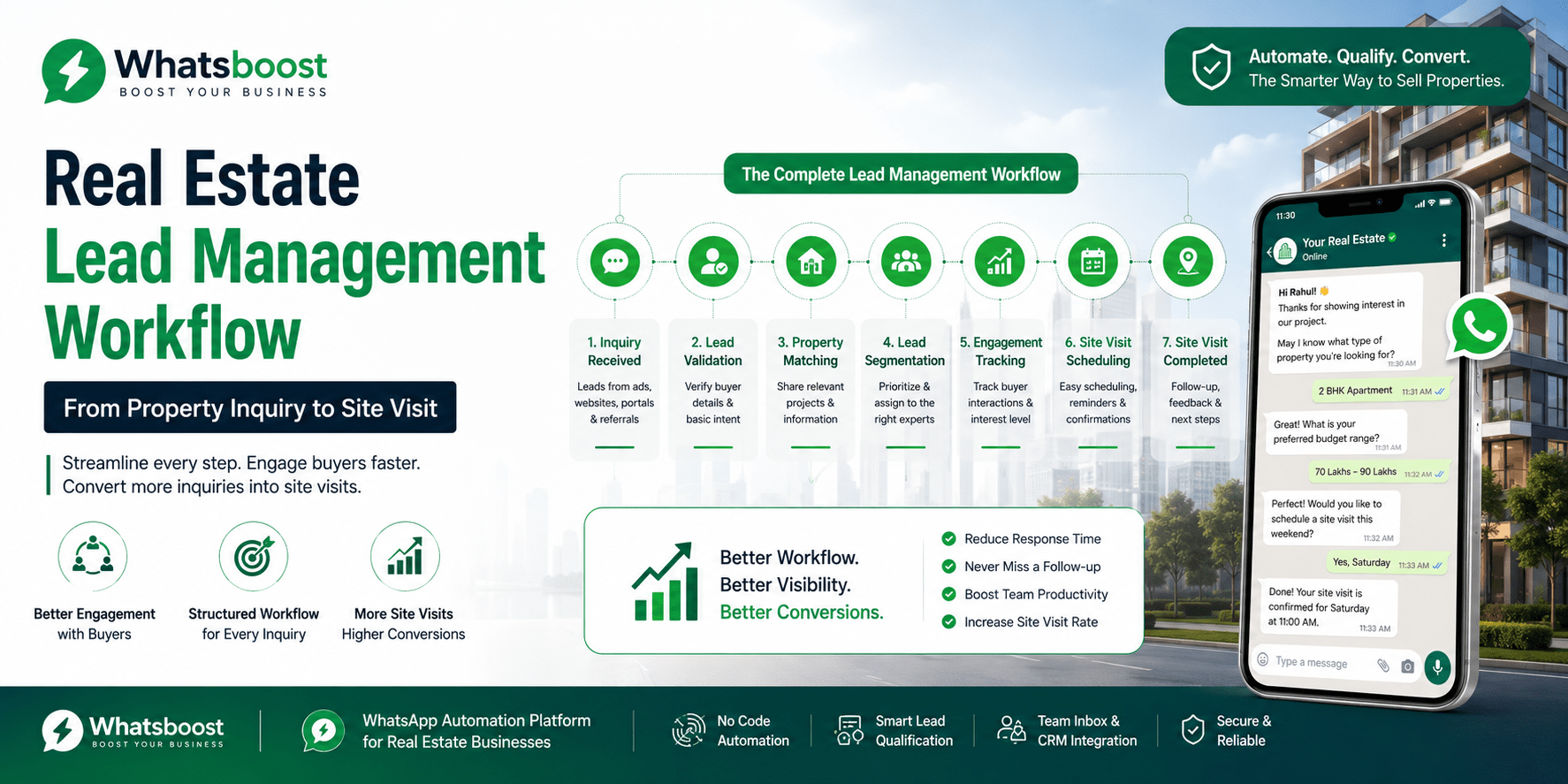
Real Estate Lead Management Workflow: From Property Inquiry to Site Visit
Explore how real estate businesses manage property inquiries, qualify buyers, track engagement, and coordinate site visits through structured lead management workflows that improve conversion efficiency and operational visibility.
Real Estate Lead Management Workflow: From Property Inquiry to Site Visit
Most real estate businesses believe their biggest challenge is generating more leads.
In reality, many are already generating enough.
The actual problem begins after the inquiry arrives.
A prospect fills out a form on a property portal. Someone clicks a Facebook ad. A buyer sends a WhatsApp message asking for project details. A broker forwards a lead. A website visitor requests a brochure.
The inquiry enters the system.
Then chaos begins.
Different sales representatives follow different processes. Leads sit unanswered for hours. Follow-ups depend on memory. Site visit scheduling becomes inconsistent. Managers struggle to understand which inquiries are moving forward and which are disappearing silently.
As inquiry volume increases, these inefficiencies compound.
The result is a pipeline that appears active on the surface but leaks opportunities at nearly every stage.
This is why high-performing real estate businesses increasingly focus on lead management workflows rather than lead generation alone.
Because the difference between a property inquiry and a booked site visit is not advertising.
It is process design.
Why Real Estate Lead Management Breaks Down
Real estate has one of the longest and most complex customer journeys among major industries.
Unlike e-commerce purchases, buyers rarely make decisions immediately.
A prospect may:
Compare multiple projects
Discuss options with family members
Evaluate financing
Visit several properties
Delay decisions for weeks or months
This creates a communication-heavy sales cycle.
Every inquiry requires:
Information sharing
Qualification
Follow-ups
Scheduling
Coordination
Relationship building
When these activities depend entirely on manual effort, businesses face operational bottlenecks.
| Workflow Breakdown | Operational Impact |
|---|---|
| Delayed responses | Lower buyer engagement |
| Missed follow-ups | Lost opportunities |
| Unstructured tracking | Poor pipeline visibility |
| Manual scheduling | Site visit drop-offs |
| Inconsistent communication | Reduced trust |
The issue is rarely the sales team itself.
The issue is the absence of a structured workflow.
The Real Estate Lead Journey Is Not a Funnel
Many businesses still visualize real estate sales as a traditional funnel.
Inquiry → Visit → Sale
The reality is more complex.
Modern buyers move through multiple conversations, comparisons, and decision points before scheduling a visit.
A more accurate model is a workflow.
Property Inquiry
↓
Lead Validation
↓
Requirement Discovery
↓
Property Matching
↓
Engagement Tracking
↓
Site Visit Scheduling
↓
Visit Confirmation
↓
Site Visit Completion
This shift in thinking is important.
Funnels focus on stages.
Workflows focus on actions.
Real estate businesses improve conversion rates when they optimize actions rather than simply tracking stages.
Stage 1: Capturing and Organizing Property Inquiries
Most real estate inquiries originate from multiple sources:
Property portals
Google Ads
Meta campaigns
WhatsApp campaigns
Website forms
Referral partners
Channel partners
The first operational challenge is centralization.
If inquiries remain scattered across different platforms, response speed decreases and tracking becomes difficult.
A structured workflow ensures every inquiry enters a unified communication system immediately.
Businesses increasingly connect website forms and marketing channels directly with WhatsApp to reduce delays between inquiry generation and engagement.
The objective is simple:
No inquiry should depend on someone manually checking multiple platforms.
Stage 2: Validating Buyer Intent
Not every inquiry represents an active buyer.
Some prospects are researching.
Some are investors.
Some are renters.
Some are competitors gathering market information.
Before sales teams invest significant time, businesses need clarity.
This stage focuses on understanding:
| Qualification Area | Example Information |
|---|---|
| Property interest | Apartment, villa, commercial |
| Location preference | Area or project interest |
| Budget range | Buying capacity |
| Purchase purpose | Self-use or investment |
| Timeline | Immediate or future purchase |
The goal is not to collect excessive information.
The goal is identifying which prospects deserve priority attention.
Businesses looking to streamline this stage increasingly use automated qualification workflows that gather information conversationally instead of relying entirely on phone calls.
Stage 3: Property Matching and Buyer Alignment
One of the biggest mistakes in real estate sales is overwhelming prospects with too many options.
A buyer interested in a 2 BHK apartment within a specific budget should not receive information about every project in the portfolio.
Effective lead management reduces complexity.
After qualification, workflows should align buyers with:
Relevant projects
Suitable inventory
Appropriate pricing ranges
Matching locations
This improves engagement while reducing decision fatigue.
The objective is not showing more properties.
It is showing more relevant properties.
Stage 4: Lead Segmentation Based on Readiness
Not every prospect should enter the same follow-up sequence.
This is where many real estate businesses lose efficiency.
A prospect planning to buy within two weeks requires a completely different engagement strategy than someone researching options six months in advance.
A structured workflow separates inquiries into categories.
| Lead Segment | Recommended Action |
|---|---|
| Hot Lead | Immediate sales engagement |
| Warm Lead | Guided nurturing sequence |
| Investor Lead | Specialized consultation |
| Long-Term Buyer | Educational follow-up workflow |
| Rental Inquiry | Separate leasing process |
Segmentation prevents sales teams from treating every inquiry identically.
It also improves resource allocation.
Stage 5: Engagement Tracking Before Site Visit
One of the most overlooked parts of lead management is engagement monitoring.
Many buyers do not immediately request a site visit.
Instead, they engage gradually.
Examples include:
Downloading brochures
Viewing floor plans
Asking pricing questions
Requesting project updates
Exploring financing options
These interactions provide signals.
Businesses that track engagement patterns gain better visibility into buyer intent.
For example:
A prospect who asks detailed pricing questions and requests location information may deserve faster follow-up than someone who only downloads a brochure.
This transforms lead management from static tracking into behavioral tracking.
Stage 6: Site Visit Scheduling Workflow
Site visits are among the most important conversion points in real estate.
Yet many businesses still manage them manually.
This creates avoidable friction.
A modern site visit workflow includes:
| Activity | Workflow Action |
|---|---|
| Visit request | Scheduling link or confirmation |
| Date selection | Automated coordination |
| Visit confirmation | Instant acknowledgment |
| Reminder sequence | Scheduled notifications |
| Rescheduling | Workflow-based updates |
| Sales assignment | Internal routing |
This reduces administrative workload while improving buyer experience.
The objective is making site visits easier to book and harder to forget.
Why Site Visit Drop-Offs Happen
Many real estate businesses focus heavily on generating visit requests.
Fewer focus on ensuring visits actually happen.
Common causes of drop-offs include:
Poor follow-up communication
Missing reminders
Scheduling confusion
Lack of location details
Delayed confirmations
A structured workflow addresses these issues before they become conversion problems.
Instead of treating scheduling as a single event, businesses treat it as a managed process.
The Operational Role of WhatsApp in Lead Management
Real estate has become increasingly WhatsApp-centric.
Buyers often prefer WhatsApp because it allows them to:
Request information quickly
Review property media
Communicate asynchronously
Share details with family members
This makes WhatsApp a natural layer within the lead management workflow.
Instead of functioning as a standalone messaging channel, WhatsApp becomes the operational bridge connecting:
Inquiry capture
Qualification
Property sharing
Follow-ups
Site visit coordination
The result is a more connected customer journey.
Lead Routing: The Missing Layer in Most Real Estate Workflows
Many businesses stop at lead collection.
High-performing organizations focus on lead routing.
The key question is:
Who should handle this inquiry?
Examples include:
| Inquiry Type | Recommended Routing |
|---|---|
| Luxury buyer | Senior consultant |
| Investor | Investment specialist |
| Rental inquiry | Leasing team |
| Commercial property | Commercial advisor |
| Existing customer | Relationship manager |
Routing improves both efficiency and customer experience.
Instead of transferring buyers repeatedly, businesses connect them with the right person earlier in the journey.
Measuring Workflow Performance
Most real estate teams measure:
Leads generated
Site visits completed
Sales closed
These metrics matter.
But workflow visibility requires additional indicators.
Examples include:
Average response time
Qualification completion rate
Property matching accuracy
Site visit booking rate
Site visit attendance rate
Follow-up completion rate
These metrics reveal where the workflow is breaking down.
Without this visibility, businesses often blame lead quality when the actual issue is process inefficiency.
The Future of Real Estate Lead Management
Real estate sales processes are becoming increasingly workflow-driven.
As inquiry volumes grow and customer expectations rise, manual coordination becomes harder to sustain.
Businesses that rely entirely on human memory and fragmented communication systems will struggle to scale efficiently.
The future lies in connected lead management workflows that combine:
Inquiry capture
Qualification
Segmentation
Property matching
Engagement tracking
Site visit coordination
into a structured operational system.
The businesses that perform best will not necessarily generate the highest number of inquiries.
They will manage inquiries more effectively.
From Inquiry Chaos to Workflow Visibility
Many real estate businesses spend heavily on lead generation while paying less attention to what happens after a prospect enters the pipeline.
Yet the journey from inquiry to site visit contains multiple decision points where opportunities can be lost.
A structured lead management workflow creates consistency across these interactions.
It reduces dependency on manual coordination, improves buyer experience, and gives teams better visibility into the path from inquiry to conversion.
In real estate, site visits rarely happen because of a single message.
They happen because every stage before the visit was managed properly.
That is what lead management workflows are designed to achieve.
Want to automate WhatsApp for your business?
Set up campaigns, replies, and follow-ups in minutes.