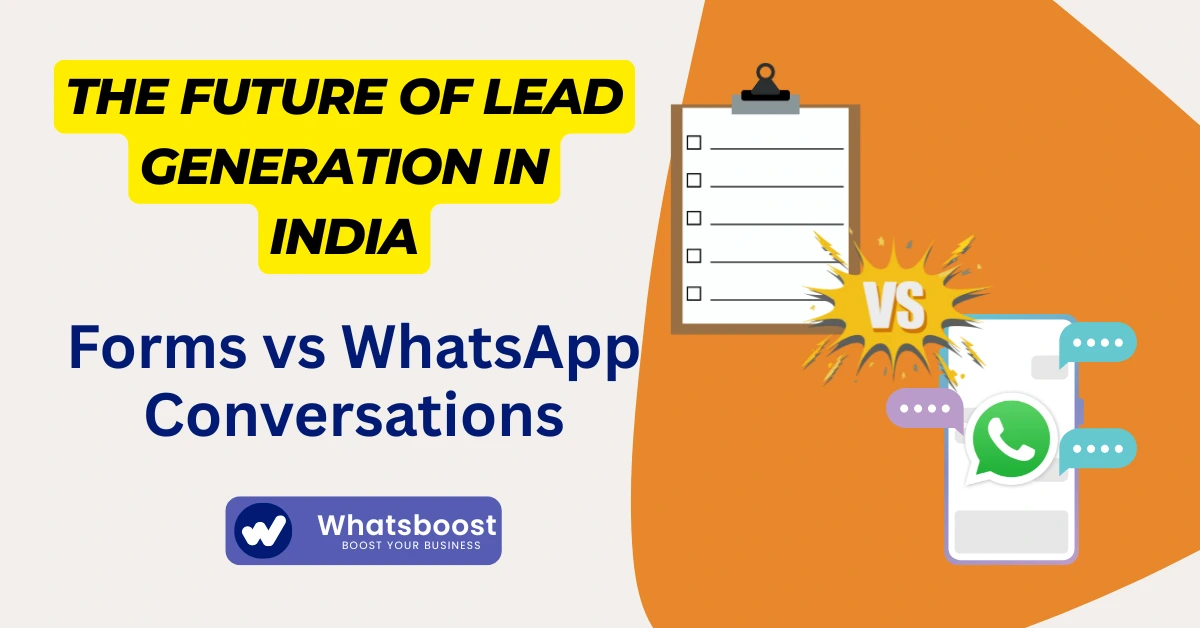
The Future of Lead Generation in India: Forms vs WhatsApp Conversations
Discover the future of lead generation in India as businesses shift from traditional forms to WhatsApp conversations. Learn which converts better in 2026 and how WhatsApp automation with Whatsboost changes lead engagement.
Lead generation in India is undergoing a fundamental shift.
For over a decade, businesses relied on forms—landing pages, Facebook lead ads, website inquiries, CRMs, and spreadsheets. But in 2026, customer behavior has changed faster than these systems.
Today, Indian buyers don’t want to submit a form and wait.
They want to start a conversation.
This is where WhatsApp is redefining how leads are generated, qualified, and converted.
Let’s break down Forms vs WhatsApp Conversations and understand what the future of lead generation in India really looks like.
How Traditional Form-Based Lead Generation Works
The classic model looks like this:
User fills out a form
Data goes into a CRM or spreadsheet
Sales team contacts the lead later
Follow-ups depend on human availability
This model worked when:
Lead volumes were low
Competition was limited
Buyers were patient
None of that is true anymore.
The Core Problems with Forms in 2026
Forms haven’t disappeared—but they’ve become a bottleneck.
1. Delayed Response Time
Most Indian businesses respond to form leads in:
30 minutes
2 hours
Sometimes the next day
By then, buyer intent is already cooling.
2. High Drop-Off Rates
Users submit forms but:
Don’t pick calls
Ignore emails
Forget which brand they contacted
Forms capture data—but lose momentum.
3. Manual Follow-Ups Don’t Scale
As lead volume increases:
Sales teams get overloaded
Follow-ups become inconsistent
Quality drops
Forms require people. People don’t scale cleanly.
Why WhatsApp Conversations Are Replacing Forms
India is a WhatsApp-first market.
With over 500 million users, WhatsApp isn’t just a messaging app—it’s where:
Business happens
Trust is built
Decisions are made
WhatsApp conversations remove friction completely.
WhatsApp Lead Generation: How It Works
Instead of “Fill this form”, the flow becomes:
User clicks “Chat on WhatsApp”
Conversation starts instantly
Questions are asked naturally
Responses are captured in real time
Automation handles follow-ups
No waiting. No guessing. No chasing.
Forms vs WhatsApp Conversations: A Direct Comparison
Speed
Forms: Slow, dependent on human response
WhatsApp: Instant, real-time engagement
Engagement
Forms: One-way data submission
WhatsApp: Two-way conversation
Trust
Forms: Feels transactional
WhatsApp: Feels personal and familiar
Conversion
Forms: Drop-offs after submission
WhatsApp: Momentum-driven conversions
Why Indian Buyers Prefer WhatsApp Over Forms
Indian users:
Are mobile-first
Prefer chatting over typing long forms
Trust WhatsApp more than emails
Respond faster on messaging apps
WhatsApp feels low effort, high comfort.
The Rise of Conversational Lead Qualification
Forms ask everything upfront.
WhatsApp asks only what’s necessary, step by step.
Example:
“What are you looking for?”
“What’s your budget range?”
“When do you want to proceed?”
This conversational approach:
Filters junk leads
Identifies high-intent buyers
Saves sales team time
Automation Makes WhatsApp Scalable
The biggest myth:
“WhatsApp doesn’t scale.”
It doesn’t—manual WhatsApp doesn’t.
Automation changes everything.
With WhatsApp automation, businesses can:
Handle thousands of conversations
Route leads based on responses
Send timed follow-ups
Trigger alerts for hot leads
This is where platforms like Whatsboost come in.
Whatsboost’s Role in the Future of Lead Generation
Whatsboost enables businesses to:
Capture leads via WhatsApp conversations
Replace static forms with dynamic chat flows
Automate qualification and follow-ups
Integrate WhatsApp with Google Sheets, CRMs, forms, and ad platforms
Instead of collecting leads and hoping for callbacks, Whatsboost helps businesses close inside WhatsApp.
Learn more at https://whatsboost.in
Forms Are Not Dead — But Their Role Has Changed
Forms still have value:
Compliance
Documentation
Data storage
But they are no longer the conversion layer.
WhatsApp has taken that role.
Smart businesses use:
Forms to collect basic data
WhatsApp to convert, qualify, and nurture
Industries Already Moving to WhatsApp Conversations
Real Estate
Property inquiries → WhatsApp walkthroughs
Education
Course inquiries → Automated counseling chats
D2C Brands
Product questions → WhatsApp checkout nudges
B2B & Exporters
RFQs → WhatsApp qualification workflows
What Lead Generation Will Look Like in 2026
In 2026:
Lead gen will be conversational
Response time will be measured in seconds
Automation will replace manual SDR work
WhatsApp will be the primary engagement channel
Forms will support conversations—not replace them.
Final Thought
The future of lead generation in India is not about collecting more leads.
It’s about starting better conversations.
Businesses that move from forms to WhatsApp conversations will:
Convert faster
Spend less on sales teams
Build stronger buyer trust
And those that don’t will keep chasing leads that never reply.
FAQs: Forms vs WhatsApp Conversations
Are forms becoming obsolete in India?
No, but they are no longer effective as the main conversion channel.
Is WhatsApp lead generation compliant?
Yes, when users initiate conversations or opt in.
Can WhatsApp replace sales calls?
For many industries, yes—especially for qualification and follow-ups.
Does WhatsApp automation feel robotic?
Not when workflows are designed conversationally.
Is Whatsboost suitable for small businesses?
Yes. It’s built to automate without complex APIs or large teams.
Can forms and WhatsApp work together?
Absolutely. The best systems combine both.
Want to automate WhatsApp for your business?
Set up campaigns, replies, and follow-ups in minutes.