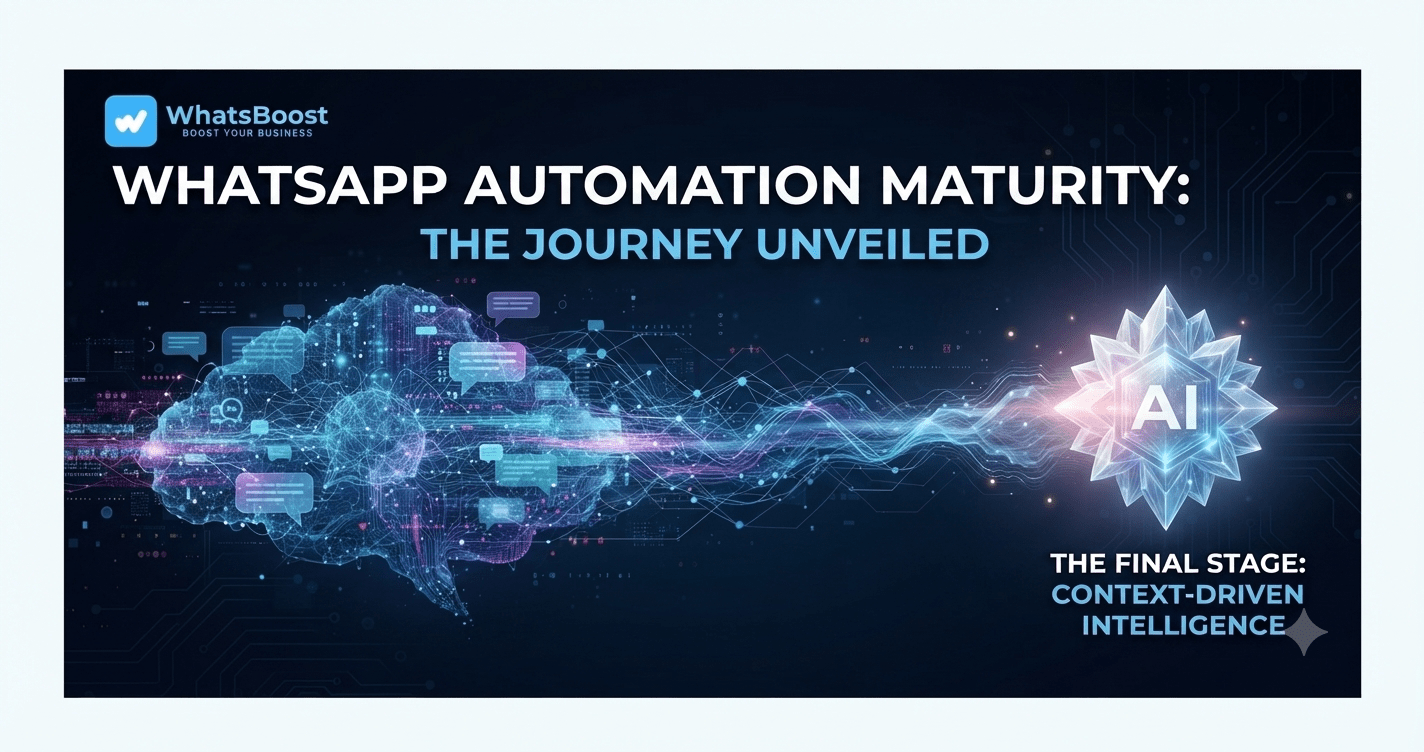
WhatsApp Automation Maturity: 5 Stages from Auto-Replies to Intelligent Business Workflows
Learn how WhatsApp automation evolves from simple auto-replies to connected, intelligent business workflows—and identify which stage your business is currently at.
Most businesses don't wake up one morning and build a fully automated WhatsApp operation.
They start small.
Someone sets up an automatic welcome message. Then a few FAQs are added. Later, the sales team starts sending automated follow-ups. Eventually, leads are routed to different people, customer information is connected with a CRM, and more complex workflows begin running in the background.
At each stage, WhatsApp automation solves a different business problem.
This is why asking whether a business "uses WhatsApp automation" doesn't tell you very much. Two companies may both claim to use WhatsApp automation while operating at completely different levels of maturity.
One may simply have an automatic greeting.
The other may have WhatsApp connected to its CRM, sales pipeline, customer lifecycle, lead qualification, routing, follow-ups, and internal workflows.
The difference isn't necessarily the software they use.
It is how deeply automation has been integrated into the way the business operates.
A useful way to understand this progression is through five stages of WhatsApp automation maturity:
Stage 1: Manual WhatsApp communication
Stage 2: Automated responses
Stage 3: Workflow automation
Stage 4: Connected business automation
Stage 5: Intelligent, context-driven automation
Understanding these stages can help businesses identify where they are today and, more importantly, what they should automate next.
Stage 1: WhatsApp Is Still Mostly Manual
At the first stage, WhatsApp is simply another communication channel.
A customer sends a message. Someone from the business reads it and responds.
A sales representative checks conversations manually. Follow-ups are remembered through personal notes or spreadsheets. Customer details may be copied into another system. If the employee handling the conversation is unavailable, the conversation may remain unanswered.
This approach can work surprisingly well when the business receives only a handful of conversations every day.
The problem appears when volume increases.
Imagine a company receiving 100 enquiries every day.
Even if each conversation requires only a few minutes of attention, the cumulative workload becomes significant. More importantly, manual communication introduces inconsistency.
One salesperson may follow up three times.
Another may forget.
One employee may record customer information properly.
Another may keep everything inside WhatsApp.
One customer may receive a response within five minutes.
Another may wait until the next morning.
At this stage, the business doesn't really have a WhatsApp automation system.
It has a WhatsApp-dependent manual process.
And that distinction matters.
The first opportunity isn't to automate everything. It is to identify the repetitive parts of the conversation that don't need human judgment.
That leads to the second stage.
Stage 2: WhatsApp Starts Responding Automatically
The second stage begins when businesses automate the obvious repetitive interactions.
A new customer sends a message and immediately receives a greeting.
Frequently asked questions can be answered automatically.
Basic information can be collected without requiring an employee to type the same response repeatedly.
For example, a real estate business might automatically ask:
"Which property type are you looking for?"
An education company might ask:
"Which course are you interested in?"
An e-commerce business might provide options for:
"Track order"
"Product information"
"Speak to support"
This is a meaningful improvement because the business is no longer completely dependent on someone being available to send the first response.
But there is an important limitation.
Auto-replies are not the same thing as workflow automation.
A business can have an impressive-looking chatbot and still be operating a largely manual process behind it.
If the bot answers a question but nobody knows what to do with the customer's response, the automation has only solved the first few seconds of the interaction.
This is where many businesses stop.
They automate the greeting and perhaps a few FAQs, then assume they have automated WhatsApp.
In reality, they have automated communication, not necessarily the process behind the communication.
The next stage is where that distinction becomes important.
Stage 3: WhatsApp Becomes a Workflow
At the third stage, automation starts responding not only to messages, but to events and decisions.
Instead of asking:
"What message should we send?"
the business begins asking:
"What should happen when this customer does this?"
That shift changes everything.
Consider a lead who fills out a form requesting information.
Instead of someone manually checking the form, copying the phone number, opening WhatsApp, and sending a message, a workflow can trigger the conversation automatically.
The lead receives an acknowledgement.
The system asks relevant questions.
The answers are captured.
The lead can then be categorized or qualified.
A sales representative can be notified when the conversation reaches a particular stage.
A reminder can be triggered if the customer stops responding.
This is no longer simply an automated reply.
It is a sequence of business actions connected together.
Lead qualification is a good example of this transition. Rather than sending the same message to every enquiry, a business can use responses and customer information to determine whether a lead is relevant or sales-ready. A structured WhatsApp lead qualification workflow can therefore reduce the amount of repetitive qualification work performed manually by sales teams.
The important development here is that WhatsApp has started becoming part of the business process.
And once that happens, another question naturally appears:
What happens when the WhatsApp conversation needs information from somewhere else?
Stage 4: WhatsApp Connects With the Rest of the Business
A business can automate a considerable amount through WhatsApp alone.
But eventually, isolated automation reaches its limits.
A customer doesn't exist only as a WhatsApp conversation.
The same customer may have:
A CRM record
A sales opportunity
A previous purchase
An open support ticket
An appointment
A subscription
A payment status
A customer lifecycle stage
If WhatsApp doesn't know anything about these events, automation remains limited.
This is why the fourth stage is about connected automation.
WhatsApp becomes connected to CRM systems, forms, sales tools, e-commerce platforms, support systems, calendars, payment workflows, or other business applications.
Now the trigger doesn't have to be a message.
A CRM status can trigger a WhatsApp message.
A form submission can start a workflow.
A change in deal stage can trigger a reminder.
A completed purchase can start onboarding communication.
A support ticket can trigger an update.
This creates a much more powerful relationship between WhatsApp and the rest of the organization.
For example, imagine a sales opportunity moving from "Proposal Sent" to "Negotiation" in the CRM.
Instead of asking a salesperson to remember the next follow-up, the CRM event can trigger an appropriate WhatsApp workflow.
This is the difference between using WhatsApp as a messaging tool and using it as part of a business automation system.
WhatsApp CRM workflows can extend beyond lead capture into sales, onboarding, support, retention, and other parts of the customer lifecycle. That broader approach is explored in WhatsBoost's guide to CRM workflows after integrating WhatsApp.
At this stage, the business has moved considerably beyond auto-replies.
But there is still another level.
Stage 5: WhatsApp Automation Becomes Intelligent and Context-Driven
The fifth stage isn't simply about adding more automation.
It is about making automation more context-aware.
At lower levels of maturity, the same trigger can produce the same response.
A customer does X.
The system sends Y.
Intelligent automation introduces another layer:
What does the customer's behavior actually tell us?
Consider two customers who both download the same product brochure.
Customer A immediately asks about pricing.
Customer B reads the brochure but doesn't respond.
Treating both customers identically doesn't make much sense.
Their behavior suggests different levels of intent.
The same principle can apply to website activity, form responses, previous purchases, CRM status, conversation history, or other available signals.
A business can begin creating different workflows based on those signals.
This is where behavior-based WhatsApp automation becomes valuable.
Instead of sending messages simply because a fixed amount of time has passed, the workflow can respond to what the customer actually did.
For example:
A customer requests a product catalogue.
→ Receives the catalogue.
The customer then asks about pricing.
→ Pricing information is provided.
The customer requests a demo.
→ The conversation moves toward booking.
Another customer downloads the same catalogue but doesn't respond.
→ A different follow-up can be triggered.
The automation is no longer blindly following one sequence.
It is responding to context and behavior.
This is the direction in which more advanced WhatsApp automation is moving: fewer generic sequences and more relevant, event-driven interactions.
WhatsBoost's behavior-based WhatsApp automation approach provides an example of how customer actions can be used to trigger more personalized workflows.
The Five Stages Are Not About Being "More Automated"
It is tempting to look at these five stages as a simple ladder:
Stage 1 is bad.
Stage 5 is good.
That isn't quite right.
The appropriate level of automation depends on the business.
A local business receiving 20 enquiries per week may not need an elaborate CRM-connected automation architecture.
A company receiving thousands of customer conversations every month may struggle if it remains at Stage 2.
The objective isn't to reach Stage 5 simply because it sounds more advanced.
The objective is to reach the level where automation solves the actual operational bottlenecks of the business.
A small business might get enormous value simply by moving from manual responses to automated lead acknowledgement and follow-up.
A growing sales team may benefit most from qualification and routing.
A larger organization may need CRM-triggered workflows across sales, support, onboarding, and retention.
The right question is therefore not:
"How advanced is our automation?"
It is:
"Where is our current process losing time, information, leads, or customer attention?"
That is where automation should be applied next.
How to Identify Your Current WhatsApp Automation Stage
A quick assessment can reveal where your business currently stands.
If employees manually answer almost every conversation...
You are primarily at Stage 1.
Your first opportunity is to automate repetitive responses and immediate acknowledgements.
If you already have greetings, FAQs, and basic chatbot flows...
You are probably at Stage 2.
The next step is to connect those conversations to meaningful business workflows.
If leads are being qualified, routed, followed up, or assigned automatically...
You are approaching Stage 3.
Now look for processes that still require manual intervention after the initial conversation.
If WhatsApp is connected to your CRM and other business systems...
You are operating at Stage 4.
The opportunity now lies in automating customer lifecycle events rather than just lead-related activity.
If workflows respond to customer behavior, intent, history, and business context...
You are approaching Stage 5.
At this point, optimization becomes more important than simply adding more workflows.
What Should a Business Automate Next?
This is perhaps the most important question.
Businesses often begin automation by looking at software features.
They ask:
"Can this tool send automated messages?"
A better question is:
"Which repetitive decision or process is currently costing us the most?"
Suppose a sales team spends hours every day qualifying low-quality leads.
Lead qualification may be the first priority.
If the qualification process is already automated but salespeople frequently forget follow-ups, follow-up workflows may create more value.
If leads are qualified but frequently sent to the wrong salesperson, routing needs attention.
If sales communication works well but customers are forgotten after purchase, post-sales automation may be the better opportunity.
If the CRM contains valuable information that never reaches WhatsApp, integration may be the missing layer.
In other words, automation maturity is not achieved by accumulating features.
It is achieved by progressively removing unnecessary manual work from the customer journey.
The Biggest Mistake: Automating a Broken Process
There is one problem that becomes more dangerous as businesses become more enthusiastic about automation.
They automate a process before understanding whether the process itself makes sense.
Imagine a company with a poor lead qualification process.
The sales team asks ten unnecessary questions.
The business then builds an automated workflow that asks exactly the same ten questions—only faster.
The company has successfully automated inefficiency.
The same thing can happen with follow-ups.
If the existing follow-up strategy is irrelevant or overly aggressive, automating it doesn't improve customer experience. It simply allows the business to send irrelevant messages at greater speed.
Good automation therefore begins with process design.
Before asking "What can we automate?", ask:
What is happening today?
Where is the delay?
Where is information being lost?
Which steps genuinely require a human?
Which decisions can be made using clear rules or customer behavior?
Only then should technology enter the discussion.
Where WhatsApp Fits Into the Modern Business Workflow
WhatsApp is particularly interesting because it sits close to the customer.
A CRM may contain the customer's record.
An e-commerce platform may contain the order.
A marketing platform may contain the campaign data.
But WhatsApp is where the customer actually has the conversation.
That makes it a natural communication layer between the customer and the business systems operating behind the scenes.
At lower maturity levels, WhatsApp simply carries messages.
At higher maturity levels, it becomes part of a system that can:
Capture → Understand → Qualify → Route → Follow up → Update → Support → Retain
The customer may experience this as one simple conversation.
Behind the scenes, however, multiple workflows can be working together.
That is ultimately what makes WhatsApp automation strategically valuable.
WhatsApp Automation Maturity Is a Business Journey
There is no single moment when a business becomes "fully automated."
The journey is gradual.
First, you remove repetitive replies.
Then you automate workflows.
Then you connect those workflows to business systems.
Then you begin responding to customer behavior and context.
And eventually, automation becomes less about sending messages and more about coordinating business actions around customer conversations.
That is the real evolution.
A business at Stage 1 asks:
"Who will reply to this message?"
A business at Stage 2 asks:
"Can we reply automatically?"
A business at Stage 3 asks:
"What should happen after the customer replies?"
A business at Stage 4 asks:
"What other business events should trigger action on WhatsApp?"
And a business at Stage 5 asks:
"What does this customer's behavior tell us, and what should happen next?"
Those are very different questions.
And the difference between them is the difference between using WhatsApp and building a WhatsApp-powered business workflow.
How WhatsBoost Fits Into This Journey
WhatsBoost can support businesses as they move from simple WhatsApp communication toward more structured automation and workflow-driven operations.
The important point is that businesses don't have to automate everything on day one.
They can start with a specific bottleneck, build a workflow around it, measure the result, and then expand automation to the next part of the customer journey.
That could mean automating lead responses today, qualification tomorrow, CRM-triggered follow-ups later, and more context-driven workflows as the business grows.
The goal is not to make every customer interaction robotic.
It is to remove the repetitive work that prevents teams from spending their time where human attention actually matters.
WhatsBoost is built around that broader idea: using WhatsApp automation and workflows to help businesses turn conversations into structured, repeatable processes.
Final Takeaway
WhatsApp automation maturity isn't measured by the number of automated messages a business sends.
It is measured by how intelligently WhatsApp is connected to the way the business works.
At Stage 1, WhatsApp is manual communication.
At Stage 2, repetitive responses become automated.
At Stage 3, conversations become workflows.
At Stage 4, WhatsApp becomes connected with CRM and other business systems.
At Stage 5, automation becomes more context-driven, responding to customer behavior, intent, and business events.
Most businesses don't need to jump directly to the final stage.
They need to identify the next unnecessary manual process and automate that first.
Because the real goal of WhatsApp automation isn't more automation.
It's less friction—for the business and for the customer.
Want to automate WhatsApp for your business?
Set up campaigns, replies, and follow-ups in minutes.