WhatsApp Lead Handoff: How to Transfer Qualified Leads from Automation to Sales Teams
Discover how businesses can use WhatsApp lead handoff to move qualified conversations from automation to the right salesperson without losing customer context or creating repetitive conversations.
A WhatsApp automation workflow can do a lot before a salesperson ever enters the conversation. It can respond to a new inquiry, understand what the customer is looking for, ask qualifying questions, collect relevant information, and even determine whether the prospect appears ready to buy.
But there is a point where automation should stop.
That point is often overlooked.
A business may successfully automate lead capture and qualification, yet still lose the advantage of automation because the transition from the chatbot to the salesperson is poorly managed. The customer has already answered several questions, but the salesperson knows nothing about the conversation. Or the lead is handed over without any indication of why it was considered qualified.
In some cases, the automated workflow continues sending messages even after a sales representative has taken over.
This is where WhatsApp lead handoff becomes important.
The objective is not to automate the entire sales conversation. It is to make sure that automation does the repetitive work first and that a human salesperson enters the conversation when human judgment, expertise, or persuasion becomes more valuable.
What Is WhatsApp Lead Handoff?
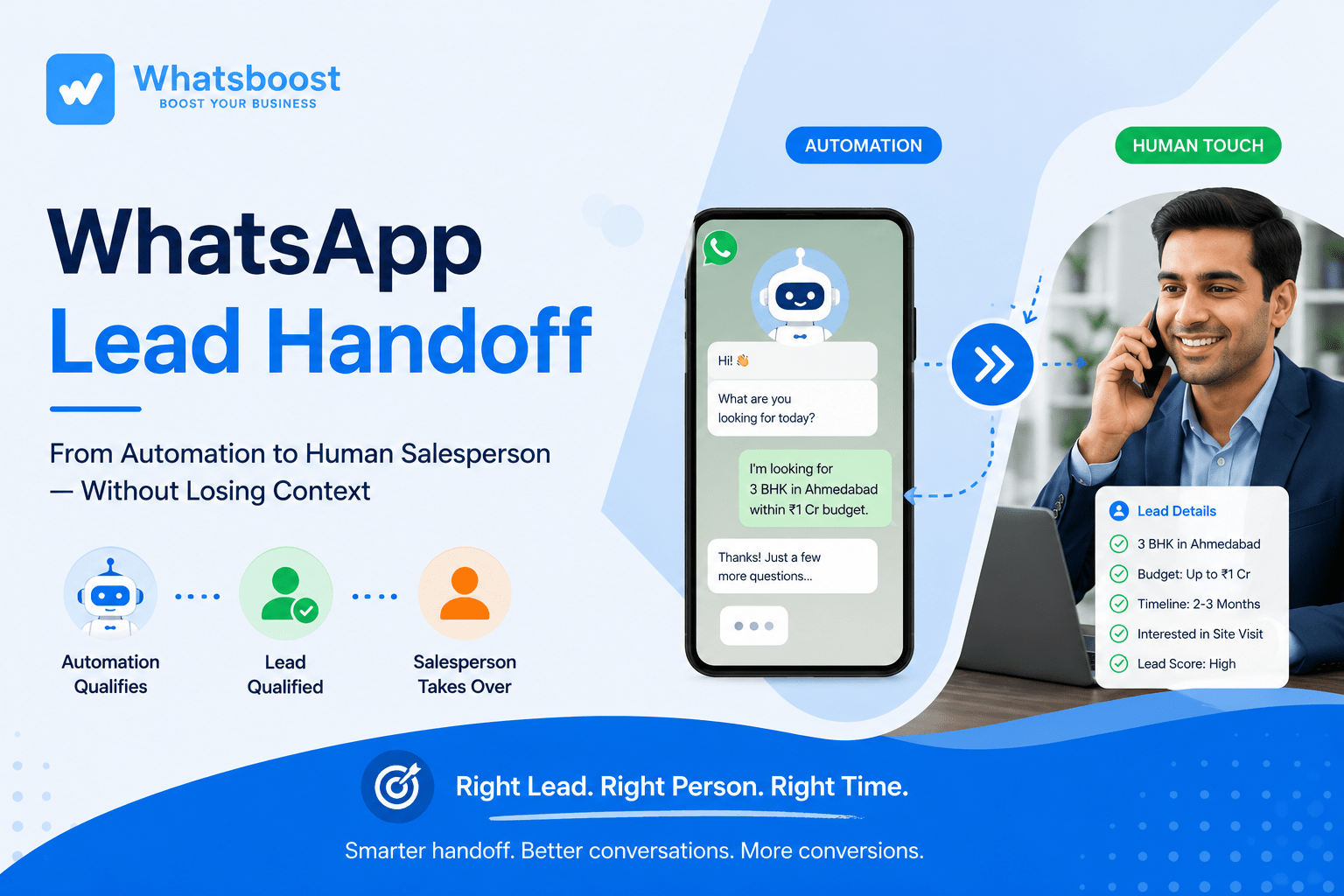
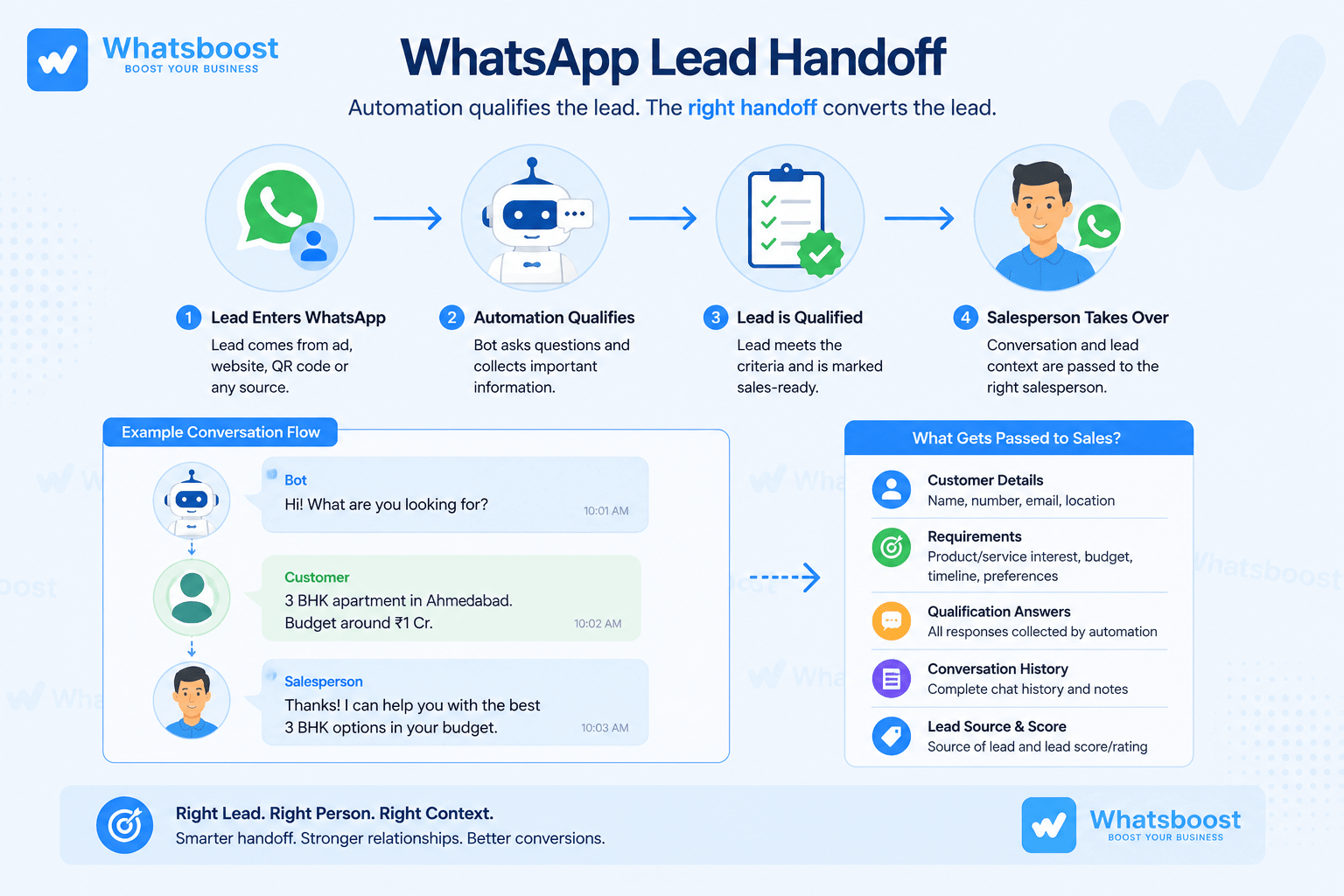
WhatsApp lead handoff is the process of transferring a customer conversation from an automated WhatsApp workflow to a human sales representative when the lead reaches a predefined point in the customer journey.
Imagine a prospect clicking a WhatsApp advertisement for a real estate project.
The first conversation might be handled automatically:
"Hi! Are you looking for a 2 BHK, 3 BHK, or another property type?"
The customer responds.
The workflow may then ask about location, budget, purchase timeline, or preferred configuration.
At some point, the system has collected enough information to understand that this isn't merely someone browsing. The prospect has a specific requirement and appears ready to discuss the property with someone.
That is the moment when the salesperson becomes more valuable than another automated question.
The workflow can notify the salesperson, provide the information collected during the conversation, and allow the salesperson to continue from exactly where the automated conversation ended.
This is the basic idea behind a WhatsApp chatbot to human handoff.
It is not a failure of automation.
It is actually a sign that automation has done its job.
Why Does the Handoff Matter So Much?
Businesses often think about WhatsApp automation in terms of response speed.
A customer sends a message, and the business responds immediately.
That's useful, but speed is only the beginning.
The real operational benefit comes from deciding what should happen next.
Suppose a customer asks for the price of a product. An automated workflow can provide basic information. But then the customer says:
"I need this for a team of 150 people. Can you customize the package?"
The nature of the conversation has changed.
This is no longer a simple information request. It requires someone who understands the product, pricing, implementation, and possibly the customer's business requirements.
If the chatbot keeps asking predefined questions, the experience begins to feel artificial.
On the other hand, if the salesperson receives the conversation without knowing what the customer has already told the business, the customer may have to start again.
Neither outcome is ideal.
The quality of a WhatsApp automation system therefore depends not only on what happens before the human enters the conversation, but also on how smoothly the transition happens.
Automation Should Qualify the Conversation, Not Replace the Salesperson
There is a tendency to think of automation as an attempt to remove human involvement.
That is not necessarily the best way to look at it.
Salespeople spend a considerable amount of time doing things that don't actually require sales expertise: collecting basic information, asking repetitive qualification questions, checking whether a prospect is interested, sending reminders, and determining which leads deserve attention first.
Those activities are good candidates for automation.
A salesperson's time becomes more valuable when the conversation reaches a stage where the customer is comparing options, discussing pricing, explaining a complicated requirement, raising objections, or preparing to make a purchase decision.
The distinction is important.
Automation can prepare the conversation. The salesperson can advance it.
This is particularly relevant for businesses that already use automated lead qualification. WhatsBoost's existing approach to WhatsApp automation for customer onboarding and follow-ups shows the broader principle: repetitive stages of a customer journey can be structured so that employees do not have to remember every action manually.
Lead handoff is the next logical step in that process.
When Should a WhatsApp Conversation Move to a Human?
The right handoff point depends on the business.
A real estate company may hand over a conversation once the customer has shared property preferences, location, budget, and purchase timeline.
A SaaS company may hand over when a prospect requests a demo.
A consulting firm may hand over when the prospect has explained the problem and confirmed that they want to discuss the solution.
An educational institution may hand over when a prospective student has selected a course and wants to discuss fees or admission.
There is therefore no universal "number of messages" after which a chatbot should transfer a conversation.
The better approach is to define business events that indicate human intervention is useful.
A handoff could happen when the customer explicitly asks to speak to a person. It could happen when the lead satisfies specific qualification criteria. It could be triggered by a pricing question, a high-value opportunity, a complex requirement, or an escalation.
The principle is simple:
Don't hand off because the automation has run for five minutes. Hand off because the conversation has reached a point where a human can create more value.
That distinction makes the workflow much more intelligent.
What Does a Salesperson Actually Need at the Moment of Handoff?
This is where many otherwise good WhatsApp automation workflows become ineffective.
Imagine a salesperson receives this notification:
New lead: Amit Sharma
Phone: XXXXXXX
That's technically a lead handoff, but it isn't a useful one.
The salesperson still doesn't know what Amit wants, what he has already discussed, whether he is interested in buying, or why the system decided to route him to sales.
A better handoff carries the context of the conversation.
For example:
Amit Sharma — Qualified Lead
Interested in: 3 BHK apartment
Location: Ahmedabad
Budget: ₹90 lakh–₹1 crore
Purchase timeline: 2–3 months
Source: Meta advertisement
Requirement: Wants to compare available projects
Now the salesperson can enter the conversation naturally:
"Hi Amit, I'm Rahul from the sales team. I understand you're looking for a 3 BHK in Ahmedabad within a ₹90 lakh to ₹1 crore budget. I can help you compare the available options."
The difference is significant.
The first approach transfers a lead.
The second transfers a conversation with context.
That is what a good WhatsApp sales handoff should accomplish.
The Handoff Should Preserve the Customer's Journey
Context becomes even more important when the conversation is connected to a CRM.
A CRM can contain information about the lead, deal stage, previous interactions, assigned salesperson, source, and other customer attributes. When WhatsApp communication and CRM workflows are connected, the handoff doesn't have to exist as a separate manual process.
For example:
New WhatsApp inquiry
→ Lead created
→ Qualification begins
→ Customer provides required information
→ Lead status changes
→ Appropriate salesperson is assigned
→ Salesperson receives notification and context
→ Human conversation begins
→ Sales activity is recorded
→ Follow-up continues
This is where WhatsApp becomes part of the sales infrastructure rather than simply another messaging application.
Businesses can also extend automation beyond the initial lead. For example, CRM-driven WhatsApp workflows can respond to changes in deal stages, support status, customer lifecycle events, or follow-up requirements. WhatsBoost's discussion of CRM workflows with WhatsApp integration covers this broader idea of using CRM events to trigger communication rather than treating WhatsApp as an isolated channel.
The result is a more connected customer journey.
What Happens When the Handoff Is Poorly Designed?
The most obvious problem is repetition.
The customer has already answered:
"What product are you interested in?"
"What is your budget?"
"When are you planning to purchase?"
Then a salesperson joins the conversation and asks exactly the same questions.
From the company's perspective, this may seem harmless.
From the customer's perspective, it feels like the business isn't listening.
There is another problem: ownership ambiguity.
A lead can be technically transferred without actually being owned by anyone. The salesperson receives a notification but doesn't respond immediately. Another employee assumes someone else is handling it. The customer waits.
Automation has successfully qualified the lead, but the organization has failed at the next operational step.
This is why lead handoff should be designed as a workflow rather than treated as a simple notification.
The workflow needs to answer three questions:
Who receives the lead?
What information do they receive?
What happens if they don't respond?
Once these questions are answered, the handoff becomes measurable and manageable.
A Practical WhatsApp Lead Handoff Workflow
Consider a B2B company that receives enquiries through WhatsApp.
A prospect starts a conversation after clicking an advertisement.
The automated workflow asks what the company is looking for, how many employees need the solution, when they want to implement it, and whether they would like a demonstration.
The prospect provides the required information.
At this stage, the system identifies the conversation as sales-ready.
Instead of continuing with another automated sequence, the workflow changes the lead status and assigns the conversation to a salesperson.
The salesperson receives the customer's information and conversation context.
The customer then receives a human response.
The salesperson discusses the requirement, answers questions, and handles objections.
If the customer requests a proposal, the CRM can record the next stage.
If the customer isn't ready to purchase immediately, the lead can enter an appropriate follow-up process.
This creates a much more sensible division of responsibility:
Automation handles consistency.
Humans handle complexity.
CRM records progression.
The three work together instead of operating as disconnected systems.
What About Leads That Aren't Ready for a Salesperson?
This is another reason why handoff should not be treated as a simple "qualified/not qualified" decision.
Not every lead falls into two categories.
A customer might be interested but not ready to buy for three months.
Another may be researching solutions without a defined budget.
Someone else may need more information before speaking to sales.
If every conversation is immediately handed to a salesperson, the team can become overloaded with low-intent leads.
A better workflow can distinguish between different levels of intent.
A high-intent lead might go directly to sales.
A prospect who needs more information might enter a nurturing workflow.
A customer who simply needs support might be routed to the support team.
Someone who is not currently ready to buy can remain in a longer-term engagement journey.
This is one of the advantages of automation: the system can make the initial decision consistently instead of asking salespeople to manually sort every incoming conversation.
Human Handoff Should Also Know When to Stop Automating
There is a subtle but important problem that businesses sometimes overlook.
They create a workflow that transfers a lead to a salesperson, but the original automation doesn't actually stop.
The customer is now speaking with a human, yet automated reminders continue appearing in the conversation.
This creates a fragmented experience.
A proper workflow needs a clear state change.
Once the salesperson takes ownership, the automated qualification flow should stop or change behavior.
The same principle applies in reverse.
Suppose the salesperson finishes the conversation and moves the lead to a follow-up stage. Automation can become useful again.
A reminder can be scheduled.
A proposal follow-up can be triggered.
A customer onboarding message can be initiated after a successful sale.
In other words, human handoff does not mean automation ends permanently.
It means the responsibility changes temporarily because the conversation requires human input.
Measuring Whether Your Handoff Actually Works
A business shouldn't judge its handoff system by the number of leads transferred.
A high handoff rate isn't necessarily a good thing.
The more meaningful question is what happens after the handoff.
Useful measurements include:
How quickly does a salesperson respond after assignment?
What percentage of qualified leads receive a human response?
How many leads are lost after handoff?
How often do customers have to repeat information?
What percentage of handed-off leads progress to the next sales stage?
How often are leads assigned to the wrong person?
How many automated workflows continue after human takeover?
These measurements reveal whether the automation is actually improving the sales process.
A company might discover, for example, that its chatbot qualifies 500 leads per month but salespeople respond to only 350 of them.
The problem isn't lead qualification.
It is the handoff and ownership process.
That insight can lead to a much more valuable optimization than simply generating more leads.
Where WhatsApp Lead Handoff Fits Into a Larger Sales Automation Strategy
Lead handoff shouldn't exist as a standalone automation.
It works best as one stage in a broader sales workflow.
A mature WhatsApp sales process might look like:
Lead acquisition
→ Instant response
→ Qualification
→ Lead classification
→ Human handoff
→ Sales conversation
→ Proposal
→ Follow-up
→ Deal closure
→ Customer onboarding
Each stage has a different purpose.
The initial automation protects response time.
Qualification protects salesperson time.
The handoff protects customer experience.
CRM integration protects data continuity.
Follow-up automation protects opportunities from being forgotten.
And human sales interaction protects the part of the process that still depends on expertise and relationships.
WhatsBoost already approaches WhatsApp sales automation as a broader journey from lead capture through qualification, nurturing and closing rather than limiting automation to the first response.
That makes the handoff an important middle layer in the overall system.
WhatsApp Lead Handoff Is About Timing, Not Just Technology
The technology behind the workflow matters, but the most important decision is actually a business one:
When should a human enter the conversation?
If the salesperson enters too early, automation isn't doing enough.
If the salesperson enters too late, the customer may become frustrated.
If the salesperson enters without context, the business loses continuity.
If the salesperson enters with the right information at the right moment, automation and human selling complement each other.
This is particularly important for products and services where customers need consultation before buying.
A chatbot cannot always understand the nuances of a business requirement.
A salesperson can.
But a salesperson also shouldn't have to spend ten minutes asking questions that an automated workflow could have collected in the first minute.
The most efficient model therefore isn't fully automated or fully manual.
It is selectively automated.
How WhatsBoost Can Support the Handoff
For businesses that use WhatsApp as an important part of their sales process, WhatsBoost can act as the automation layer connecting customer conversations with lead management and workflow actions.
The value is not simply in making the first response faster.
It is in creating a sequence where a lead can enter through WhatsApp, provide relevant information, move through qualification, reach the appropriate stage, and then be handled by the right person.
Once the human interaction is complete, automation can become useful again for subsequent follow-ups, onboarding, reminders, or other customer lifecycle activities.
This creates a more practical model of automation:
Automate what is repetitive.
Route what requires expertise.
Preserve the context.
Continue automation when it becomes useful again.
That is much closer to how real sales teams operate.
The Real Value of a WhatsApp Human Handoff
A successful WhatsApp automation strategy isn't measured by how much of the conversation can be handed over to a bot.
It is measured by whether the right parts of the customer journey are being handled by the right system.
A customer shouldn't have to wait for a salesperson simply to receive basic information.
A salesperson shouldn't have to manually qualify every inquiry.
And a qualified prospect shouldn't have to repeat everything they already told the chatbot.
The handoff solves the gap between those three problems.
When the transition is designed properly, the customer experiences one continuous conversation even though different systems and people may be involved behind the scenes.
Want to automate WhatsApp for your business?
Set up campaigns, replies, and follow-ups in minutes.