WhatsApp Workflows for Missed Call Lead Follow-Ups
Discover how WhatsApp workflows help businesses handle missed call leads faster, automate follow-ups, reduce lead leakage, and improve sales coordination through structured communication systems.
Most Indian businesses assume missed call leads are easy to handle.
A customer gives a missed call. Someone from the team calls back. Conversation done.
But in reality, this is where a large percentage of sales pipelines quietly start leaking.
The lead calls during lunch hours. The sales rep is busy. Somebody forgets to follow up. Another rep messages later from a personal number. Notes stay inside WhatsApp chats. No reminder gets scheduled. The customer replies after two days and nobody notices.
By the time the business reconnects, the lead has already moved to a faster competitor.
This is not a marketing problem.
It is an operational workflow problem.
And for Indian MSMEs increasingly running sales through WhatsApp, the first 15 minutes after a missed call often decide whether the lead converts or disappears.
According to Statista, WhatsApp remains the world’s most-used messaging platform, with India continuing to be its largest market. At the same time, customers now expect businesses to respond conversationally and almost instantly rather than through delayed callbacks or formal email chains.
That shift is changing how missed call lead management works.
Why Missed Call Leads Are High-Intent Leads
In India, missed calls are not accidental behavior.
They are often signals of immediate interest.
Customers use missed calls because they:
want quick information
prefer chat over forms
do not want long IVR interactions
expect a callback or WhatsApp reply
are comparing multiple vendors quickly
This is especially common in:
real estate
coaching institutes
clinics
distributors
D2C brands
local services
automobile inquiries
B2B supply businesses
The problem is that most businesses still treat missed calls manually.
And manual follow-ups break very quickly at scale.
What Usually Happens After a Missed Call
A typical workflow inside growing businesses looks like this:
Customer gives missed call
Staff notices it later
Someone manually saves the number
WhatsApp message gets delayed
No structured follow-up happens
Lead goes cold silently
The business assumes:
“Customer was not serious.”
But often, the real issue was response continuity.
This becomes worse when:
multiple team members handle the same number
conversations stay inside personal devices
there is no centralized visibility
reminders depend on memory
leads are tracked in spreadsheets
Many businesses still rely on disconnected workflows even after implementing CRMs.
This is exactly why articles like Zoho CRM + WhatsApp Automation: Why Most Teams Still Miss Follow-Ups in 2026 explain that businesses usually lose leads because follow-up execution breaks operationally, not because the CRM itself is weak.
Why WhatsApp Works Better Than Traditional Callback Systems
Traditional lead handling was designed around calls.
Modern customer behavior is not.
Today, after giving a missed call, customers usually prefer:
a WhatsApp message
a product catalog
pricing information
appointment scheduling
a voice note
a brochure
a quick clarification
instead of repeated phone calls.
WhatsApp works because:
messages are seen faster
conversations feel personal
follow-ups feel less intrusive
documents can be shared instantly
context remains visible
communication becomes asynchronous
For Indian businesses, this creates a major operational advantage.
A missed call can immediately become:
a lead qualification flow
an appointment booking
a support request
a distributor inquiry
a sales pipeline
a payment reminder sequence
inside the same chat thread.
The Ideal WhatsApp Workflow for Missed Call Follow-Ups
The strongest systems are not complicated.
They simply remove operational friction.
Instant WhatsApp Acknowledgment
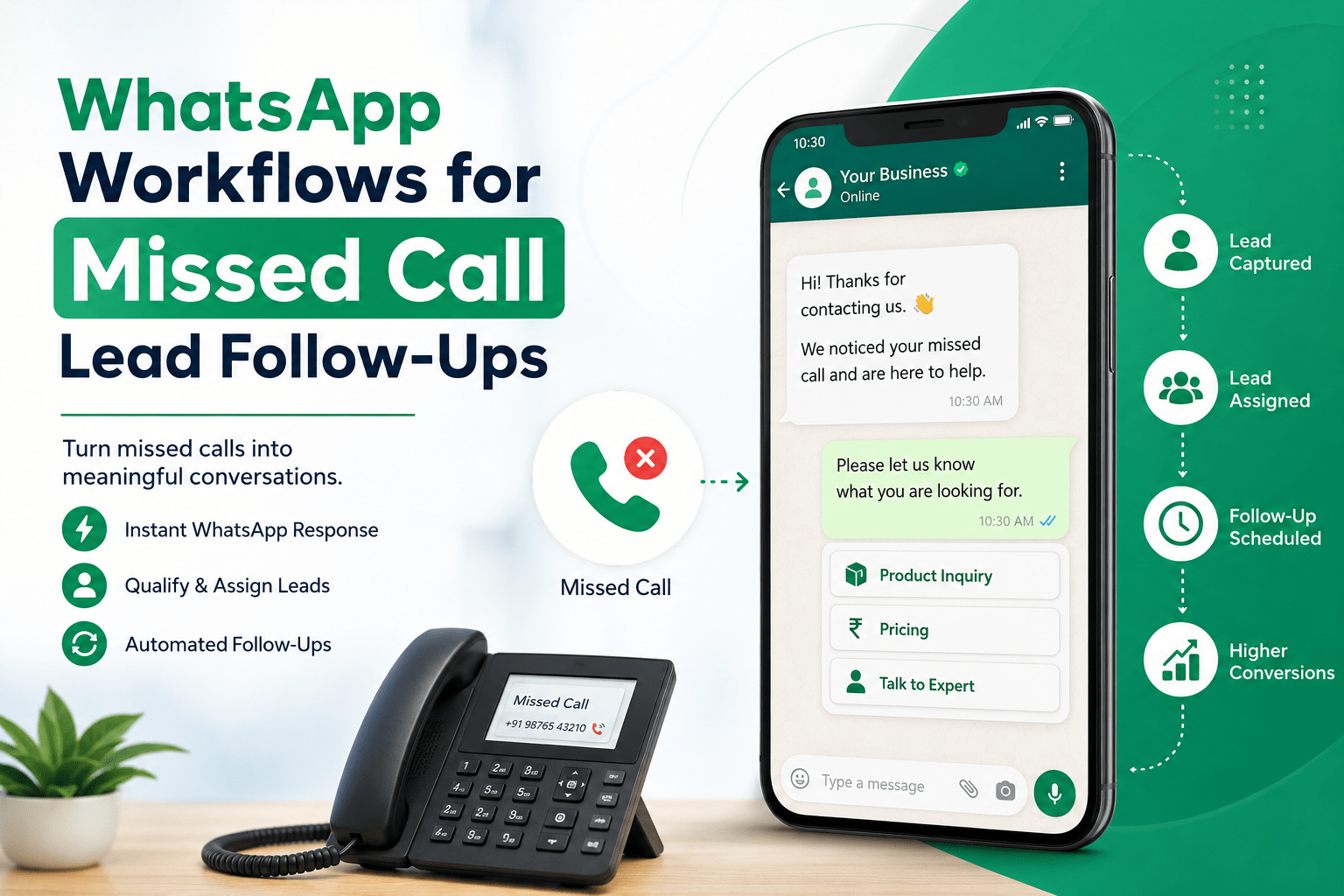
The moment a missed call happens, the customer should receive a WhatsApp message automatically.
Not after two hours.
Not after somebody remembers.
Immediately.
A good acknowledgment message should:
confirm the inquiry
introduce the business
reassure the customer
guide the next step
For example:
Hi! Thanks for contacting [Business Name].
We noticed your missed call and wanted to connect with you here on WhatsApp for faster assistance.
Please share what you’re looking for, and our team will help you shortly.
This single step improves:
response confidence
customer trust
engagement rates
operational professionalism
Businesses increasingly use structured workflows like WhatsApp Sequences for Auto Follow-Ups to automate these first-touch interactions instead of depending on manual coordination.
Lead Qualification Should Happen Inside WhatsApp
One major mistake businesses make is pushing every lead directly into a sales call.
That creates unnecessary workload.
Instead, high-performing teams qualify intent first.
Inside WhatsApp itself.
This can include:
product interest
location
budget
urgency
appointment preference
service requirement
business type
The important part is making automation feel conversational rather than robotic.
Indian customers respond far better to contextual interactions than scripted sequences.
Businesses building conversational qualification systems often combine CRM logic with WhatsApp workflows similar to the systems discussed in Building a WhatsApp-Based Lead Qualification System with NeoDove CRM.
Why Speed-to-Lead Changes Everything
The first few minutes after inquiry are extremely important.
Especially for:
IndiaMART leads
Meta ad inquiries
website inquiries
distributor inquiries
callback requests
Customers are usually contacting multiple businesses simultaneously.
The business responding first often controls the conversation first.
This is why many companies now use instant lead routing systems like CTWA Lead Capturing Workflows and Website Lead to WhatsApp Integrations to reduce response delays dramatically.
The Real Problem Is Not Missed Calls — It’s Missed Follow-Ups
Most businesses do attempt the first response.
But follow-up consistency collapses afterward.
This is where pipelines quietly leak revenue.
Common operational failures include:
forgotten callbacks
no reminder systems
duplicated conversations
delayed quotations
inconsistent replies
no lead ownership
no conversation visibility
And these failures compound as the business grows.
This is why many Indian businesses are shifting from:
manual reminders → workflow-based automation.
The operational logic behind this shift is explained well in Why Manual Lead Tracking Breaks at Scale, where growing businesses struggle to maintain continuity once lead volumes increase.
Why Shared Visibility Matters in Growing Teams
One of the biggest problems in WhatsApp-led businesses is fragmented communication ownership.
Customer conversations live:
in employee phones
inside personal WhatsApp accounts
across spreadsheets
inside notebooks
in disconnected CRMs
This creates:
repeated questions to customers
lost context
dependency on individual employees
poor accountability
inconsistent customer experiences
As businesses scale, centralized conversation visibility becomes essential.
Teams increasingly need:
shared inbox visibility
searchable conversations
automated task reminders
lead assignment workflows
unified customer history
rather than isolated chats.
Automation Is Not About Removing Humans
This is where many businesses misunderstand WhatsApp automation.
The goal is not replacing sales conversations.
The goal is removing operational gaps around those conversations.
Automation handles:
response timing
reminders
routing
acknowledgment
sequencing
assignment
tracking
while humans focus on:
negotiation
relationship-building
qualification
conversions
That combination is what creates scalable communication systems.
How WhatsBoost Helps Businesses Handle Missed Call Workflows
WhatsBoost helps businesses turn missed calls into structured WhatsApp workflows without depending entirely on manual coordination.
Teams can:
trigger instant WhatsApp replies after missed calls
assign inquiries automatically
centralize conversations
automate reminders
build follow-up sequences
manage customer history
track lead progression
inside one connected workflow.
Businesses also integrate tools like:
CRM systems
Meta Lead Ads
IndiaMART
LeadsBridge
scheduling workflows
Android automations
to create faster response systems around customer inquiries.
The Businesses Winning on WhatsApp Are Operationally Faster
Most businesses think they need:
more ads
more leads
more sales staff
But often, the real issue is operational delay between inquiry and follow-up.
In WhatsApp-first markets like India, customers increasingly reward businesses that feel:
responsive
conversational
organized
continuous
easy to communicate with
And that experience is rarely created by manual workflows alone.
Missed call follow-ups are no longer just callbacks.
They are now part of a larger conversational sales infrastructure — one where timing, visibility, automation, and continuity directly influence revenue outcomes.
Want to automate WhatsApp for your business?
Set up campaigns, replies, and follow-ups in minutes.