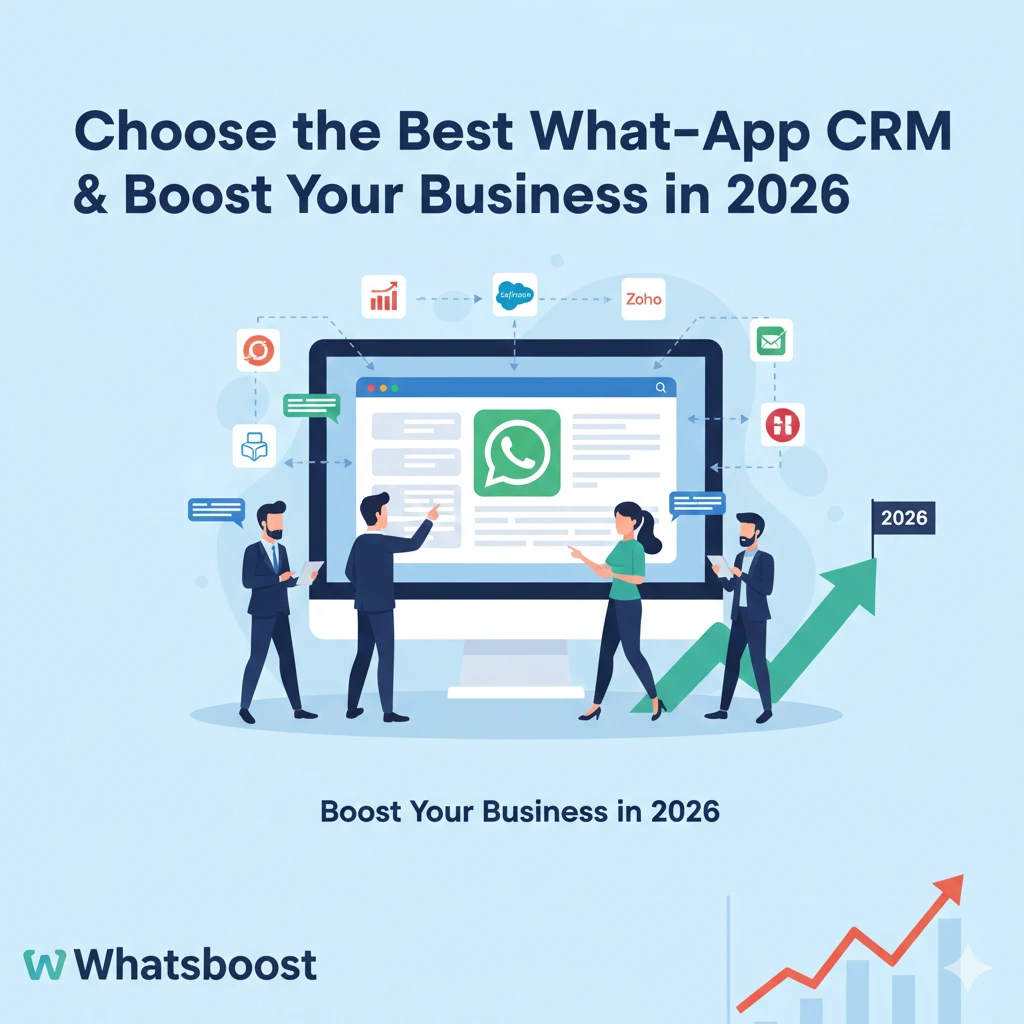
Choose the Best WhatsApp CRM & Boost Your Business in 2026
Discover the best WhatsApp CRM tools to boost your business in 2026. Compare automated vs manual messaging, explore key CRM features, and learn how Whatsboost can transform your WhatsApp strategy.
If you've just started using WhatsApp for Business, there's a good chance you're still managing promotions and customer conversations manually. For small volumes, that works fine. But as your customer base grows and messages start pouring in, manually replying to each one in a timely manner becomes nearly impossible — even with a full team on deck.
Now add the complexity of running marketing campaigns, nurturing sales leads, and handling support queries all at once. Suddenly, the question isn't whether you need a smarter system — it's which one you choose.
That's exactly where a WhatsApp CRM comes in. And in 2026, picking the best WhatsApp CRM for your business isn't just a good idea — it's a competitive necessity.
What Is a WhatsApp CRM and Why Does It Matter in 2026?
A WhatsApp CRM is a customer relationship management solution that integrates directly with WhatsApp to help businesses manage conversations, track leads, automate messaging, and build stronger customer relationships — all from one centralized platform.
Unlike traditional CRMs that focus on email pipelines or spreadsheets, a WhatsApp-first CRM lets you work within the messaging app your customers already use and trust. WhatsApp Business users have grown by 35% between 2022 and 2024, and that growth trajectory shows no signs of slowing.
For businesses in 2026, this means one thing: if you're not managing WhatsApp strategically, you're leaving money on the table.
Automated WhatsApp Messages vs. Manual Messaging: Which Is Right for You?
Before choosing a WhatsApp CRM, it's important to understand the two core messaging approaches — automation and manual — and how they each fit into a modern business strategy.
What Are Automated WhatsApp Messages?
Automated WhatsApp messages are pre-written texts that are triggered and sent to customers automatically based on specific inputs, actions, or workflow conditions. These messages don't require a human to be actively present. Common examples include automated replies to new inquiries, scheduled promotional broadcasts, and AI-powered chatbot flows.
Automation makes it possible for businesses to respond instantly, stay consistent, and scale their communication without adding headcount.
What Is Manual Messaging on WhatsApp?
Manual messaging is exactly what it sounds like — a team member types and sends messages directly through WhatsApp. There's no pre-set trigger or auto-reply. It's real-time, human-driven communication that relies entirely on the availability of your team.
Manual messaging has its strengths, but it simply cannot keep up with high-volume conversations without significant resource investment.

Advantages of Automated WhatsApp Messages
Automating your WhatsApp messages through a CRM platform like Whatsboost offers several compelling advantages for growing businesses:
Speed: Customers receive instant responses the moment they send a message, dramatically improving their overall experience and reducing drop-offs.
Consistency: Automated messages are standardized, which means your brand tone, accuracy, and messaging quality remain uniform across every conversation.
Scalability: Whether you're handling 100 conversations or 10,000, automation handles the load without breaking a sweat. This is especially valuable during peak sale seasons when message volumes spike.
Cost Efficiency: By automating repetitive queries and standard follow-ups, businesses reduce the manual workload on support teams and cut operational costs significantly.
Data Collection and Lead Segmentation: Automated workflows built into platforms like Whatsboost allow you to gather lead information naturally through conversational flows, enabling smarter targeting and personalization.
Advantages of Manual Messaging on WhatsApp
Manual messaging isn't obsolete — it still plays an important role in a well-rounded strategy:
Personalization: When a human types a message, customers can often sense the authenticity. This personal touch builds trust, especially in high-value or sensitive interactions.
Flexibility: Sales agents can adapt their tone and approach in real time based on how a conversation unfolds, something no pre-written template can fully replicate.
Better Problem-Solving: Complex queries that require judgment, nuance, and contextual understanding are better handled by trained agents who can read the situation holistically.
Higher Engagement in Some Segments: Many customers, particularly in B2B or high-ticket B2C contexts, prefer speaking with a real person rather than a bot.
Key Differences Between Automated and Manual Messaging
Understanding where each approach excels will help you make smarter decisions when setting up your WhatsApp CRM strategy.
Response Time: Automated messages respond instantly, regardless of the time of day. Manual messaging depends entirely on agent availability, which can lead to delays and missed opportunities — especially outside business hours.
Personalization: Manual messages tend to feel more tailored in the moment. However, modern automated systems — particularly those powered by WhatsApp Business API providers like Whatsboost — can leverage real-time customer data like past purchases and previous interactions to deliver highly personalized automated messages at scale.
Scalability: Automation handles unlimited simultaneous conversations. Manual messaging, by contrast, is constrained by team size, which creates bottlenecks during high-demand periods.
Cost and Efficiency: When calculated over time, WhatsApp automation saves significantly more time and money than manual messaging. Teams are freed up to focus on complex issues that genuinely require human judgment, rather than spending hours answering the same five FAQs.
Types of WhatsApp CRM Solutions Available in 2026
Not all WhatsApp CRMs are built the same. Depending on your technical capabilities and business needs, you'll likely fall into one of three categories:
WhatsApp Business API — Native CRM Integration
This approach uses the official WhatsApp Business API to connect directly with your existing CRM system. It's the most stable and secure option, offering high performance and the flexibility to customize workflows to your exact requirements. Businesses with development resources often prefer this route for its reliability and full feature access.
Third-Party Integrations
Third-party tools act as a bridge between WhatsApp and your CRM. This is a great option for businesses that want a faster setup without deep technical involvement. These integrations typically involve middleware platforms that handle the connection and sync data between systems.
WhatsApp-First CRM Platforms
This is where platforms like Whatsboost shine. A WhatsApp-first CRM is a full-stack solution built specifically around WhatsApp, eliminating the need to bolt WhatsApp onto a traditional CRM that wasn't designed for it.
With Whatsboost, businesses can capture high-intent leads from multiple sources including WhatsApp, Instagram, and APIs — all without complicated integrations. The platform supports automated lead qualification, personalized message broadcasting, visual sales pipeline management, and real-time analytics, making it one of the most comprehensive options available for businesses looking to boost their business through WhatsApp in 2026.
Key Features to Look for in the Best WhatsApp CRM in 2026
When evaluating WhatsApp CRM tools, here are the features that should be non-negotiable:
Automated Messaging and Workflows
Your CRM should allow you to set up automated message flows triggered by customer actions or CRM updates. This includes everything from welcome messages to abandoned cart reminders and post-purchase follow-ups. Whatsboost's automation capabilities make it easy to build these workflows without writing a single line of code.
Shared Team Inbox and Multi-Device Support
A shared inbox means your entire customer support or sales team can manage incoming WhatsApp conversations from one centralized location. This prevents duplicate responses, improves coordination, and ensures no message gets missed — even when multiple team members are working simultaneously.
Smart Lead Assignment
The ability to automatically assign leads to the right agents based on rules like source, tags, or customer traits is critical at scale. Whatsboost includes intelligent auto-assignment that ensures every lead is handled promptly by the most appropriate team member.
CRM Analytics and Reporting
You can't improve what you don't measure. A strong WhatsApp CRM should provide insights into response times, resolution rates, team performance, and campaign effectiveness. These metrics help you make data-driven decisions and refine your messaging strategy over time.
Omnichannel Support
In 2026, customers communicate across multiple platforms. The best WhatsApp CRM tools — including Whatsboost — extend beyond WhatsApp to manage Instagram messages, enabling truly unified omnichannel customer support.
End-to-End Encryption and Data Privacy
Customer trust depends on data security. Any WhatsApp CRM you choose should comply with data privacy regulations and maintain end-to-end encryption across all communications.
Integration Capabilities
Your WhatsApp CRM should seamlessly connect with your existing tools — whether that's your e-commerce platform, analytics tools, or marketing software — so data flows freely and operations stay streamlined.

How to Choose the Best WhatsApp CRM for Your Business
Every business is different, and the right WhatsApp CRM depends on your specific situation. Here are the key factors to evaluate:
Business Size and Use Case: A solopreneur has very different needs from a 200-person sales team. Identify whether you need WhatsApp primarily for marketing, sales, customer support, or all three.
Customer Volume: Consider how many customers are in your WhatsApp list and how many messages you're sending and receiving each day. High-volume businesses almost always benefit from automation.
Nature of Interactions: Are most of your customer queries straightforward FAQs that can be standardized, or are they complex inquiries that require tiered, human-in-the-loop responses? This distinction will heavily influence how much automation you need.
Available Resources: Factor in your team size, technical capabilities, and budget. Platforms like Whatsboost are designed to be accessible even for businesses without dedicated IT teams.
Business Objective: Are you focused on lead generation? Support efficiency? Marketing ROI? Align your CRM choice with the outcomes you're trying to drive.
Hybrid Approach: Most businesses benefit from a combination of automation and human interaction. Setting up chatbot-to-agent handoff workflows means customers get instant responses initially, with seamless escalation to a real person when needed.
How to Set Up a WhatsApp CRM with Whatsboost
Getting started with Whatsboost is straightforward. Here's a simplified roadmap:
Sign up on Whatsboost and connect your WhatsApp Business number through the official API. Once onboarded, you can assign statuses and owners to your leads, add tasks and documents for better follow-ups, and view a complete interaction history for every contact. Set up visual sales pipelines, automate contact assignment from new incoming messages, build your sales teams with role-based permissions, and start generating reports to track performance at the agent and funnel level. The entire process is designed to get your team operational quickly, without requiring deep technical expertise.
Future Trends in WhatsApp CRM for 2026 and Beyond
The WhatsApp CRM space is evolving rapidly. Here's what businesses should be watching:
AI is moving far beyond simple chatbot responses. In 2026, expect AI-powered WhatsApp agents to automatically score leads, segment audiences, analyze sentiment in real time, and suggest the next best action — all within the conversation window.
Analytics are getting smarter too. Modern CRM platforms are beginning to read between the lines of customer conversations — identifying behavioral patterns, interest levels, and emotional cues — not just tracking clicks and replies.
The integration of sales CRM functionality directly into WhatsApp is another major shift. Instead of juggling multiple tools, sales teams can manage leads, deals, and follow-ups entirely from within the WhatsApp ecosystem. This is exactly what platforms like Whatsboost are built for.
Conclusion: Boost Your Business with the Right WhatsApp CRM in 2026
The approach you choose for WhatsApp messaging should align with what you actually want to achieve. If you're still managing everything manually, you're not just working harder — you're falling behind businesses that have already automated and streamlined their customer communications.
The ideal strategy for most businesses in 2026 is a combination of automation and human touch. Use automated workflows to handle the volume, maintain speed, and collect data. Reserve your team's energy for the conversations that genuinely benefit from a personal, expert response.
If you're ready to stop firefighting and start scaling, Whatsboost offers everything you need to build a smarter, faster, and more profitable WhatsApp presence — from no-code automation and lead management to omnichannel support and real-time analytics.
Get started with Whatsboost today and discover what a truly optimized WhatsApp CRM can do for your business.
Frequently Asked Questions About WhatsApp CRM
What is a WhatsApp CRM? A WhatsApp CRM is a customer relationship management solution that integrates with WhatsApp to help businesses manage conversations, track leads, automate messages, and build lasting customer relationships — all from a central platform.
Why do businesses need a WhatsApp CRM in 2026? As customer expectations for fast, personalized communication continue to rise, managing WhatsApp manually is no longer sustainable. A WhatsApp CRM brings automation, organization, and analytics to your messaging strategy, helping you scale without sacrificing quality.
What is the difference between automated and manual WhatsApp messaging? Automated messages are triggered by pre-set conditions and sent without human involvement. Manual messages are typed and sent directly by a team member. Each has its strengths — automated messaging excels at speed and scale, while manual messaging is better suited for complex, high-context conversations.
Can small businesses benefit from a WhatsApp CRM? Absolutely. Even small businesses that handle a modest volume of messages benefit from the organization, automation, and analytics that a WhatsApp CRM provides. Many platforms, including Whatsboost, offer plans that are designed to be accessible and affordable at every stage of business growth.
What features should I look for in the best WhatsApp CRM? Key features include automated messaging and workflows, a shared team inbox, smart lead assignment, omnichannel support, end-to-end encryption, real-time analytics, and integration capabilities with your existing tools.
Is it safe to use a WhatsApp CRM for customer data? Yes, provided you choose a platform that uses the official WhatsApp Business API and complies with data protection regulations. End-to-end encryption and strict privacy policies are essential features to look for.
How does a WhatsApp CRM help with sales? A WhatsApp CRM enables sales teams to track leads across a visual pipeline, automate follow-ups, send personalized product recommendations, and close deals faster — all from within WhatsApp.
What is the hybrid messaging approach? A hybrid approach combines automated messages for speed and scalability with human agent support for complex or high-value conversations. Many businesses use chatbot-to-agent handoff workflows to get the best of both worlds.
Frequently Asked Questions About Whatsboost Automation
What is Whatsboost? Whatsboost is a WhatsApp-first CRM and automation platform that helps businesses manage leads, automate messaging, handle customer support, and run marketing campaigns — all within WhatsApp and Instagram.
Does Whatsboost require coding knowledge to set up? No. Whatsboost features a no-code interface that makes it easy for non-technical teams to build chatbot flows, set up automated workflows, and manage customer interactions without writing any code.
Can Whatsboost handle both WhatsApp and Instagram messages? Yes. Whatsboost provides a unified omnichannel inbox that brings together customer messages from both WhatsApp and Instagram, allowing your team to manage all interactions from one platform.
How does Whatsboost's automated lead assignment work? Whatsboost allows you to set up custom lead assignment rules based on factors like message source, customer tags, or specific traits. When a new lead comes in, the system automatically assigns it to the right agent or team. If no rule matches, a fallback distribution ensures no lead goes unattended.
Can I track my team's performance using Whatsboost? Yes. Whatsboost provides detailed analytics and reporting on individual agent performance, team metrics, sales funnels, and campaign results — helping you identify areas for improvement and make smarter decisions.
Does Whatsboost support WhatsApp broadcast messaging? Yes. Whatsboost allows businesses to send personalized broadcast messages to large customer segments simultaneously, making it an effective tool for promotions, announcements, and re-engagement campaigns.
Is Whatsboost suitable for e-commerce businesses? Absolutely. Whatsboost is particularly well-suited for e-commerce businesses that need to manage order confirmations, shipping updates, abandoned cart recovery, post-purchase support, and promotional campaigns — all through WhatsApp.
How do I get started with Whatsboost? You can sign up and get started at whatsboost.in. The onboarding process is designed to be simple and fast, with guidance available to help you connect your WhatsApp Business number and configure your first automated workflows.
Want to automate WhatsApp for your business?
Set up campaigns, replies, and follow-ups in minutes.