
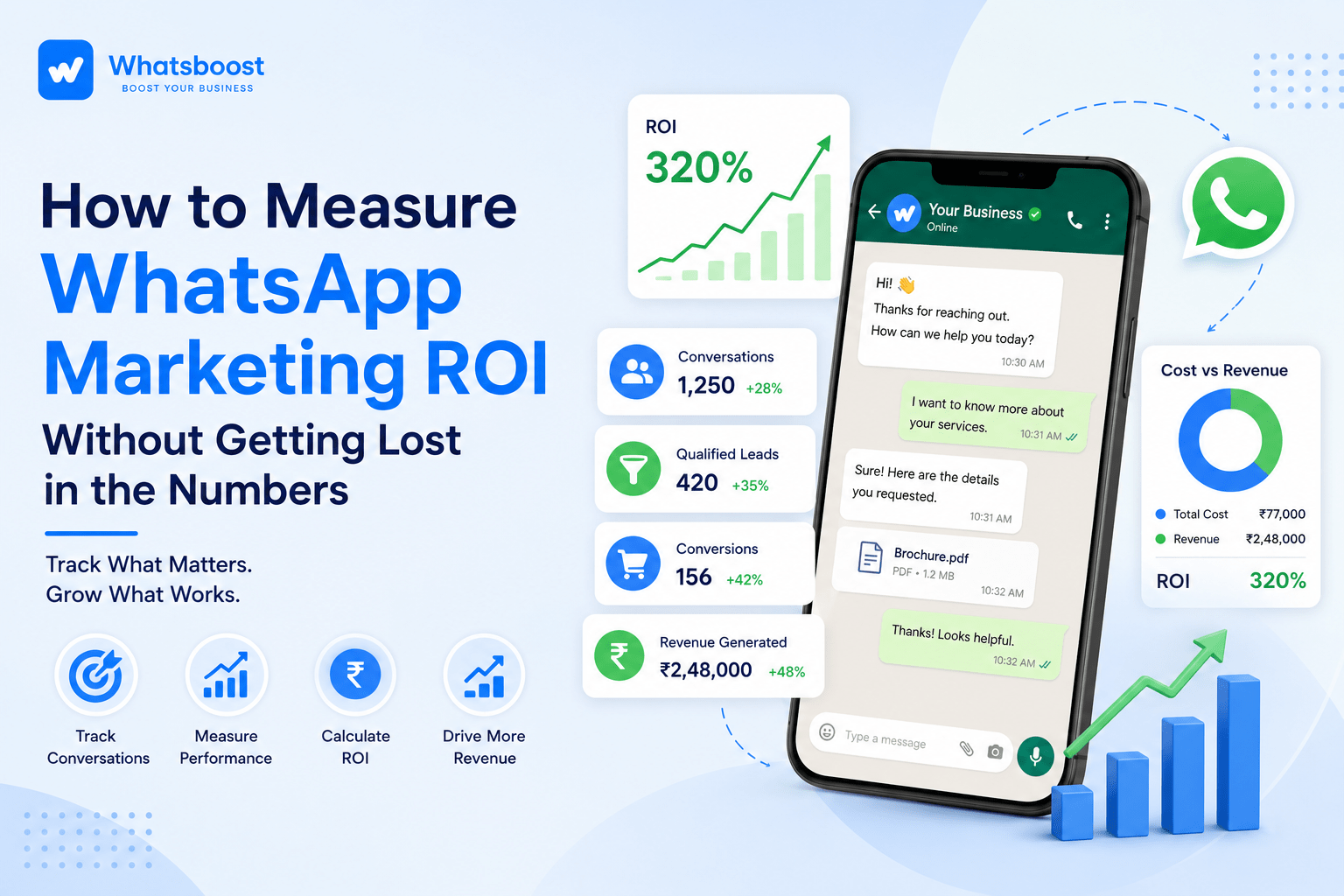
How to Measure WhatsApp Marketing ROI Without Getting Lost in the Numbers
A practical guide for Indian businesses to measure WhatsApp marketing ROI properly using conversion-focused metrics, operational insights, and structured customer communication workflows.
Most businesses already know WhatsApp marketing gets attention.
Messages get opened faster than emails.
Customers reply more naturally.
Follow-ups feel less intrusive.
Sales conversations move quicker.
That part is obvious now.
The real challenge starts later — when businesses try to measure whether WhatsApp is actually generating business value or just generating activity.
Because somewhere between:
open rates
reply counts
campaign dashboards
CRM reports
and sales spreadsheets
most teams lose clarity completely.
Marketing says engagement is increasing.
Sales says lead quality is inconsistent.
Founders ask:
“Are we actually making money from this?”
And nobody gives a confident answer.
This is exactly why WhatsApp ROI measurement has become such a major operational problem for growing businesses.
Not because WhatsApp marketing lacks ROI.
But because most businesses are measuring too many disconnected metrics without understanding which numbers genuinely matter.
The Core Problem With WhatsApp ROI Tracking
Traditional marketing channels are easier to measure.
A customer:
clicks an ad
lands on a website
fills a form
makes a purchase
The attribution path is relatively visible.
WhatsApp behaves differently because it is conversational.
A customer may:
discover your business through Instagram
start a WhatsApp conversation
disappear for two days
return later
ask pricing questions
request case studies
speak with sales
finally convert after multiple conversations
So which channel gets credit?
The ad?
WhatsApp?
The sales team?
Retargeting?
This is why many businesses struggle with WhatsApp ROI measurement.
Conversational commerce does not behave like traditional click-based marketing funnels.
Why Businesses Get Lost in the Numbers
The biggest mistake businesses make is measuring activity instead of outcomes.
They focus heavily on:
delivery rates
read rates
clicks
replies
total messages sent
These metrics feel important because they are easy to track.
But visibility does not equal profitability.
A campaign with:
97% open rates
hundreds of replies
strong engagement
can still generate weak revenue.
Meanwhile, another campaign with fewer conversations may generate dramatically higher conversions because the lead quality is stronger.
This is the difference between vanity metrics and business metrics.
| Vanity Metrics | Business Metrics |
|---|---|
| Open rates | Revenue generated |
| Message delivery | Qualified leads |
| Reply volume | Conversion rate |
| Total messages sent | Cost per acquisition |
| Link clicks | Customer retention |
| Blue ticks | Repeat purchases |
One category looks impressive in reports.
The other actually affects business growth.
The Real Purpose of WhatsApp ROI Measurement
Good ROI tracking is not about collecting more data.
It is about answering four business questions clearly:
Is WhatsApp helping us acquire customers more efficiently?
Is it improving conversion consistency?
Is it reducing operational workload?
Is it increasing long-term customer value?
That is the framework businesses should focus on.
Not endless dashboards.
Not random KPIs copied from generic marketing blogs.
Start With the Simplest ROI Formula
Most businesses overcomplicate ROI immediately.
The foundation is actually simple:
ROI = \frac{Revenue\ Generated\ From\ WhatsApp\ -\ Total\ WhatsApp\ Costs}{Total\ WhatsApp\ Costs}
The challenge is not the formula itself.
The challenge is identifying:
what revenue should be counted
what costs should be included
and how attribution should work realistically
Why WhatsApp Engagement Metrics Alone Are Misleading
WhatsApp naturally performs better than traditional channels when it comes to engagement.
According to global messaging behavior research and communication studies, messaging apps consistently outperform email in visibility and response behavior because they reduce friction and feel more conversational.
That means:
high open rates on WhatsApp are normal.
So businesses should stop treating open rate as the primary success metric.
Because visibility alone does not create revenue.
Customers may:
open messages
read them
ignore them completely
The businesses generating stronger ROI usually optimize:
response quality
lead qualification
follow-up consistency
timing
customer experience
not just message visibility.
The 5 WhatsApp Metrics That Actually Matter
Most businesses do not need 25 dashboards.
They need clarity on a few operational metrics that directly affect growth.
1. Conversion Rate
This is the single most important metric.
Not clicks.
Not replies.
Not delivery rates.
Conversions.
The real question is:
“How many WhatsApp conversations turn into business outcomes?”
Depending on your business, that outcome may be:
sales
appointments
demo bookings
consultations
subscription renewals
qualified leads
payments collected
Businesses increasingly improve these conversions through structured conversational systems instead of fragmented manual communication.
Many companies building organized customer journeys now use a structured WhatsApp sales funnel to guide leads from inquiry to conversion inside one continuous conversation flow.
2. Cost Per Qualified Conversation
Not every conversation has equal value.
A random inquiry is not the same as a serious buyer.
This is where many businesses miscalculate ROI completely.
Instead of measuring:
“cost per message”
smart businesses measure:
“cost per qualified conversation.”
That includes:
API costs
ad spend
automation tools
CRM integrations
team handling effort
Businesses using automated qualification systems often reduce operational inefficiency because repetitive screening gets automated before sales teams step in.
This becomes especially important for smaller Indian businesses operating with lean sales teams.
3. Response Speed
Response speed directly affects conversions on WhatsApp.
Why?
Because WhatsApp is a high-intent communication environment.
When customers message businesses on WhatsApp, they usually expect immediate interaction.
A delayed reply often means:
reduced intent
weaker trust
lower engagement
higher lead drop-offs
This is why automation matters operationally.
Businesses trying to improve response consistency increasingly rely on structured automation and follow-up workflows instead of manually managing conversations across scattered chats and spreadsheets.
4. Follow-Up Completion Rate
One of the biggest hidden revenue leaks in Indian businesses is inconsistent follow-up.
A customer inquiry happens.
Then:
no reminder
no proposal
no next-step coordination
no structured continuation
The lead slowly disappears.
This is usually not a lead quality problem.
It is an operational consistency problem.
Businesses should actively measure:
how many leads received follow-ups
how quickly follow-ups were sent
how many dormant leads were re-engaged
how many reminders were completed
Businesses handling high inquiry volumes often improve conversion consistency using organized WhatsApp follow-up workflows for IndiaMART leads instead of relying entirely on manual coordination.
5. Revenue Per Conversation
This is one of the most valuable advanced metrics.
Instead of asking:
“How many messages did we send?”
the better question becomes:
“How much revenue does each qualified conversation generate?”
This metric reveals:
audience quality
targeting quality
sales efficiency
conversational effectiveness
A smaller number of high-quality conversations often generates stronger ROI than large-scale mass messaging campaigns.
That is one of the biggest shifts happening in WhatsApp marketing right now.
Businesses are moving away from:
volume-first messaging
toward:
conversation-quality optimization.
What Businesses Usually Forget to Include in ROI
Operational efficiency.
This is one of the biggest blind spots in WhatsApp ROI analysis.
Businesses usually calculate:
Revenue – Software Cost
But ignore:
time saved
support workload reduced
missed follow-ups prevented
appointment coordination simplified
repetitive queries automated
lead leakage reduced
These improvements have real economic value.
For smaller businesses especially, operational efficiency itself often becomes one of the biggest ROI drivers.
Businesses heavily dependent on appointment workflows often improve coordination efficiency using structured WhatsApp appointment reminder automation systems that reduce no-shows and repetitive manual reminders.
Why Many WhatsApp Campaigns Still Fail Despite High Engagement
This is important.
Because WhatsApp itself is not magic.
Many businesses still treat WhatsApp like bulk SMS or email blasting.
That approach usually fails long term.
Customers do not want:
repetitive promotions
generic broadcasts
robotic messaging
They want:
relevance
faster coordination
contextual communication
smoother conversations
The businesses generating the strongest ROI today are not necessarily sending more messages.
They are creating:
better conversational journeys
faster responses
smoother follow-ups
more organized customer experiences
That operational maturity matters far more than raw message volume.
A Better Way to Think About WhatsApp ROI
The smartest businesses no longer ask:
“How many messages did we send?”
They ask:
Did lead quality improve?
Did response time improve?
Did follow-up consistency improve?
Did customer coordination become smoother?
Did conversions become more predictable?
Because ultimately:
WhatsApp marketing ROI is not just a marketing metric anymore.
It is increasingly an operational efficiency metric combined with conversational conversion performance.
That combination is where the real business value emerges.
How WhatsBoost Helps Businesses Measure and Improve WhatsApp ROI
WhatsBoost helps businesses centralize WhatsApp communication into structured, trackable workflows instead of scattered manual conversations.
Businesses can organize:
lead response systems
qualification workflows
reminder sequences
follow-up automation
nurturing campaigns
customer communication journeys
inside one operational environment.
Instead of relying on disconnected spreadsheets and manual tracking, businesses gain better visibility into:
conversion flow
conversation quality
follow-up consistency
operational bottlenecks
customer progression
which makes ROI analysis substantially clearer.
Final Thoughts
Most businesses do not actually have a WhatsApp ROI problem.
They have a measurement clarity problem.
They are tracking:
too many metrics,
too many dashboards,
too many disconnected numbers,
without connecting them to actual business outcomes.
The businesses seeing the strongest WhatsApp ROI today are usually not the ones sending the highest volume of messages.
They are the ones building:
faster response systems
smoother follow-up workflows
better customer coordination
more structured conversational experiences
Because in modern conversational marketing, ROI is no longer just about attention.
It is about how efficiently conversations turn into revenue, retention, and operational consistency.
Want to automate WhatsApp for your business?
Set up campaigns, replies, and follow-ups in minutes.