
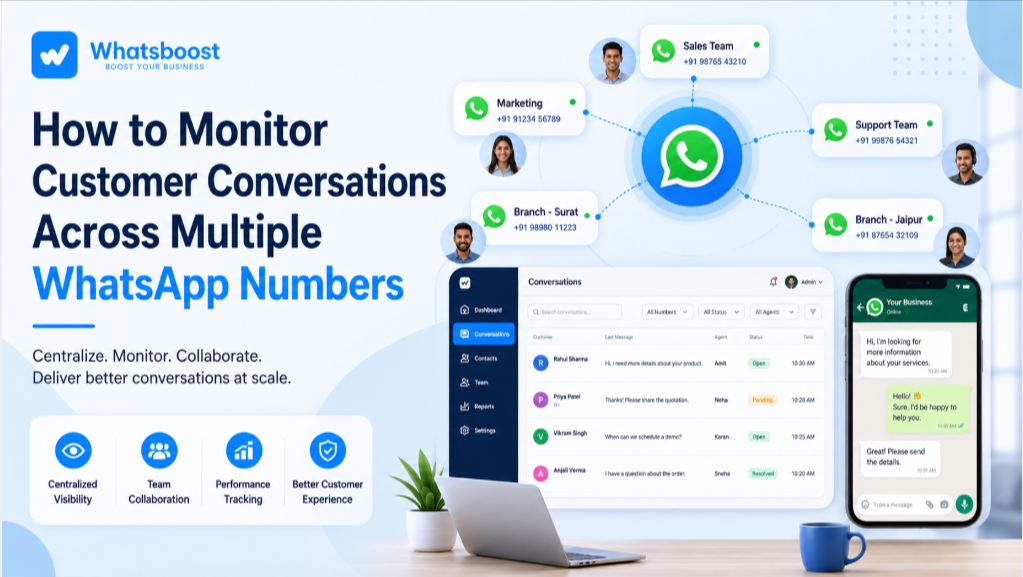
How to Monitor Customer Conversations Across Multiple WhatsApp Numbers
Discover how businesses monitor customer conversations across multiple WhatsApp numbers, improve visibility, reduce missed follow-ups, and create accountability across teams and locations.
As businesses grow, WhatsApp communication becomes increasingly fragmented.
The marketing team uses one number.
Sales representatives use separate numbers.
Customer support operates from another account.
Regional branches maintain their own WhatsApp presence.
Senior managers often continue communicating through personal business numbers.
Initially, this arrangement appears manageable.
Then problems begin to surface.
A customer receives conflicting information from different teams. Leads disappear because nobody knows who was supposed to follow up. Managers have no visibility into ongoing conversations. When employees leave the company, valuable customer history leaves with them.
Most businesses assume they have a lead generation problem.
Many actually have a communication visibility problem.
The challenge is not managing more WhatsApp numbers.
The challenge is managing customer conversations across those numbers without creating operational blind spots.
The Growing Complexity of Business WhatsApp Communication
WhatsApp has become the default communication channel for Indian businesses.
Customers use it to:
Request quotations
Book appointments
Ask product questions
Share requirements
Submit documents
Track orders
Seek support
As inquiry volume grows, businesses often create additional WhatsApp numbers to distribute workload.
For example:
| Department | WhatsApp Number |
|---|---|
| Marketing | Number 1 |
| Sales | Number 2 |
| Customer Support | Number 3 |
| Branch Office | Number 4 |
| Founder or Director | Personal Business Number |
While this approach solves short-term capacity challenges, it creates a new operational problem.
Communication becomes fragmented.
No single person has complete visibility into customer interactions.
Why Conversation Fragmentation Is Dangerous
A fragmented communication environment creates hidden operational risks.
The consequences are often invisible until revenue begins to suffer.
| Problem | Business Impact |
|---|---|
| Conversations spread across multiple devices | No centralized visibility |
| Customers contact multiple team members | Duplicate communication |
| No ownership tracking | Missed follow-ups |
| Employee exits | Customer history lost |
| No monitoring system | Management blind spots |
The most expensive leads are often not the ones you fail to generate.
They are the ones you already acquired but failed to manage properly.
The Real Problem Is Not WhatsApp Numbers
Many businesses assume they need fewer numbers.
That is rarely the issue.
A multi-location real estate company, healthcare group, educational institution, or manufacturing business may legitimately require multiple WhatsApp accounts.
The real challenge is visibility.
Managers need answers to questions such as:
Who responded to this customer?
When was the last interaction?
Is the lead still active?
Has a site visit been scheduled?
Is support waiting for a response?
Which agent owns the conversation?
Without visibility, operations become dependent on individuals rather than systems.
What Businesses Should Actually Monitor
Most organizations focus only on messages.
High-performing businesses monitor workflows.
Instead of simply tracking conversations, they track:
Response Times
How quickly are inquiries receiving their first response?
Research consistently shows that response speed has a significant impact on lead conversion.
Ownership Status
Who is responsible for this customer?
Clear ownership reduces confusion and prevents duplicate outreach.
Follow-Up Completion
Has the customer received the promised callback, quotation, or proposal?
Escalations
Which conversations require management attention?
Unanswered Messages
Which customers are waiting for responses?
These metrics provide far more operational value than message counts alone.
The Four-Layer Framework for Monitoring Customer Conversations
Businesses that successfully manage communication at scale typically implement four operational layers.
Layer 1: Centralized Conversation Visibility
Every customer conversation should be visible from a single operational view.
This does not necessarily mean using a single WhatsApp number.
It means creating visibility across all communication channels.
Benefits include:
Complete customer history
Better handovers
Reduced duplication
Improved management oversight
When communication is centralized, businesses stop relying on screenshots and manual updates.
Layer 2: Ownership and Accountability
One of the biggest causes of missed leads is unclear ownership.
Consider a common scenario.
A prospect inquires about a property.
Marketing shares the lead with sales.
Sales assumes another representative is handling it.
No follow-up occurs.
The lead disappears.
Ownership tracking eliminates this problem.
Every conversation should have:
| Monitoring Field | Purpose |
|---|---|
| Assigned Agent | Accountability |
| Last Activity Date | Visibility |
| Current Status | Workflow tracking |
| Next Action | Follow-up management |
This transforms WhatsApp from a messaging tool into an operational system.
Layer 3: Internal Team Collaboration
Customer communication often involves multiple departments.
For example:
A customer requests:
Pricing information
Product specifications
Delivery timelines
Payment terms
Multiple teams may contribute to the response.
Without collaboration tools, employees rely on:
Screenshots
Forwarded messages
Phone calls
Internal WhatsApp groups
This creates inefficiencies.
Modern communication workflows support:
Internal notes
Team tagging
Conversation assignment
Escalation workflows
As a result, teams collaborate without exposing internal discussions to customers.
Layer 4: Performance Monitoring
Most managers only discover communication problems after sales decline.
Monitoring systems help identify issues earlier.
Useful performance metrics include:
| KPI | Why It Matters |
|---|---|
| First Response Time | Measures responsiveness |
| Average Resolution Time | Measures efficiency |
| Conversation Volume | Tracks workload |
| Missed Follow-Ups | Identifies process gaps |
| Customer Satisfaction | Measures service quality |
| Agent Productivity | Supports coaching |
These indicators provide operational visibility that traditional WhatsApp usage cannot offer.
Why WhatsApp Web Is Not Enough
Many businesses assume WhatsApp Web solves multi-user communication challenges.
It helps with device access.
It does not solve operational visibility.
WhatsApp Web cannot effectively provide:
Lead ownership tracking
Conversation assignment
Performance analytics
Team accountability
Workflow visibility
Operational reporting
This distinction is important.
Multiple device access and conversation management are not the same thing.
One improves convenience.
The other improves operations.
The Multi-Branch Business Challenge
The communication challenge becomes even greater for businesses operating across multiple locations.
Consider a real estate company with offices in:
Ahmedabad
Surat
Vadodara
Rajkot
Each branch manages local inquiries.
Management requires visibility across the entire organization.
Questions emerge:
Which branch responds fastest?
Which office converts the most inquiries?
Are leads being followed up consistently?
Which teams require additional support?
Without centralized monitoring, answering these questions becomes difficult.
With visibility, leadership can identify patterns and improve performance across all locations.
Customer Experience Suffers When Conversations Are Disconnected
Customers do not care how your organization is structured.
They expect a seamless experience.
Imagine this scenario:
A customer contacts marketing.
Then speaks with sales.
Later requests support.
Each department asks the same questions repeatedly.
The customer becomes frustrated.
Disconnected communication creates friction.
Centralized monitoring helps preserve continuity throughout the customer journey.
The Role of WhatsApp CRM Platforms
As conversation volumes increase, businesses often require more than a messaging application.
They need a communication management system.
This is where WhatsApp CRM platforms become valuable.
Instead of viewing WhatsApp as a standalone communication channel, businesses integrate it into broader operational workflows.
This enables:
Centralized visibility
Team collaboration
Ownership tracking
Lead management
Customer journey monitoring
Businesses already using structured lead management processes often find communication visibility becomes the next operational bottleneck to solve.
For example, organizations looking to improve lead workflow governance may also benefit from understanding how a structured real estate lead management workflow moves inquiries from first contact to site visit, ensuring conversations remain connected throughout the customer journey.
https://whatsboost.in/blog/real-estate-lead-management-workflow-from-property-inquiry-to-site-visit
Similarly, businesses that automate lead qualification often discover that monitoring ongoing conversations becomes essential after inquiry volumes increase.
These operational layers work together to reduce lead leakage and improve customer experience.
What an Ideal Monitoring Workflow Looks Like
A mature communication workflow typically follows this path:
Customer Inquiry
↓
Automatic Assignment
↓
Agent Ownership
↓
Conversation Monitoring
↓
Follow-Up Tracking
↓
Escalation Management
↓
Resolution or Conversion
Instead of reacting to communication issues, businesses proactively manage them.
This creates consistency across departments and locations.
The Future of Business Communication Is Visibility
Most businesses have already adopted WhatsApp.
The competitive advantage no longer comes from using the platform.
It comes from managing it effectively.
As customer communication volumes continue growing, visibility becomes increasingly important.
Businesses that monitor conversations effectively can:
Respond faster
Improve customer experience
Reduce lead leakage
Increase accountability
Scale operations confidently
The challenge is not having multiple WhatsApp numbers.
The challenge is ensuring those numbers operate as part of a connected communication system rather than isolated silos.
Want to automate WhatsApp for your business?
Set up campaigns, replies, and follow-ups in minutes.