WhatsApp Automation Implementation Service in India for Enterprises
Indian enterprises don't have a WhatsApp adoption problem — they have a WhatsApp implementation problem. Most large businesses are already using the channel informally. What's missing is the API infrastructure, CRM integration, compliance governance, and automation architecture that makes WhatsApp perform at enterprise scale. This guide covers what enterprise implementation actually involves, how it differs by industry, what it costs when done wrong, and how Whatsboost delivers it end-to-end for
For most Indian enterprises, WhatsApp has already won.
It isn't a question of adoption anymore. 1.5 crore Indian businesses are already on WhatsApp Business — the largest concentration of WhatsApp Business adoption anywhere in the world. Your customers are on it. Your competitors are on it. And in most cases, your own teams are already using it — just not in a way that the organisation controls or can scale.
That gap — between WhatsApp being used and WhatsApp being implemented — is where most Indian enterprises are stuck in 2026.
This is the guide that closes it.
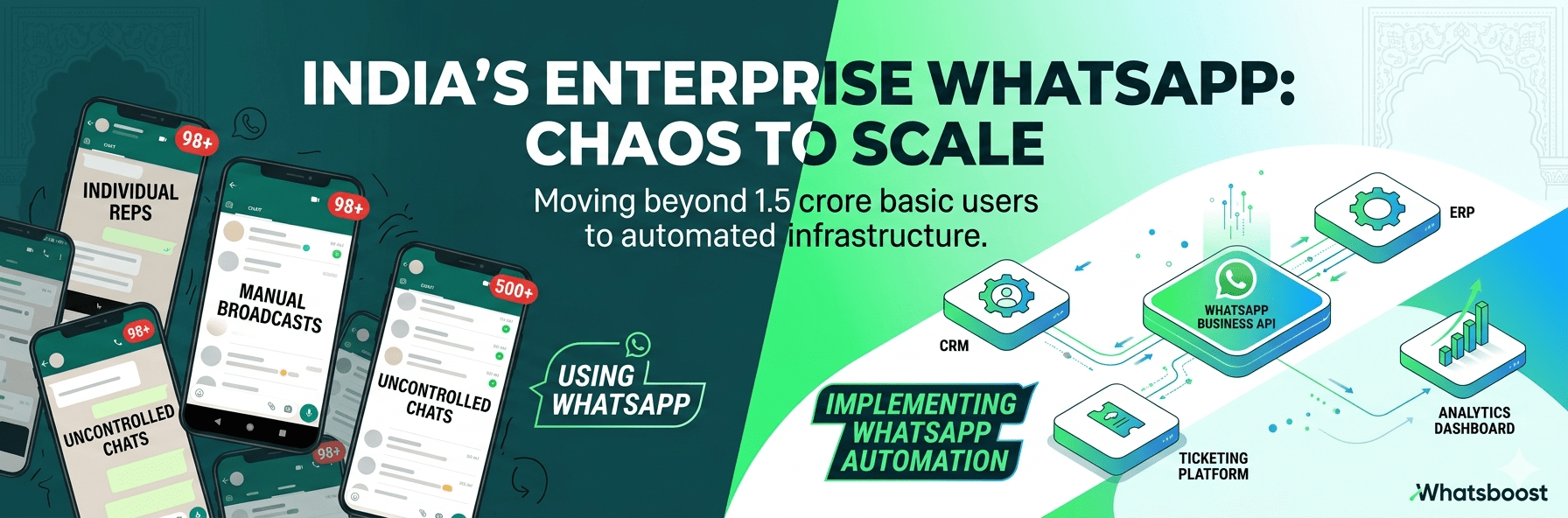
Why "Using WhatsApp" and "Implementing WhatsApp Automation" Are Entirely Different Things
There's a version of WhatsApp that almost every Indian business is already running: a few business numbers, some reps managing their own chats, maybe a broadcast list for promotions. It works at small scale. It falls apart at enterprise scale.
Enterprise-grade WhatsApp automation is something categorically different. It's the infrastructure layer that connects WhatsApp to your existing business systems — CRMs, ERPs, ticketing platforms, marketing automation, analytics dashboards — and runs structured, scalable, compliant communication workflows across every customer-facing function simultaneously.
The distinction matters because the implementation challenges at enterprise scale are not just bigger versions of SMB problems. They're structurally different:
- Volume: An enterprise isn't sending 500 messages a week. It's managing hundreds of thousands of conversations monthly across sales, support, marketing, and operations — simultaneously, across departments, often across multiple business units.
- Integration complexity: Enterprise communication doesn't sit in isolation. Every WhatsApp interaction needs to connect to the CRM that holds customer history, the ERP that holds order data, the support platform that holds ticket status, and the analytics stack that measures it all.
- Compliance: Regulated industries — BFSI, healthcare, insurance — cannot treat WhatsApp as a casual channel. Template governance, opt-in management, data residency, audit trails, and regulatory alignment are non-negotiable from day one.
- Governance: Who approves templates? Who manages agent access? Who monitors quality? Who owns the number if a regional head leaves? These questions don't have answers in a personal-phone WhatsApp setup.
80% of large enterprises plan to adopt the WhatsApp Business API for customer communications, with the global adoption rate growing at approximately 15% year-over-year. The enterprises that are seeing results aren't just turning on the API — they're implementing it with the infrastructure, governance, and integration architecture that makes it perform at scale.
The Indian Enterprise Context: Why This Is Urgent Right Now
India is not a generic market for WhatsApp automation. It's the market.
India leads WhatsApp Business adoption globally with 15 million active business accounts. Three out of four Indian smartphone users are on WhatsApp. The platform is, for most practical purposes, the default digital communication infrastructure of the country — not a channel you choose to be on, but the channel your customers expect you to be on.
The enterprise urgency in 2026 is driven by three converging pressures:
Competitive pressure from agile competitors. Mid-size and fast-growing businesses in every sector are deploying WhatsApp automation faster than large enterprises. Businesses that fail to adopt advanced WhatsApp automation risk losing customers to more agile, tech-enabled competitors. The window for first-mover advantage in enterprise WhatsApp automation in India is closing.
Customer expectation shift. Indian customers — across all income segments, all age groups, all geographies — have been trained by consumer apps to expect instant, conversational responses. Indians prefer messaging over emails or calls, and WhatsApp messages have a 98% open rate with significantly higher engagement than traditional channels. Enterprises still routing customer queries through email and IVR are experiencing this preference gap as increasing customer dissatisfaction.
The cost case. Companies report saving up to 30% on communication costs after switching to WhatsApp Business API, and contact centre volume reduction from automated WhatsApp handling of routine queries has been 25–40% in documented enterprise deployments. At Indian enterprise scale, those percentages represent significant operational savings that make the implementation investment straightforward to justify.
What Enterprise WhatsApp Automation Actually Covers
The term "WhatsApp automation" is used loosely. For enterprise implementation, it covers five distinct capability layers — each of which requires separate configuration, integration, and governance:
1. Conversational Automation (Chatbots and Flows)
The most visible layer — AI-powered or rule-based bots that handle customer queries, collect information, process requests, and escalate to human agents when needed. At enterprise scale, this goes well beyond simple FAQ bots to include multi-step transactional flows: loan status enquiries, order tracking, appointment booking, KYC collection, and payment confirmations — all automated within WhatsApp. Advanced WhatsApp automation tools enable Indian enterprises to automate up to 70% of customer interactions without compromising experience.
2. CRM and Backend Integration
This is where enterprise implementation diverges most sharply from basic WhatsApp business usage. Every customer-facing WhatsApp conversation needs to sync bidirectionally with the systems that hold customer data. Integrating WhatsApp with enterprise CRM platforms — whether that's Salesforce, HubSpot, Zoho, SAP, or a custom-built system — means that a support agent picking up a conversation can see the customer's full history, that a sales trigger in the CRM can initiate a WhatsApp follow-up automatically, and that every conversation outcome is logged without manual data entry.
For enterprises running Salesforce specifically, the Salesforce-WhatsApp integration layer turns WhatsApp conversations into structured, trackable CRM records — with leads created automatically, pipeline stages updated based on conversation triggers, and case management initiated without leaving the chat.
3. Broadcast and Campaign Automation
Enterprise broadcast is not the same as SMB bulk messaging. It involves segmented contact databases, personalised message variables drawn from CRM data, campaign scheduling across time zones, A/B testing of message templates, and detailed engagement analytics. It also involves strict compliance with Meta's template approval process and India's TRAI regulations around opt-in consent.
4. Multi-Agent Team Management
Large enterprises have dozens or hundreds of agents handling WhatsApp conversations across sales, support, and operations. Managing this at scale requires a proper multi-agent infrastructure — shared inboxes with role-based access, intelligent conversation routing based on skill or department, SLA monitoring, agent performance analytics, and supervisory oversight — all running on a single business number that the organisation owns and controls.
5. Analytics and Reporting
Enterprise decisions require enterprise data. Conversation volume trends, response time benchmarks, resolution rates, campaign engagement metrics, agent productivity, and funnel conversion rates from WhatsApp touchpoints — all of this needs to be visible in dashboards that connect to the broader business analytics infrastructure, not sitting in a disconnected platform that only the WhatsApp team can access.
Industry-Specific Implementation Patterns in India
Enterprise WhatsApp automation doesn't look the same across sectors. Here's how the implementation priorities differ across the industries where deployment is most active in India:
BFSI (Banking, Financial Services, Insurance)
BFSI enterprises in India are running some of the most sophisticated WhatsApp automation deployments in the world — and for good reason. The ROI is direct and measurable.
Core use cases: OTP delivery and verification, EMI reminders and payment confirmations, loan application status updates, KYC document collection, fraud alerts, and insurance policy renewals. All of these are high-volume, transactional, and previously handled through SMS or IVR — both of which are significantly less effective at current engagement rates.
For BFSI enterprises spending ₹15-20 crore annually on customer communication, the cost structure of WhatsApp Business API implementation represents a significant optimisation opportunity — particularly with Meta's 2026 INR billing model eliminating foreign exchange markups from conversation pricing.
Compliance priorities for BFSI are non-negotiable: RBI guidelines for secure customer communications, NPCI/UPI compliance for in-chat payment flows, DLT registration for outbound messaging, and complete audit trails for all customer interactions.
Retail and E-commerce
For Indian retail enterprises — particularly those operating at scale across both digital and physical channels — WhatsApp automation covers the full post-purchase journey: order confirmations, shipping updates, delivery notifications, return and refund workflows, and loyalty programme communications.
The more advanced implementations are deploying WhatsApp as a pre-purchase discovery and conversion channel: catalogue browsing, product recommendations based on past purchase history, abandoned cart recovery sequences, and in-chat checkout via WhatsApp Pay. The retail and e-commerce sector is forecasted to exhibit the strongest growth among all enterprise verticals in WhatsApp Business API adoption, expanding at a CAGR of 22.8% through 2034.
Group and community automation is particularly valuable for retail enterprises with loyalty programmes — managing thousands of customer segments across WhatsApp groups with automated, personalised content at a scale that no manual team could sustain.
Healthcare
Healthcare WhatsApp automation in India is deployed primarily around appointment management, diagnostic report delivery, medication reminders, post-consultation follow-ups, and preventive health nudges. These are use cases where WhatsApp's open rate and mobile-first nature make it structurally superior to every alternative channel.
The implementation complexity in healthcare is in the privacy and compliance layer — patient data must be handled in accordance with applicable regulations, opt-in management must be documented, and the human escalation path from automated flows to medical professionals must be clearly defined and reliably triggered.
Logistics and Supply Chain
For Indian logistics enterprises managing thousands of shipments and delivery partners simultaneously, WhatsApp automation handles real-time shipment tracking updates, delivery confirmation and exception alerts, driver and partner communication workflows, and customer escalation management. The volume at which logistics enterprises operate makes automation not just efficient but necessary — manual communication at this scale is simply not viable.
The 5 Most Common Implementation Failures (And How to Avoid Them)
Understanding what works starts with understanding what consistently fails. Enterprise WhatsApp automation projects that underdeliver typically fail for one of five reasons:
1. Starting with technology, not with use cases. The most common failure pattern: an enterprise chooses a platform, spins up the API, and then tries to figure out what to automate. The result is generic chatbots that handle nothing well. The right order is the opposite — identify the two or three specific workflows that are currently creating the most friction, cost, or delay, and build the automation around those. Everything else follows.
2. Treating compliance as a Phase 2 problem. In regulated industries especially, compliance that isn't built into the initial architecture has to be retrofitted — which is always more expensive and more disruptive than doing it right the first time. Opt-in infrastructure, template governance, data handling protocols, and audit trail requirements should be defined before a single message is sent.
3. Integration as an afterthought. WhatsApp automation that doesn't connect to the CRM and backend systems delivers only a fraction of its potential value. An automated response that can't reference the customer's account history feels like a generic bot. An automation that can't update the CRM creates a data silo. Integration is not an optional add-on — it's the foundation on which enterprise WhatsApp automation value is built.
4. Ignoring the human layer. Automation should handle the high-volume, repetitive, and time-sensitive interactions. But every automated flow needs a clearly defined escalation path to a human agent. Enterprise deployments that automate everything — including complex complaints, sensitive situations, and high-value customer queries — create customer experience failures that take months to recover from.
5. Underestimating change management. The technology is often the easy part. Getting customer-facing teams to adopt a new workflow, understand what the automation handles versus what they handle, and trust the system enough to let it run — that's the human challenge. Enterprises that invest in team training and change management from day one see adoption and results significantly faster.
What a Phased Enterprise Implementation Looks Like
Enterprise WhatsApp automation is not a switch you flip. It's a phased build that compounds in value at each stage. Here's a realistic implementation roadmap:
Phase 1 — Foundation (Weeks 1-4)
API access through a verified Business Solution Provider. WhatsApp Business number verification and display name approval. Initial template library creation and Meta approval. Opt-in collection mechanism design and deployment. Basic team inbox setup with role-based access. Integration with primary CRM (read-only first, bidirectional after testing).
Phase 2 — Core Automation (Weeks 5-10)
First conversational flow deployed for the highest-volume, lowest-complexity use case (typically: lead acknowledgement, order status, or appointment confirmation). Quality rating monitoring and template performance tracking. Agent training on the shared inbox interface. First broadcast campaign to an opted-in segment. Response time SLAs established and monitored.
Phase 3 — Intelligence Layer (Weeks 11-18)
AI-powered routing based on query intent. Advanced personalisation using CRM data variables. Multi-step transactional flows for core business processes. Full bidirectional CRM sync. Analytics dashboard connected to business reporting infrastructure. A/B testing of message templates and timing.
Phase 4 — Scale and Optimisation (Ongoing)
Expansion to additional departments and use cases. Regional language variants for Tier 2 and Tier 3 market penetration. Integration with additional backend systems. Continuous template optimisation based on engagement data. Compliance audit and documentation refresh.
How Whatsboost Delivers Enterprise WhatsApp Automation in India
Enterprise implementation requires a platform that is built for the operational realities of Indian enterprises — not a tool designed for SMBs that has been stretched to accommodate larger use cases.
Whatsboost is designed from the ground up for businesses that need to operate WhatsApp at scale. The platform provides the full enterprise stack:
API and Connectivity: WhatsApp Business API access as a verified Business Solution Provider — no third-party middleware, no setup friction.
Team Infrastructure: Multi-agent shared inbox with role-based access, conversation assignment, SLA monitoring, and supervisor oversight across unlimited agents.
Automation Engine: Visual workflow builder for creating conversational flows, drip sequences, and trigger-based automations — no coding required for standard workflows, full API/webhook access for custom integrations.
Integration Ecosystem: Native connectors for Salesforce, HubSpot, Zoho, and major CRM platforms. Webhook support for custom backend integrations. Google Sheets integration for lighter data sync requirements.
Broadcast and Campaigns: Segmented broadcast management with personalisation variables, campaign scheduling, delivery analytics, and template performance tracking — with built-in safeguards against spam triggers and quality rating degradation.
Analytics and Reporting: Conversation-level and campaign-level analytics visible in a unified dashboard, with export capability for integration into enterprise BI tools.
Compliance Layer: Template approval workflow management, opt-in documentation, DPDP Act alignment, and audit trail maintenance for regulated industry deployments.
The implementation approach is consultative, not just technical. The Whatsboost team works with enterprise clients to map their specific customer journey touchpoints, identify the highest-value automation opportunities, design the integration architecture, and manage the phased rollout — rather than handing over a platform login and leaving teams to figure it out independently.
For enterprises that want to understand what implementation looks like for their specific industry context and scale before committing to a full deployment, booking a consultation with the Whatsboost enterprise team is the right first step — a structured conversation that maps your current WhatsApp usage to a deployment roadmap with realistic timelines and ROI projections.
The Compounding Advantage
Enterprise WhatsApp automation isn't a project that gets completed. It's an infrastructure that compounds in value over time.
The first phase delivers operational efficiency — faster responses, lower support costs, fewer dropped leads. The second phase delivers customer experience differentiation — personalised, conversational interactions at scale that feel nothing like the SMS blasts and IVR menus customers have learned to ignore. The third phase delivers strategic intelligence — data from millions of conversations that informs product development, pricing, and customer retention strategy.
WhatsApp Business API-driven revenue is projected to double between 2025 and 2027 as enterprise adoption accelerates. The enterprises that are capturing that growth aren't the ones waiting for the technology to mature — it already has. They're the ones that started implementation early enough to build institutional knowledge, optimise their workflows, and compound the advantage while competitors are still evaluating platforms.
The question for Indian enterprise leaders in 2026 is no longer whether WhatsApp automation is worth implementing. The data on that is unambiguous. The question is whether the implementation your organisation builds is thoughtful enough, integrated enough, and governed well enough to deliver on what the channel is capable of.
That's the work. And it starts with a plan, not a platform.
Want to automate WhatsApp for your business?
Set up campaigns, replies, and follow-ups in minutes.