WhatsApp Price-Negotiation Workflows: How Sales Teams Handle Budget Objections Over Chat
A practical guide for Indian sales teams on handling price objections over WhatsApp using value-based negotiation, structured responses, CRM workflows, and smart follow-up strategies.
"Your price is too high."
Four words. Every sales rep in India has heard them — on calls, in meetings, on WhatsApp.
The difference is what happens next.
On a call, you can read the room. Tone, hesitation, the pause before "too high" — all of it gives you context. On email, you have time to craft a considered response but lose the momentum of the moment.
On WhatsApp, you have neither of those luxuries — and both of them simultaneously.
You have to respond while the conversation is live and the lead is still in the chat. But you also have the one thing no other channel gives you: a written, visible, scrollable record of everything that's been said, plus the ability to share proof, documents, and social evidence in real time without making it feel like a sales pitch.
Done right, WhatsApp is the best possible channel for handling price objections. Done wrong, it's where deals die silently with a single "let me think about it."
This is the guide to doing it right.
The Data Behind the Objection
Before diving into workflow, it's worth understanding what's actually happening when someone says "it's too expensive" on WhatsApp.
Research from sales psychology specialists consistently shows that around two-thirds of price objections come from psychological barriers rather than genuine budget constraints. The prospect isn't necessarily unable to pay — they're unsure whether the value justifies the ask.
This changes everything about how you respond. You're not solving a budget problem. You're solving a confidence problem.
Layer this with the Indian market context: WhatsApp has 550+ million monthly active users in India, with 78% of Indian SMBs already using it for business and 65% reporting increased sales after adoption (IAMAI Digital India Report 2026). The channel is where buyers are most comfortable. Which means it's also where they're most comfortable saying no — and most open to being brought back.
One more critical data point: WhatsApp conversational commerce achieves 45–60% conversion rates — up to 12× higher than traditional channels. The gap between a conversation that converts and one that doesn't often comes down to how a single objection is handled mid-chat.
That's the stakes.
Why Budget Objections Hit Differently on WhatsApp
Phone calls are ephemeral. Emails are formal. WhatsApp is somewhere in between — and that middle ground creates a unique dynamic during price negotiations.
The lead can screenshot and forward your response. Anything you say about pricing, discounts, or flexibility can travel beyond the conversation. This isn't a reason to be guarded — it's a reason to be precise.
Silence is visible. When a rep takes 20 minutes to respond to "it's too expensive," the lead sees the three dots appear and disappear. That hesitation communicates uncertainty. Speed of response in a negotiation signals confidence.
Tone is harder to read. "That's a fair point, let me explain" reads identically to a defensive rep and a confident one. On WhatsApp, you can't rely on voice tone — your word choice carries 100% of the emotional signal.
The conversation is permanent. Unlike a phone call that neither party can reference later, every message is there. This is an advantage if used well — you can reference what the lead said three messages ago, quote their stated priorities back to them, and build a case that's grounded in their own words.
The 5 Real Reasons Behind "Your Price Is Too High"
When a lead says this on WhatsApp, they're usually communicating one of five underlying concerns. Identifying which one is happening before responding is the difference between a handled objection and a longer, messier conversation.
1. They haven't understood the full value yet. The price feels high because the outcome hasn't been made concrete. They see the cost but not what it replaces, saves, or generates.
2. They're comparing to a cheaper alternative. They've seen a competitor's price and your number doesn't win in a direct comparison — because you're being compared on price alone, not on total value.
3. They need to justify it internally. In B2B, the person you're talking to often isn't the decision-maker. They need to sell your price upward. What they're really asking for is help building that internal case.
4. They're testing your flexibility. This is the most common one in Indian sales contexts — "it's too expensive" is sometimes the opening move in a negotiation rather than a genuine objection. They want to see if you'll move.
5. They actually can't afford it right now. This one is real but rare — and usually identifiable from the qualification stage if the process was done properly.
The mistake most sales teams make is responding to all five scenarios the same way: either dropping the price or defending it. Both approaches fail for four of the five actual situations.
The WhatsApp Negotiation Framework: 5 Stages
This is the core of how budget objections should be handled over WhatsApp — not with scripted lines, but with a structured flow.
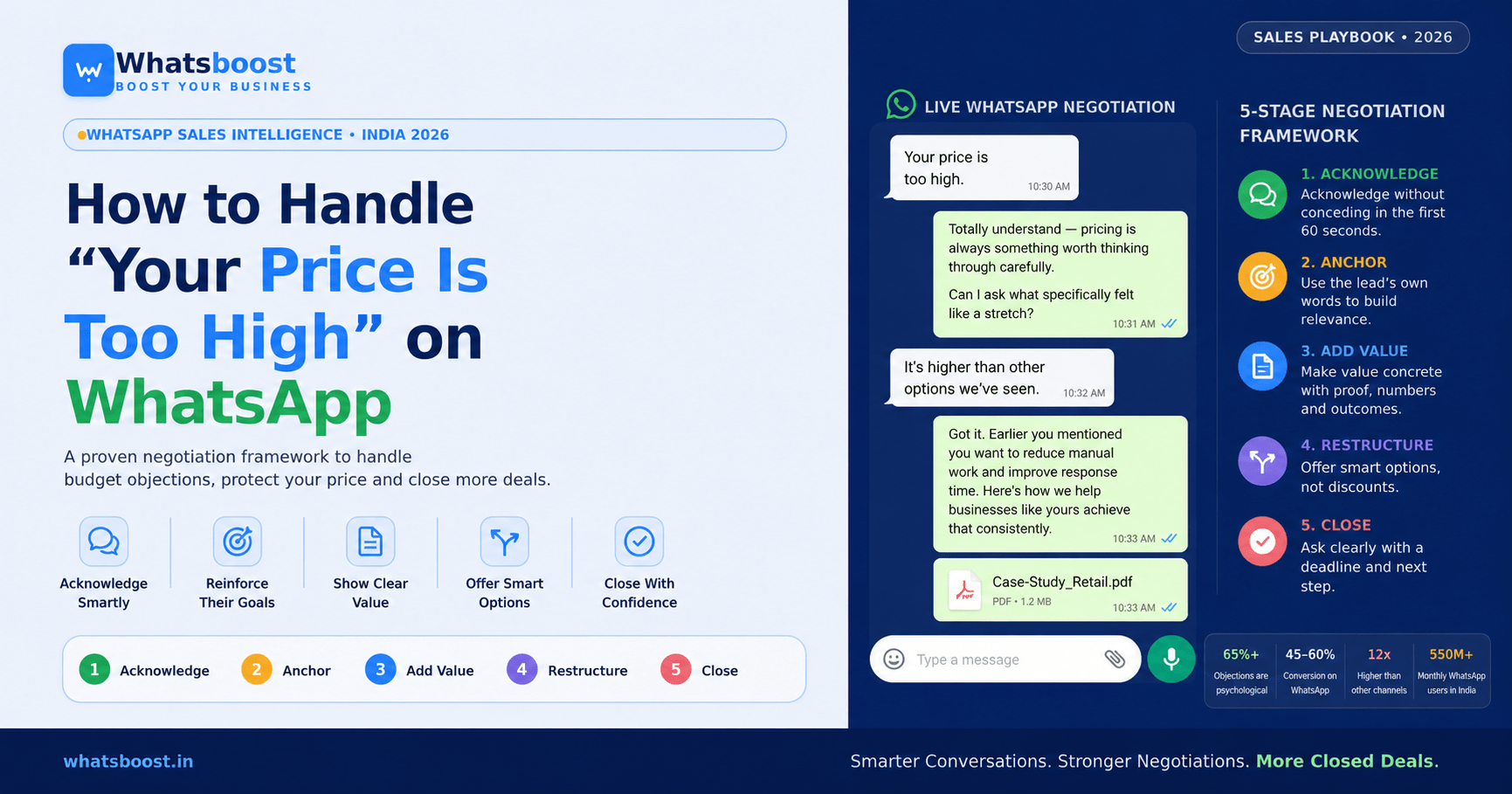
Stage 1 — Acknowledge Without Conceding (First 60 Seconds)
The moment a price objection lands, the worst thing you can do is either go defensive or immediately offer a discount. Both signal that the price was inflated to begin with.
The right move: acknowledge the concern, then ask one specific question before saying anything about the price itself.
What this looks like in chat:
"Totally understand — pricing is always something worth thinking through carefully. Can I ask what specifically felt like a stretch? Was it the total investment, the monthly commitment, or how it compares to what you were expecting?"
That question does three things: it shows you're listening, it identifies which of the five objections you're actually dealing with, and it buys you time to think without going silent.
This single step is what separates a negotiation from a price concession.
Stage 2 — Anchor the Conversation in Their Own Words
Once you know which concern you're dealing with, go back to something the lead said earlier in the conversation. Every WhatsApp chat has a history — use it.
This is what Gartner research on digital negotiation consistently shows: buyers are far more persuaded by their own stated priorities than by a seller's argument. When you reference what they told you, you're not selling to them — you're helping them arrive at a decision they already want to make.
What this looks like:
"Earlier you mentioned [specific problem or goal they stated]. What we're looking at is basically what it costs to solve that — not just for this project, but ongoing. Would it help to break down exactly what you get per month?"
Notice: no discount mentioned. No defensiveness. Just their words, reflected back with a value frame around them.
Stage 3 — Make the Value Concrete, Not Abstract
"You get great ROI" means nothing. "You get X outcome in Y timeframe, which replaces Z cost you're currently carrying" means everything.
WhatsApp allows you to share things in the moment that a phone call can't: a quick PDF, a screenshot of a result, a voice note that personalises the delivery. This is a structural advantage — use it.
Specific things that work in this stage on WhatsApp:
Send one case study — not three. One relevant example of a similar customer getting a specific result is more persuasive than a brochure. Keep it to 2-3 lines plus an image or PDF attachment.
Use a cost-of-inaction frame. Instead of "our price is ₹X," try: "If this problem stays unsolved for another 6 months, what does that cost you in [time / lost revenue / staff effort]? That's usually where the real number is."
Voice notes work well here. A 45-second voice note explaining the value in a conversational tone lands differently than a wall of text. It feels personal. In a negotiation context, personal matters.
Stage 4 — The Structured Options Move (Not a Discount)
If the concern persists after Stages 1-3, the next move is not to drop the price — it's to restructure the offer.
There's a significant psychological difference between "I'll give you a discount" and "let me show you two ways we can make this work." The first signals desperation. The second signals confidence and genuine problem-solving.
Three restructuring options that work on WhatsApp:
a) Scope adjustment: "What if we started with [smaller scope] and expanded once you've seen the results? That brings the initial investment to ₹X."
b) Payment structure: "The annual total stays the same, but we can split it quarterly. Does that work better for how your budgets are structured?"
c) Phased onboarding: "We start with [core feature/service], prove the value in 30 days, and the rest unlocks from there. You're not committing to the full investment upfront."
All three preserve your pricing integrity. None of them involve saying "okay, I'll reduce the price." And all three give the lead a psychologically easier path to yes — because they're deciding how to buy, not whether to buy.
Stage 5 — The Definitive Ask (With a Clear Deadline)
After the value has been demonstrated and options have been laid out, most negotiation stalls not because the lead isn't convinced but because there's no clear next step with a reason to act.
Leaving the conversation open-ended is where deals go quiet.
On WhatsApp, this looks like:
"Based on what we've discussed, the [specific option] seems like the right fit for where you are. I can hold this for you until [specific day/date] — after that, the structure changes. Shall I send you the agreement to review?"
Two things are happening here: a soft deadline that creates urgency without pressure, and a specific, concrete next step. The lead doesn't have to decide "do I buy this" — they're deciding "do I want to read the agreement." That's a much smaller ask.
The Indian-Specific Dynamics That Change This Conversation
Budget objections on WhatsApp in India carry some specific cultural and market dynamics that most sales playbooks — written for Western B2B contexts — miss entirely.
Negotiation is expected, not offensive. In many Indian business contexts, particularly in SMB and family-run businesses, some degree of negotiation is a cultural norm rather than a sign of objection. A buyer who asks for a discount isn't necessarily unhappy with the offer — they're participating in a process they're comfortable with. The framework above handles this because it restructures rather than immediately discounts, which earns more respect than a quick concession.
WhatsApp is used across hierarchies. The same conversation that starts with a junior manager can suddenly involve a founder or CFO who joins the chat or asks to see the exchange. This is why the written record matters — your case needs to be clear enough that it can be forwarded upward and make sense without you explaining it.
Response time signals commitment. In Indian WhatsApp sales culture, a rep who responds quickly — even to a difficult message — signals seriousness. A rep who goes quiet for hours after a price objection signals that they don't have a strong answer. Keep the response rhythm consistent even if your response is just "let me pull that number up for you — two minutes."
Voice notes are culturally natural. Unlike in European or American B2B sales where voice notes can feel intrusive, voice notes in Indian WhatsApp conversations are completely normal and often appreciated. Using a voice note to explain a complex value proposition or pricing structure feels personal and warm in a way that a text wall doesn't.
What Goes Wrong: The 4 Most Common Mistakes
1. Responding with a discount before being asked for one. The lead said "it's expensive." They did not say "give me a lower price." Offering a discount at this stage tells them the original price was inflated and trains them to always open with a price objection.
2. Sending a wall of text in response. When a lead raises a price concern and receives a 400-word WhatsApp message in return, the message doesn't land — it overwhelms. Keep each response to 3-4 lines maximum. If you need to share detailed information, put it in a document and attach it with one sentence of context.
3. Going quiet and waiting for them to follow up. After a price objection, silence from the sales rep is almost never interpreted as "they're thinking carefully." It's interpreted as "they don't have a good answer." If you need time to think, say so: "Good point — let me come back to you in 10 minutes with the right breakdown."
4. Treating the objection as the end of the negotiation. Most deals that close after a price objection require 2-3 more exchanges before they do. The objection is not the end of the conversation — it's the beginning of the actual negotiation. Teams that treat the first "too expensive" as a closing signal miss deals that were always going to close.
When the Negotiation Stalls: Re-engaging Cold Price Conversations
Some leads raise a price objection, seem partially convinced, and then go quiet. This is one of the most common and most frustrating sales situations — and WhatsApp handles it better than any other channel.
The rule is: don't follow up on the price. Follow up with new value.
A lead who went quiet after "let me think about it" doesn't need another message saying "just checking in." They need a reason to reopen the conversation — a new piece of information, a relevant development, a case study from a similar business, or a time-sensitive reason to decide.
This is exactly where re-engagement WhatsApp sequences deliver their highest value — not as generic nudges, but as contextually timed messages that add something to the conversation rather than just reopening it.
For leads that have been cold for longer — a week or more after a price discussion — retargeted WhatsApp campaigns that reference their specific situation can reopen deals that most reps would have written off entirely.
Logging and Tracking Negotiation History
One of the most overlooked dimensions of WhatsApp price negotiations is what happens to the conversation history after the call ends.
If a lead raises a price objection in WhatsApp and the rep handles it well, that entire exchange — the concern they raised, the framing that worked, the specific restructure they responded to — is valuable data. It should be in your CRM, tagged and accessible the next time that lead comes back or the rep picks up a similar conversation.
Most Indian sales teams don't do this. The WhatsApp conversation exists in isolation from everything else, and institutional knowledge about what works for specific objections never accumulates.
Connecting WhatsApp to your CRM without needing a full API setup means every negotiation exchange gets logged, tagged with the deal stage, and carries forward into the next interaction. When a lead who raised a price objection three months ago comes back, your rep knows exactly what was said, what was offered, and what the lead responded to.
That context is the difference between starting a new negotiation and continuing an existing relationship.
The Pre-Negotiation Work That Most Teams Skip
Here's the insight that the best-performing Indian sales teams have absorbed: price objections that arrive late in a conversation are almost always a symptom of insufficient qualification earlier.
When a lead reaches the pricing stage without a clear understanding of what the outcome is worth to them, they're evaluating cost in a vacuum. Of course it seems high. There's nothing to compare it to.
The answer isn't to handle the objection better — it's to qualify the lead's context and goals before price ever enters the conversation. A qualification flow that establishes the specific problem, the cost of that problem, the timeline for solving it, and the budget range the lead is working with — before the pricing conversation happens — reduces the frequency and intensity of price objections dramatically.
The negotiation workflow described in this article is most powerful when it follows proper pre-sales qualification. When a rep knows a lead's situation deeply before price comes up, every stage of the framework above becomes sharper, more personalised, and more effective. That context — and how to build it systematically through WhatsApp pre-sales flows before the pricing conversation begins — is what separates teams that handle objections reactively from those that prevent most of them entirely.
How Whatsboost Supports Price Negotiation Workflows
Managing a price negotiation across WhatsApp — with the right response timing, the right documents ready to share, the right CRM context visible, and the right follow-up sequence triggered when the lead goes quiet — requires a platform layer underneath the conversation.
Whatsboost gives sales teams the infrastructure to handle this without dropping anything. Conversation history syncs to CRM. Documents are ready to share from the platform. Follow-up sequences trigger automatically when a lead stops responding. Multiple reps can see the same conversation thread so context isn't lost when someone is unavailable.
The negotiation itself is always human — no automation replaces a thoughtful response to a price concern. But the infrastructure around the negotiation — the context, the history, the timing, the follow-up — can all run systematically so the rep's attention goes where it matters: on the conversation, not on the logistics.
If you want to see how this works in a live sales setup for your specific context, booking a walkthrough with the Whatsboost team is the fastest way to map the framework above to your actual pipeline.
The Shift
Price objections don't end negotiations. They start them.
The question is whether your team has a framework for what happens in the next 5 messages — or whether they're making it up as they go.
WhatsApp, used correctly, gives Indian sales teams something no other channel does during a price conversation: a live, written, multimedia-capable, high-attention channel where the lead is comfortable, the conversation is permanent, and the right response at the right moment can turn "your price is too high" into "okay, let's do this."
The framework is straightforward. The execution is consistent. The results compound.
Want to automate WhatsApp for your business?
Set up campaigns, replies, and follow-ups in minutes.