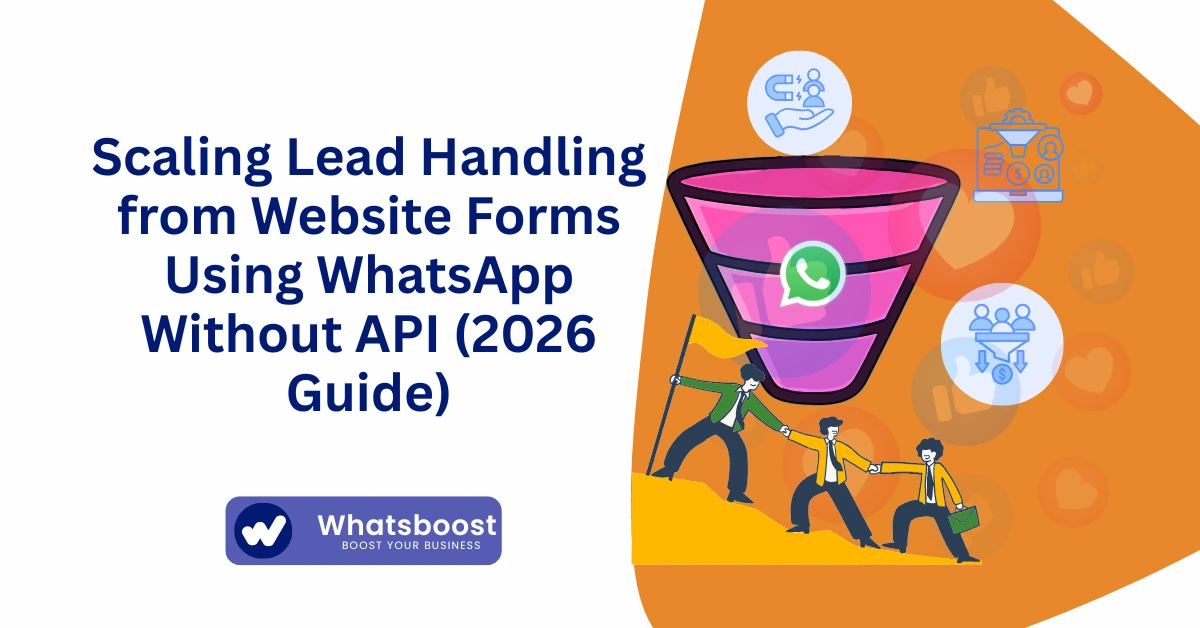
Scaling Lead Handling from Website Forms Using WhatsApp Without API (2026 Guide)
Learn how businesses scale website form lead handling using WhatsApp automation without relying on costly WhatsApp API. Faster replies, better conversions, lower costs.
Website forms are still one of the most common ways Indian businesses collect leads.
But as lead volume increases, most teams hit the same wall:
-
Delayed responses
-
Missed inquiries
-
Manual follow-ups
-
High dependency on sales teams
Many assume the only way to scale is by moving to WhatsApp Business API.
That assumption is wrong.
In 2026, some of the fastest-scaling businesses handle thousands of form leads on WhatsApp without API dependency, using smarter automation workflows instead.
Why Website Form Leads Break at Scale
At low volume, manual handling works.
At scale, problems appear quickly:
-
Leads come outside working hours
-
Sales teams can’t respond instantly
-
Follow-ups get forgotten
-
Cold leads pile up in spreadsheets
The biggest issue is response time.
Every minute delayed reduces conversion probability.
WhatsApp solves this—but only when used correctly.
The Myth: “You Need WhatsApp API to Scale”
WhatsApp API is powerful, but it’s not always necessary.
For many businesses:
-
API costs grow faster than revenue
-
Conversations start unnecessarily
-
Automation becomes rigid and expensive
Scaling lead handling is not about sending more messages.
It’s about handling leads intelligently.
What “Scaling Lead Handling” Actually Means
Scaling doesn’t mean:
-
Blasting WhatsApp messages
-
Running fixed sequences
-
Messaging every lead equally
It means:
-
Instant acknowledgment
-
Intelligent qualification
-
Automated follow-ups
-
Zero lead leakage
All of this can be done without API overuse.
How WhatsApp Fits After Website Forms
When someone submits a form, they expect:
-
Confirmation
-
Clarity on next steps
-
Fast human-like interaction
WhatsApp delivers this better than:
-
Email autoresponders
-
CRM task reminders
-
Manual callbacks
But WhatsApp should act as a conversation layer, not a broadcast tool.
Step 1: Connect Website Forms to WhatsApp Intelligently
Instead of triggering WhatsApp blindly, smart setups:
-
Capture form data
-
Evaluate lead intent
-
Trigger WhatsApp conditionally
Examples:
-
High-intent inquiry → WhatsApp instantly
-
Low-intent download → nurture later
-
Incomplete form → reminder only if required
This prevents unnecessary conversations.
Step 2: Auto-Respond Without Starting Endless Conversations
The first WhatsApp message should:
-
Acknowledge the inquiry
-
Set expectations
-
Invite a response (not push sales)
This keeps conversations:
-
Short
-
Relevant
-
Cost-efficient
When users respond, automation continues.
If they don’t, workflows pause.
Step 3: Use WhatsApp as a Lead Qualification Layer
Instead of assigning every lead to a salesperson:
-
Ask 2–3 qualifying questions
-
Route only qualified leads forward
-
Auto-close unresponsive ones
This reduces:
-
Sales workload
-
Follow-up fatigue
-
Lead handling chaos
WhatsApp becomes the filter, not the bottleneck.
Step 4: Build Follow-Ups That Don’t Feel Like Follow-Ups
Effective WhatsApp follow-ups:
-
Are behavior-based
-
Stop when goals are met
-
Adjust tone and timing
Examples:
-
If user clicks → move ahead
-
If user ignores → slow down
-
If user converts → stop immediately
No spam. No overuse. No burn.
Where WhatsBoost Enables This Without API Dependency
WhatsBoost allows businesses to:
-
Connect website forms to WhatsApp
-
Build logic-based workflows
-
Automate responses without blasting
-
Manage leads like a CRM inside WhatsApp
It focuses on control, not volume.
This is why many businesses scale lead handling without moving fully into API-heavy setups.
Real Benefits of WhatsApp Automation Without API
Businesses see:
-
Faster response times
-
Higher lead engagement
-
Lower operational cost
-
Better sales focus
-
Healthier WhatsApp numbers
Most importantly, they scale without complexity.
When Do You Actually Need WhatsApp API?
API makes sense when:
-
You send transactional alerts at scale
-
You run verified enterprise messaging
-
You need deep system-level integrations
For website form lead handling alone, many businesses don’t need it immediately.
Smart automation bridges the gap.
The 2026 Shift: From Message Volume to Message Intent
WhatsApp is no longer forgiving to:
-
Spam
-
Repetition
-
Irrelevant follow-ups
Businesses that win:
-
Send fewer messages
-
Build smarter workflows
-
Treat WhatsApp like a conversation channel
FAQs
Can I scale website form leads on WhatsApp without API?
Yes. With logic-based automation, many businesses handle high volumes without API dependency.
What causes WhatsApp cost overuse?
Triggering conversations for every lead, running fixed sequences, and not stopping automation when users disengage.
Is WhatsBoost suitable for form-to-WhatsApp automation?
Yes. WhatsBoost is designed to manage WhatsApp workflows without relying on bulk or spam-style messaging.
Does delayed WhatsApp reduce conversions?
No. Well-timed messages convert better than instant but irrelevant messages.
Is this approach safe for WhatsApp account health?
Yes. Fewer, relevant conversations reduce blocks and reports.
Final Thought
Scaling lead handling isn’t about adding more tools.
It’s about removing inefficiencies.
When website forms and WhatsApp work together intelligently:
-
Leads feel attended
-
Teams feel lighter
-
Costs stay controlled
Automation without API overuse isn’t a compromise.
In 2026, it’s the smarter strategy.
Want to automate WhatsApp for your business?
Set up campaigns, replies, and follow-ups in minutes.