The Future of Messaging Automation: Lessons from 2025 Every Business Must Know
Discover The Future of Messaging Automation and key Lessons from 2025. Learn how AI, WhatsApp CRM integrations, omnichannel strategies, and automation platforms like Whatsboost are transforming customer engagement.
Messaging automation is no longer optional — it is essential.
By 2025, businesses that failed to automate customer communication struggled to keep up with rising expectations for instant replies, personalized conversations, and seamless experiences across channels.
The Future of Messaging Automation is defined by:
AI-powered personalization
Real-time CRM integrations
Omnichannel communication strategies
Predictive analytics
Workflow automation
Centralized team collaboration
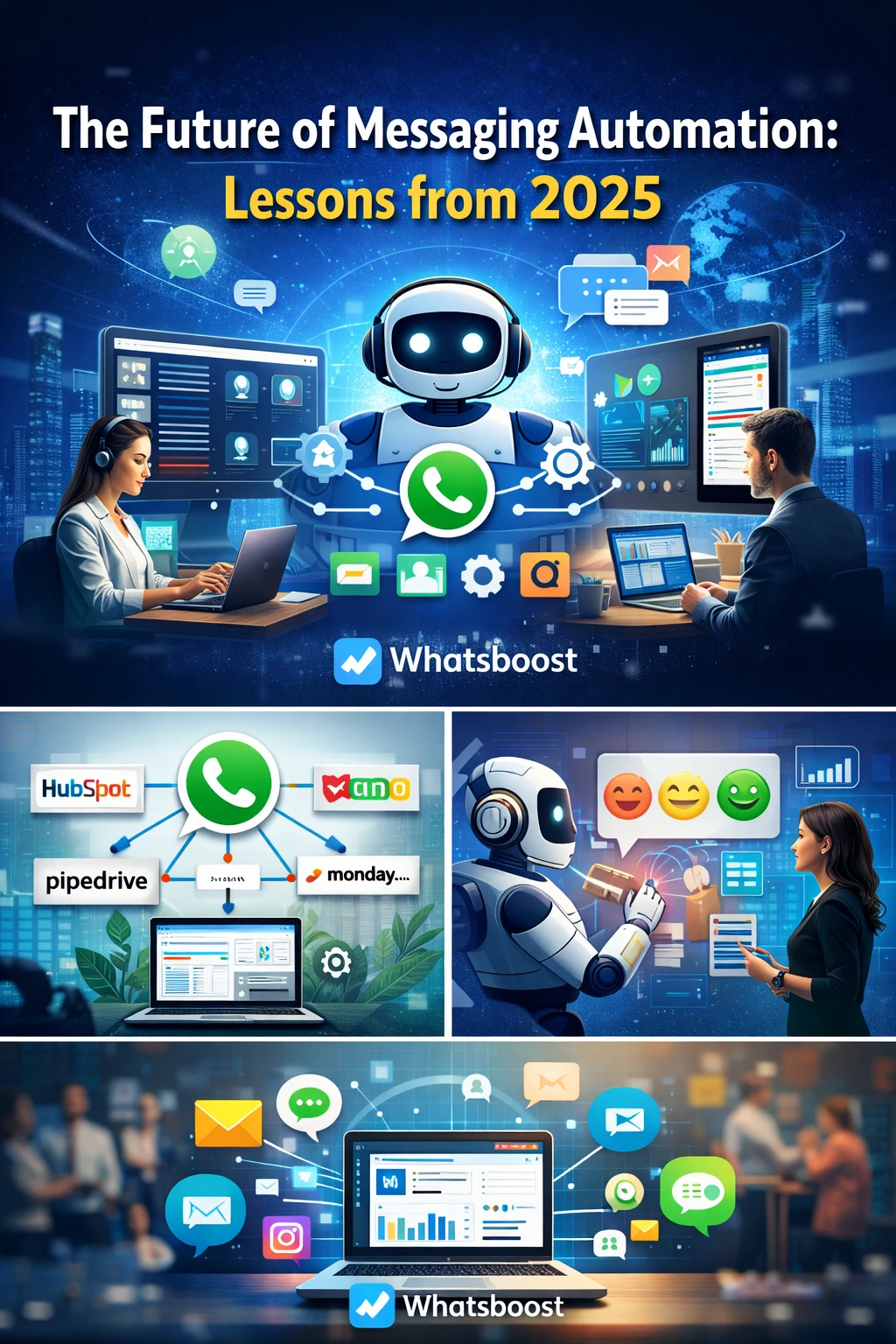
Platforms like Whatsboost have helped businesses transform WhatsApp into a centralized automation hub — integrating CRMs, enabling shared inboxes, and building intelligent workflows without complex coding.
Let’s explore the biggest lessons from 2025 and what they mean for the future of customer communication.
Why Messaging Automation Became Non-Negotiable in 2025
Customer expectations evolved dramatically.
Consumers now expect:
Instant replies
Context-aware responses
Seamless cross-channel communication
Personalized interactions
24/7 availability
Businesses that relied solely on manual communication faced:
Slower response times
Lost leads
Inconsistent messaging
Higher operational costs
Automation emerged as the only scalable solution.
Major Advances in WhatsApp CRM Integrations

From Contact Syncing to Centralized Communication Hubs
Earlier CRM integrations were limited to basic contact syncing.
By 2025, WhatsApp CRM integration evolved into:
Real-time bidirectional data syncing
Automated deal-stage messaging
Full conversation history tracking
Centralized communication dashboards
Sales + support alignment
With Whatsboost, WhatsApp conversations automatically sync with CRMs such as:
HubSpot
Pipedrive
Zoho
monday.com
Close CRM
This allows teams to:
Message customers directly from CRM
View purchase history instantly
Track deal progress
Trigger automated workflows
Bidirectional Automation: A Game-Changer
One of the most impactful Lessons from 2025 is the power of bidirectional sync.
Example:
A deal moves to “Proposal Sent” in Pipedrive
WhatsApp automatically sends a follow-up message
CRM logs the conversation
Sales team gets notified
No manual work required.
This real-time automation ensures:
Faster customer updates
Reduced human error
Higher deal closure rates
Shared Inbox: Collaboration at Scale
High message volumes demand structured communication systems.
The shared inbox feature inside Whatsboost allows:
Multiple team members to manage one WhatsApp number
Chat assignment to specific agents
Internal team notes
Real-time collaboration
Group chat management
During high-volume periods, this prevents:
Missed messages
Duplicate replies
Delayed responses
Centralized communication is one of the biggest pillars shaping the Future of Messaging Automation.
Workflow Builders: No-Code Automation at Enterprise Level
Automation in 2025 is no longer technical or developer-heavy.
Modern workflow builders allow businesses to:
Create automated replies
Trigger CRM actions
Send follow-ups
Assign leads
Create tasks
Example workflow:
Customer asks about pricing →
Pre-approved response sent →
Lead created in CRM →
Sales rep notified →
Follow-up scheduled automatically
This eliminates repetitive manual tasks and improves team productivity dramatically.
AI-Driven Messaging: The Biggest Lesson from 2025
AI fundamentally reshaped messaging automation.
1. Intent Recognition
Advanced NLP (Natural Language Processing) allows AI systems to:
Understand customer intent
Detect urgency
Analyze sentiment
Categorize queries automatically
Instead of keyword-based bots, businesses now deploy intelligent assistants that feel human.
2. Autonomous vs Assistive AI
By 2025, AI systems operate in two ways:
Autonomous Agents
Handle repetitive tasks like:
Order tracking
FAQs
Appointment confirmations
Assistive Agents
Support human agents by:
Summarizing conversations
Suggesting replies
Generating case notes
This hybrid approach balances automation with personalization.
Data Analytics: From Reactive to Predictive Communication
The Future of Messaging Automation is predictive.
Instead of reacting to inquiries, businesses now:
Anticipate customer needs
Trigger proactive outreach
Predict churn risk
Identify buying signals
Predictive AI analyzes:
Purchase behavior
Browsing patterns
Interaction history
Engagement metrics
This transforms messaging from reactive support to proactive growth.
Omnichannel Strategies Outperform Single Channels

One of the strongest Lessons from 2025:
Multi-channel messaging outperforms single-channel strategies by up to 3.7x.
Businesses using:
WhatsApp
Email
SMS
In-app messaging
saw significantly higher engagement and retention.
In-app messaging achieved click-through rates 11.8x higher than email campaigns.
The takeaway?
Messaging automation must integrate across platforms.
Pricing & Scalability: Automation for Every Business Size
Platforms like Whatsboost offer tiered pricing to scale with business needs.
CRM Integration Plan
WhatsApp sync
Basic automation
Messaging integration
1,000 workflow actions/month
Shared Inbox Plan
Team collaboration
Advanced filters
Bulk replies
2,000 workflow actions/month
Mass Messaging & Automation Plan
Targeted campaigns
Advanced workflows
Higher automation limits
Enterprise Plan
Unlimited actions
Dedicated manager
Custom features
Automation is no longer expensive infrastructure — it’s an operational multiplier.
Businesses investing in CRM automation report:
20–30% productivity growth
Reduced operational errors
Higher lead conversion rates
New Trends Shaping the Future of Messaging Automation

1. No-Code Integrations with Zapier & Make.com
Automation platforms now connect with thousands of applications.
This eliminates:
Data silos
Manual data entry
Platform switching
Real-time data flow ensures:
Unified customer records
Faster responses
Consistent communication
2. Chrome Extensions for CRM Messaging
Messaging directly inside CRM dashboards became mainstream.
Benefits include:
Automatic message logging
No platform switching
Faster response times
Full conversation visibility
This increases agent efficiency significantly.
3. Precision Mass Messaging
Bulk messaging evolved into targeted precision campaigns.
Instead of blasting generic messages, businesses now:
Segment customers by behavior
Use dynamic content
Adapt messages in real-time
Personalize at scale
Mass messaging now feels one-to-one.
How to Optimize Messaging Workflows in 2026 and Beyond
Step 1: Centralize Communication
Use a platform like Whatsboost to bring WhatsApp and CRM together.
Step 2: Automate Repetitive Queries
Identify:
Top 20 FAQs
Order-related questions
Pricing inquiries
Automate them first.
Step 3: Use AI for Personalization
Deploy AI agents to:
Understand intent
Suggest responses
Trigger predictive workflows
Step 4: Monitor Analytics
Track:
Response time
Automation rate
Customer satisfaction
Conversion rates
Optimization is ongoing.
Key Lessons from 2025 Summarized
Automation is mandatory, not optional
WhatsApp leads in conversational marketing
CRM integration drives efficiency
AI personalization improves engagement
Omnichannel strategies increase retention
Workflow builders reduce manual effort
Predictive analytics drives proactive communication
The businesses that embraced these lessons gained measurable competitive advantage.
The Future of Messaging Automation: What Comes Next?
Looking ahead:
AI will become more contextual
Voice + chat integration will expand
Hyper-personalization will become standard
Automation will extend into sales forecasting
Predictive workflows will dominate customer engagement
Messaging will no longer be a support tool — it will be a growth engine.
Frequently Asked Questions (FAQs)
What is The Future of Messaging Automation?
The Future of Messaging Automation involves AI-driven, predictive, omnichannel communication systems that integrate seamlessly with CRM platforms to deliver personalized, scalable customer interactions.
Why is WhatsApp important in messaging automation?
WhatsApp offers high engagement rates, global adoption, and strong CRM integration capabilities, making it central to modern conversational marketing strategies.
How does CRM integration improve messaging?
CRM integration centralizes customer data, enables automated workflows, tracks conversations, and ensures teams work with complete context.
What role does AI play in messaging automation?
AI analyzes intent, sentiment, and behavior to deliver personalized responses, automate repetitive queries, and assist human agents.
FAQs About Whatsboost Automation
What is Whatsboost Automation?
Whatsboost Automation is a platform that enables businesses to automate WhatsApp communication, integrate CRM systems, and streamline messaging workflows.
How does Whatsboost improve productivity?
By automating repetitive queries, routing conversations intelligently, and centralizing communication, Whatsboost reduces manual effort and improves response times.
Can Whatsboost integrate with CRM systems?
Yes, Whatsboost supports CRM integration to sync conversations, automate follow-ups, and track customer interactions efficiently.
Is Whatsboost suitable for enterprises?
Yes, Whatsboost offers scalable solutions designed for startups, SMEs, and large enterprises.
Conclusion
The Future of Messaging Automation is intelligent, integrated, and predictive.
The Lessons from 2025 are clear:
Businesses that centralized communication, embraced AI, implemented CRM integrations, and adopted omnichannel strategies achieved measurable growth.
Automation is no longer about saving time.
It’s about:
Improving customer experience
Driving revenue
Enhancing team productivity
Scaling sustainably
Platforms like Whatsboost demonstrate how messaging automation can transform WhatsApp into a powerful business engine.
The future belongs to businesses that automate intelligently.
Want to automate WhatsApp for your business?
Set up campaigns, replies, and follow-ups in minutes.