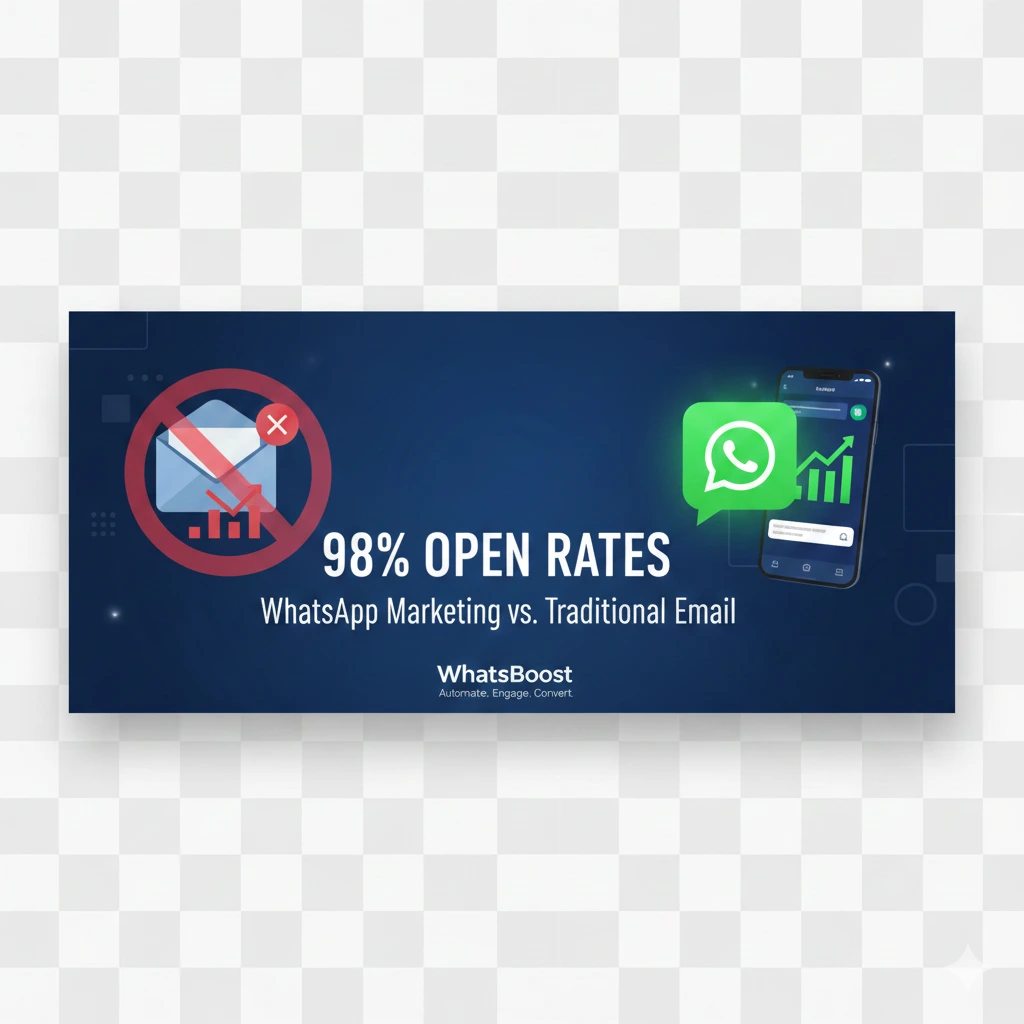
WhatsApp Marketing vs. Traditional Email: Why 98% Open Rates are Changing the Game
Email is cluttered and ignored. Discover why WhatsApp marketing is changing the game with massive open rates and real-time customer engagement.
For years, email marketing was the "gold standard." Every business relied on the inbox for newsletters, promotions, and onboarding. But in 2026, the reality has shifted. Marketers are waking up to a harsh truth: emails go unopened, promotions land in the "Spam" or "Promotions" tab, and customers respond days later—if they respond at all.
Meanwhile, WhatsApp has become a daily habit. With open rates as high as 98%, businesses are no longer asking if they should use it, but how fast they can switch. This guide breaks down the battle between WhatsApp and Email and how you can use the
The Decline of the Traditional Inbox
Email isn't dead, but it’s definitely "slower." Here is why email marketing is struggling to keep up:
Inbox Saturation: The average user gets hundreds of emails daily. Your message is just a needle in a haystack.
Filtering: Modern algorithms filter even the best emails into the "Promotions" tab before the user ever sees them.
Delayed Action: Email is passive. Someone might see your "Flash Sale" two days after it ends.
Low Open Rates: While
WhatsApp vs SMS Marketing is a common debate, email lags behind both with average open rates stuck between 15% and 25%.
Why WhatsApp is Changing the Game
WhatsApp isn't just an app; for most Indians, it is the primary way they communicate with the world. This behavior creates a massive advantage for businesses:
Lock Screen Visibility: A WhatsApp message pops up right on the user's home screen.
Personal Connection: Unlike a "No-Reply" email, a WhatsApp message feels like a 1-on-1 conversation.
Instant Engagement: Most messages are read within seconds, not days.
WhatsApp vs. Email: The Head-to-Head Comparison
| Feature | Email Marketing | WhatsApp Marketing (WhatsBoost) |
| Open Rate | 15% - 25% | 98% |
| Response Time | Hours or Days | Minutes |
| Style | One-way / Passive | Two-way / Conversational |
| Trust Factor | Often felt as "Spam" | Felt as "Service" |
For tasks like lead nurturing and closing sales, speed is everything. Using
Is Email Still Useful?
Yes—but its role has changed. Email is now best for long-form reports, formal documentation, or receipts. WhatsApp, however, should be your primary tool for:
Flash Sales and Promotions.
Real-time Customer Support.
Appointment Reminders.
Scaling Without the Chaos
The biggest fear businesses have with WhatsApp is "How do I handle 1,000 replies?" If you try to do this on a personal phone, you will fail (and likely get banned).
Smart Broadcasting: Send messages to segments of your audience without getting blocked.
Workflow Automation: Set up auto-replies for common questions so your team doesn't get overwhelmed.
Shared Team Inbox: Let multiple agents handle conversations from one central dashboard.
Compliance: Unlike "grey-market" tools, WhatsBoost focuses on
safe, official messaging to protect your business number.
FAQs
1. Is WhatsApp marketing better than email?
For engagement and speed, absolutely. You get nearly 5x more people to actually see your message compared to email.
2. Can WhatsApp get my number banned?
Only if you use "bulk sender" software or spam people without permission. If you follow
3. Does WhatsApp marketing cost more?
While Meta charges a per-message fee, the ROI is usually much higher because the conversion rate is significantly better than email. WhatsBoost offers 0% markup on these fees to keep costs low.
4. How do I manage 500 replies at once?
Through automation and a shared team inbox. You can set up "Keywords" that trigger specific answers so you only talk to the most "Hot" leads.
Conclusion: Engage or Be Ignored
In 2026, the winner isn't the one who sends the most messages; it's the one who gets the most responses. Email informs, but WhatsApp engages. If you want faster responses and better sales, it’s time to move your primary marketing efforts to a conversation-driven model.
Want to automate WhatsApp for your business?
Set up campaigns, replies, and follow-ups in minutes.