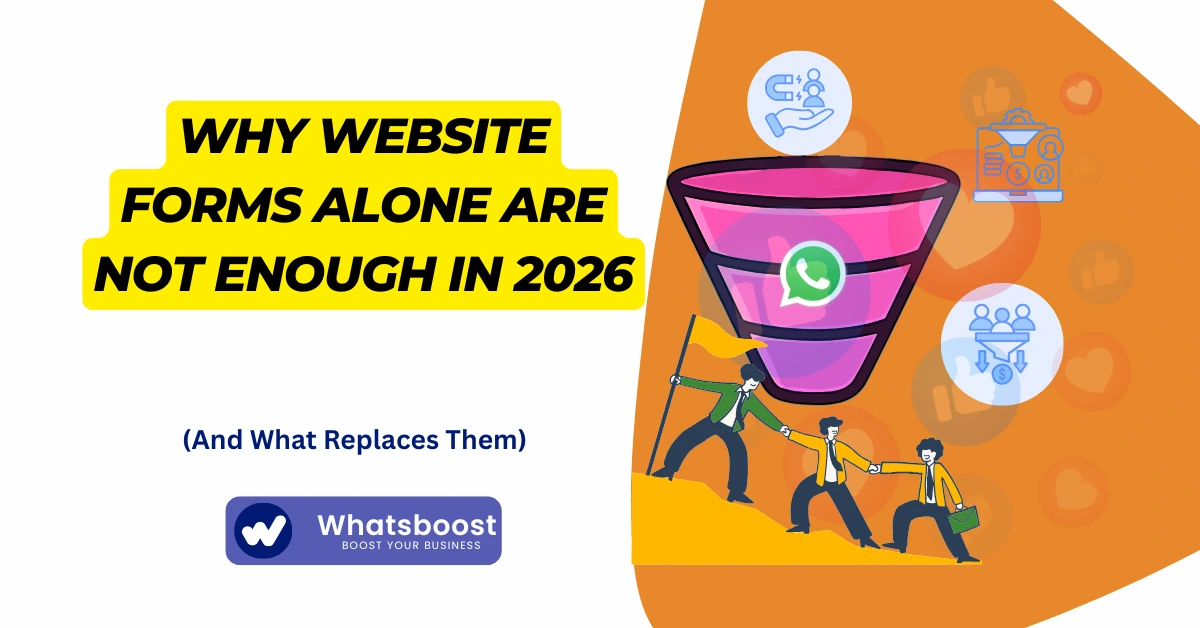
Why Website Forms Alone Are Not Enough in 2026 (And What Replaces Them)
Website forms are no longer enough to convert leads in 2026. Learn why businesses are shifting to WhatsApp conversations for faster responses and higher conversions.
Website forms were once the backbone of online lead generation.
Fill the form. Submit. Wait for a callback.
In 2026, that model is breaking—fast.
Buyer behavior has changed, attention spans are shorter, and response expectations are immediate. Businesses still relying only on website forms are losing leads without realizing it.
Not because forms are “dead,” but because forms alone can’t handle modern intent, speed, and conversation demands.
The Core Problem with Website Forms Today
Website forms collect data.
They do not handle conversations.
And in 2026, conversions happen in conversations, not inboxes.
Common problems businesses face:
-
Leads submit forms and disappear
-
Sales teams respond hours later
-
Emails go unread
-
Follow-ups are inconsistent
By the time a salesperson reaches out, buyer intent has cooled—or moved to a competitor.
Speed Is No Longer a Competitive Advantage — It’s the Minimum
In earlier years, responding within an hour felt fast.
Today:
-
Buyers expect acknowledgment in seconds
-
Mobile-first users don’t check email immediately
-
Delays signal disinterest or inefficiency
Website forms don’t solve this on their own.
Even with email autoresponders:
-
Open rates are low
-
Replies are rare
-
Conversations don’t start
Why Forms Fail at Intent Recognition
Not all leads are equal.
Forms treat every submission the same:
-
Same thank-you page
-
Same autoresponder
-
Same follow-up sequence
But buyer intent varies massively:
-
Some want pricing now
-
Some are just browsing
-
Some need clarification
-
Some are comparison shopping
Forms capture data, but they don’t adapt to intent.
The Attention Shift: From Forms to Conversations
In 2026, buyers prefer:
-
Messaging over waiting
-
Clarifying before committing
-
Conversational buying journeys
WhatsApp has become the default:
-
Faster than email
-
More personal than calls
-
Less intrusive than SMS
Businesses that move leads from forms to WhatsApp outperform those who don’t.
Where Website Forms Still Matter (But Only as a Trigger)
Forms aren’t useless.
They’re just no longer the endpoint.
Modern usage:
-
Forms capture structured information
-
WhatsApp handles interaction
-
Automation manages flow
Forms initiate the journey.
WhatsApp completes it.
Why Email-Based Follow-Ups Are Losing Effectiveness
Email was built for long-form communication.
Today:
-
Emails get buried
-
Promotions land in spam
-
Replies take hours or days
WhatsApp messages:
-
Get opened within minutes
-
Encourage quick replies
-
Keep context alive
A form followed by WhatsApp converts significantly better than a form followed by email.
The Real Issue: Manual Lead Handling Doesn’t Scale
Most businesses still:
-
Export leads to spreadsheets
-
Assign them manually
-
Depend on human follow-ups
This breaks when:
-
Lead volume increases
-
Teams change
-
Leads arrive outside work hours
Website forms without automation create operational debt.
How WhatsApp Fixes What Forms Can’t
WhatsApp solves three major gaps forms leave behind:
-
Instant acknowledgment
-
Two-way interaction
-
Behavior-based progression
Instead of waiting:
-
Leads engage immediately
-
Businesses qualify faster
-
Sales teams focus only on ready prospects
The 2026 Model: Form + WhatsApp Automation
High-performing businesses now:
-
Capture leads via forms
-
Trigger WhatsApp responses instantly
-
Ask qualifying questions automatically
-
Route or pause based on replies
No manual chasing.
No unnecessary conversations.
No wasted effort.
Why “More Forms” Is the Wrong Fix
Some businesses respond by:
-
Adding more fields
-
Creating longer forms
-
Asking qualifying questions upfront
This reduces:
-
Form completion rates
-
Mobile usability
-
Lead volume
Qualification should happen after submission, not before.
How WhatsBoost Bridges the Gap
WhatsBoost enables businesses to:
-
Connect any website form to WhatsApp
-
Trigger smart, conditional workflows
-
Qualify leads conversationally
-
Avoid unnecessary API cost explosions
Instead of replacing forms, it activates them.
Forms vs WhatsApp Conversations: The 2026 Reality
Forms are static.
WhatsApp is dynamic.
Forms collect.
WhatsApp converts.
Businesses that combine both:
-
Respond faster
-
Convert more
-
Spend less on ads
The Buyer Psychology Shift
Modern buyers:
-
Want confirmation immediately
-
Prefer chat over calls
-
Trust responsiveness
A silent form submission feels like a black hole.
A WhatsApp reply feels like service.
FAQs
Are website forms still useful in 2026?
Yes, but only as a data capture layer. They must be followed by conversational automation to convert effectively.
Why don’t form autoresponders work anymore?
Low open rates, delayed engagement, and lack of two-way interaction reduce effectiveness.
Does WhatsApp automation replace sales teams?
No. It filters, qualifies, and prepares leads so sales teams focus only on high-intent prospects.
Is WhatsApp automation expensive?
Not when workflows are designed to avoid unnecessary conversations and overuse.
Can WhatsBoost work with any form?
Yes. WhatsBoost connects with most website forms and tools to trigger WhatsApp workflows intelligently.
Final Thought
In 2026, collecting leads is easy.
Converting them is not.
Website forms alone don’t fail because they’re outdated.
They fail because buyers no longer wait.
Businesses that pair forms with WhatsApp conversations will win attention, trust, and conversions—while others keep wondering where their leads went.
Want to automate WhatsApp for your business?
Set up campaigns, replies, and follow-ups in minutes.